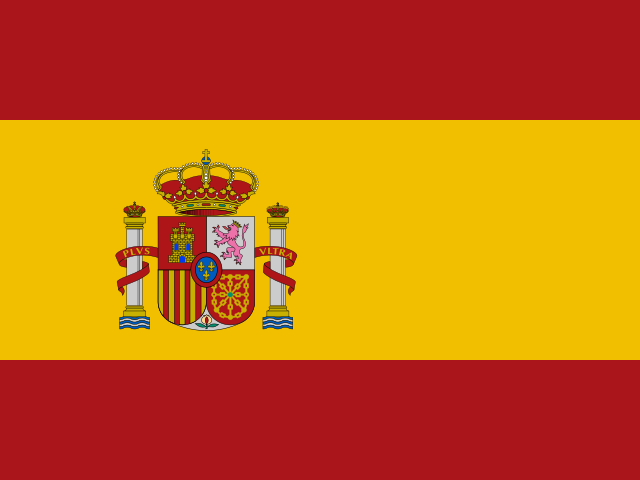
Flag sizes in Spain: proportion and official types
Published Written by Flagpole Guides
This page is an English translation of the Spanish original. Where the two versions differ, the Spanish text is the original.
The dimensions of the flag of Spain are better regulated than in many other countries. The Constitution sets the stripes, a royal decree the proportion and the position of the coat of arms, and the Flag Regulation of 1977 sets five official sizes and which size a public building flies according to its height. For a private flagpole, on the other hand, there is no rule, and makers publish their own tables. This guide covers both.
Width, length and proportion
For flags, Spanish uses anchura or caída (the vertical measurement, next to the pole, known in English as the hoist) and longitud or vuelo (the horizontal one, the fly). The vaina is the fabric sleeve that goes around the staff or the halyard.
Under article 3 of Royal Decree 2964/1981, the normal proportion of the flag of Spain is a length equal to three halves of the width, that is, 2:3. The Flag Regulation repeats that ratio. A flag with a 100 cm hoist is thus 150 cm long.
The stripes
Article 4.1 of the Constitution sets three horizontal stripes, red, yellow and red, with the yellow stripe twice as wide as each red one. Each red stripe therefore takes up a quarter of the width, and the yellow one half. On a 100 × 150 cm flag, the stripes are 25, 50 and 25 cm.
The colours are defined in the CIELAB system by Royal Decree 441/1981: flag red and flag weld yellow (amarillo gualda), with a tolerance of five CIELAB units.
The coat of arms
Under the same article 3 of Royal Decree 2964/1981, the coat of arms of Spain is two fifths of the width of the flag high and appears on both sides, in the centre of the yellow stripe. With the normal proportion, the centre line of the coat of arms is placed at a distance of half the width of the flag from the sleeve. If the length is shorter than normal or the flag is square, the coat of arms goes in the centre.
On a 100 × 150 cm flag, the coat of arms is 40 cm high and its centre line is 50 cm from the sleeve.
The five official types
Rule 20 of the Flag Regulation (Royal Decree 1511/1977) sets these types for flags whose dimensions are not otherwise specified:
| Type | Length | Width |
|---|---|---|
| 1 | 6640 mm | 4430 mm |
| 2 | 4110 mm | 2740 mm |
| 3 | 3240 mm | 2160 mm |
| 4 | 1500 mm | 1000 mm |
| 5 | 750 mm | 500 mm |
For the Navy, Ministerial Order 57/1989 sets slightly different sizes, which the regulation itself includes, with a type 3 of 2370 × 1580 mm.
Size by building
The same rule sets which type military buildings and buildings in the service of the State fly, in proportion to the height of the building:
| Height of the building | Flag type |
|---|---|
| More than 25 metres | Type 2 (4110 × 2740 mm) |
| Between 10 and 25 metres | Type 3 (3240 × 2160 mm) |
| Less than 10 metres | Type 4 (1500 × 1000 mm) |
Military buildings also have a type 4 flag for days of bad weather. In establishments where the flag is raised on a flagpole fixed to the ground, type 3 is used, and the poles, masts and gaffs are of wood in a light walnut colour or metal painted white, with a height in proportion to the flag.
Size by flagpole
For a private or business flagpole there is no rule. Makers apply a general rule: according to ClickBanderas, the flag does not exceed the top third of the flagpole, and its reference table, for moderate wind and 115 g/m² polyester, is this:
| Height of the flagpole | Flag (hoist × fly) |
|---|---|
| 4 metres | 80 × 120 cm |
| 5 metres | 100 × 150 cm |
| 6 metres | 120 × 180 cm |
| 8 metres | 150 × 220 cm |
| 10 metres | 200 × 300 cm |
| 12 metres | 250 × 375 cm |
In windy areas, the same maker indicates a smaller flag relative to the flagpole. La Tienda de las Banderas gives similar ranges: from 100 × 150 to 150 × 225 cm for a 6-metre flagpole and from 200 × 300 to 300 × 450 cm for flagpoles of 8 to 12 metres. The flag size calculator applies the ClickBanderas table and works out the stripes and the coat of arms for that size.
Balconies and indoors
For balconies, according to La Tienda de las Banderas, the most common sizes are 70 × 100 and 100 × 150 cm, depending on the width of the railing, the height above the street and exposure to wind. Indoor and office flags are usually smaller. The guide to flag types describes the different formats.
Frequently asked questions
What proportion does the flag of Spain have?
The normal proportion is 2:3: under Royal Decree 2964/1981, the length equals three halves of the width. A flag with a 100 cm hoist is 150 cm long. The red, yellow and red stripes take up a quarter, a half and a quarter of the width.
How big is the coat of arms on the flag?
Under article 3 of Royal Decree 2964/1981, the coat of arms is two fifths of the width of the flag high and appears on both sides, in the centre of the yellow stripe. With the normal proportion, its centre line is half the width of the flag from the sleeve; on a shorter or square flag, it is in the centre.
What are the official flag sizes?
Rule 20 of the Flag Regulation (Royal Decree 1511/1977) sets five types: 6640 × 4430 mm, 4110 × 2740 mm, 3240 × 2160 mm, 1500 × 1000 mm and 750 × 500 mm, length by width. They are the reference sizes for military and State buildings.
Which flag goes on a public building, by its height?
Under the Flag Regulation, military buildings and buildings in the service of the State fly type 2 (4110 × 2740 mm) if they are more than 25 metres high, type 3 (3240 × 2160 mm) between 10 and 25 metres and type 4 (1500 × 1000 mm) below 10 metres. On a flagpole fixed to the ground, type 3 is used.
What size of flag is used on a 6-metre flagpole?
No rule sets it for a private flagpole. In the reference table of the Spanish maker ClickBanderas, a 6-metre flagpole corresponds to a 120 × 180 cm flag. La Tienda de las Banderas gives between 100 × 150 and 150 × 225 cm, with the smaller size in windy areas.
Sources
This guide is based on the following sources, most of them in Spanish:
- Real Decreto 2964/1981, de 18 de diciembre, por el que se hace público el modelo oficial del Escudo de España – Boletín Oficial del Estado
- Real Decreto 1511/1977, de 21 de enero, por el que se aprueba el Reglamento de Banderas y Estandartes, Guiones, Insignias y Distintivos – Boletín Oficial del Estado
- Constitución Española, artículo 4 – Boletín Oficial del Estado
- Real Decreto 441/1981, de 27 de febrero, por el que se especifican técnicamente los colores de la Bandera de España – Boletín Oficial del Estado
- Cómo calcular el tamaño de mástil correcto para tu bandera – ClickBanderas
- Qué tamaño de bandera elegir para cada mástil – La Tienda de las Banderas
Related guides
- Flag size calculatorFlag calculator for Spain: the nearest standard size for the height of the flagpole, the stripe widths and the position of the coat of arms under RD 2964/1981.
- Flag typesThe types of flags in Spain: with and without the coat of arms, regional, municipal, for pleasure boats, standards, guidons and advertising flags.
- Flagpole heightsFlagpole heights in Spain: factory heights, the link with flag size, the wind zones of the Building Technical Code, foundations and planning limits.
- Price of a flagThe price of a flag in Spain: how size, fabric, coat of arms, finishing and customisation affect it, and the consumer’s rights of withdrawal and guarantee.