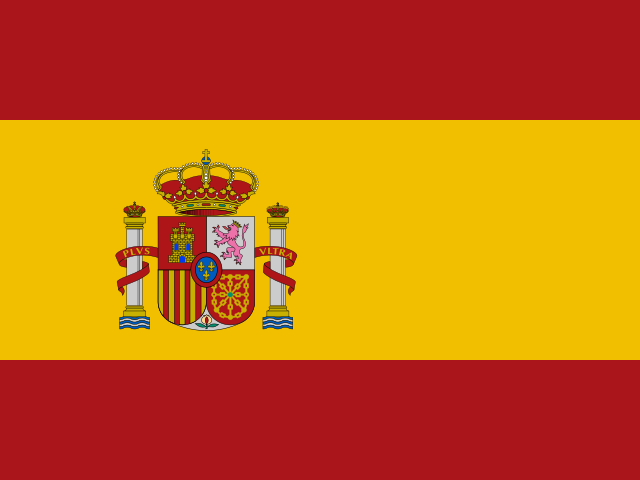
Half-mast in Spain: when and who decides
Published Written by Flagpole Guides
This page is an English translation of the Spanish original. Where the two versions differ, the Spanish text is the original.
In Spain, the flag flies at half-mast when official mourning is declared. There are no fixed half-mast days: each period of mourning is declared expressly, by the Government for the whole country or by an autonomous community or a local council for its territory. The rule that declares it sets the dates and places. This guide explains who decides, what the royal decrees on mourning say and which rules the Armed Forces follow.
Official mourning declared by the Government
Nationwide official mourning is declared by royal decree, on the proposal of the Prime Minister, and published in the Official State Gazette (BOE). Recent royal decrees use almost identical wording: official mourning is declared from one time to another, during which the national flag will fly at half-mast on all public buildings and Navy ships.
Two examples from 2024:
- Royal Decree 115/2024: official mourning from 00:00 to 24:00 on 31 January 2024 for the death of the former President of the European Commission Jacques Delors.
- Royal Decree 1117/2024: official mourning from 00:00 on 31 October to 24:00 on 2 November 2024 for the floods of 29 and 30 October.
The royal decree applies to public buildings throughout the country. The guide to flags in mourning lists the reasons for which mourning has been declared.
Regional and municipal mourning
The Government is not the only authority that can declare mourning. Under article 3.2 of the Regulation on Military Honours (Royal Decree 684/2010), the Armed Forces act in the same way within the autonomous communities, the cities of Ceuta and Melilla and the municipalities when mourning is declared by their competent bodies. A regional government or a mayor can thus declare mourning for a disaster or for the death of a person linked to their territory, with the flag at half-mast on their buildings.
The rules of the Armed Forces
The Regulation on Military Honours contains the most detailed rules:
- Day and night: when the Government decrees national mourning, no honours are rendered except funeral honours, and the flag stays at half-mast continuously, day and night (article 3.2). Outside mourning, the flag is raised at eight in the morning and lowered at sunset.
- Black ribbon: on days of official mourning, a black ribbon is attached to the flags of the units taking part in official ceremonies, and the flag stays at half-mast (article 39.3).
- Service members killed on duty: flags fly at half-mast for two days in the units the deceased belonged to (article 40.3).
- Death of the King or the heir: when the news becomes official, the flags and standards of the units carry a black ribbon and the flag is flown at half-mast in the units of the Armed Forces (articles 42 and 43).
What “half-mast” means
State rules do not set the exact height: the expression means that the flag does not fly at the top of the pole but at an intermediate height, visibly below the top. For indoor flags, which hang from a staff without a halyard, Royal Decree 538/2020, which declared ten days of mourning for those who died in the COVID-19 pandemic, provided for a crêpe ribbon on the finial of the staff, that is, on its metal tip. On balcony poles, which have no halyard either, the same solution is common. More about the mechanism in the guide to flagpole mechanics.
Several flags at half-mast
Royal decrees on mourning mention only the national flag. When it flies together with the regional and municipal flags, it is usual to lower the others too, so that none flies above the flag of Spain, which under article 6 of Law 39/1981 takes the place of honour. The guide to flag protocol explains the order.
Private individuals and businesses
Royal decrees on mourning refer to public buildings and Navy ships. Nothing obliges private individuals, businesses or owners’ associations to lower their flags, but they may join in voluntarily.
Frequently asked questions
Who decides that the flag flies at half-mast in Spain?
Nationwide, the Government, by declaring official mourning in a royal decree. Under the Regulation on Military Honours, the autonomous communities, the cities of Ceuta and Melilla and the municipalities can declare their own mourning through their competent bodies, with the flag at half-mast within their remit.
Where does the flag fly at half-mast during official mourning?
Royal decrees on official mourning usually provide that the national flag flies at half-mast on all public buildings and Navy ships. That was the wording, for example, of Royal Decree 1117/2024, which declared three days of mourning after the floods of October 2024.
Is the flag lowered at night during mourning?
Not in military units. Under article 3 of the Regulation on Military Honours, when the Government decrees national mourning for a set period, the flag stays at half-mast continuously, day and night.
Do private households have to fly the flag at half-mast?
No. Royal decrees on official mourning refer to public buildings and Navy ships. Private individuals, businesses and owners’ associations may join in voluntarily.
What is the black ribbon?
It is a black ribbon, called a corbata negra, tied to the staff of the flag as a sign of mourning. Under article 39 of the Regulation on Military Honours, on days of official mourning a black ribbon is attached to the flags of the units taking part in official ceremonies.
Sources
This guide is based on the following sources, most of them in Spanish:
- Real Decreto 1117/2024, de 30 de octubre, por el que se declara luto oficial con motivo de las inundaciones acaecidas los días 29 y 30 de octubre de 2024 – Boletín Oficial del Estado
- Real Decreto 115/2024, de 30 de enero, por el que se declara luto oficial con motivo del fallecimiento del expresidente de la Comisión Europea, señor Jacques Lucien Jean Delors – Boletín Oficial del Estado
- Real Decreto 538/2020, de 26 de mayo, por el que se declara luto oficial por los fallecidos como consecuencia de la pandemia COVID-19 – Boletín Oficial del Estado
- Real Decreto 684/2010, de 20 de mayo, por el que se aprueba el Reglamento de Honores Militares – Boletín Oficial del Estado
- Ley 39/1981, de 28 de octubre, por la que se regula el uso de la bandera de España y el de otras banderas y enseñas – Boletín Oficial del Estado
Related guides
- Flags in mourningHow official mourning is declared in Spain, how long it lasts, what happens to the flag on public buildings, indoors and in the military, with recent examples.
- Flag rulesThe flag rules in Spain: where the flag flies under Law 39/1981, regional and municipal flags, the place of honour, prohibited symbols and insults to the flag.
- Flag daysThe national holidays and flag dates in Spain in 2026 and 2027: 12 October, Constitution Day and Armed Forces Day, with the rule behind each day.
- Flag protocolThe order of flags in Spain under Law 39/1981: the place of honour with odd and even numbers of flags, regional and municipal flags, indoors and at events.