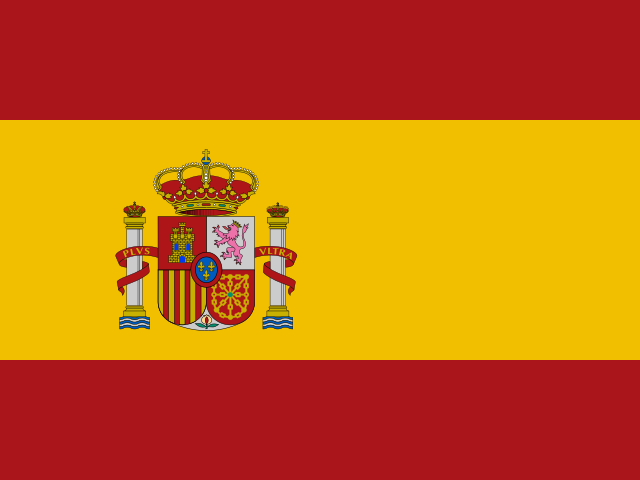
Flag protocol in Spain: order and place of honour
Published Written by Flagpole Guides
This page is an English translation of the Spanish original. Where the two versions differ, the Spanish text is the original.
On the front of a Spanish town hall there are usually three or four flags: the flag of Spain, that of the autonomous community, that of the municipality and often that of the European Union. Their order is not random. Law 39/1981 sets the place of the flag of Spain, and the State’s General Order of Precedence gives the criterion for ranking authorities at official events. This guide summarises those rules.
The place of honour
Article 6 of Law 39/1981 provides that, when the flag of Spain is used, it always takes a prominent, visible place of honour. If other flags are used with it, it takes the pre-eminent place of highest honour, and the others may not be larger. The law defines that place as follows:
- Odd number of flags: the central position.
- Even number of flags: of the two central positions, the one on the right of the presiding authority, if there is one, or the observer’s left.
The right of the presiding authority is the right of the person presiding over the event, facing the audience. For someone looking at the façade or the stage from the front, that same position is on the left.
Common examples
| Number of flags | Position of the flag of Spain |
|---|---|
| 2 (Spain and autonomous community) | On the left as seen from outside |
| 3 (Spain, community and municipality) | In the centre |
| 4 (Spain, community, municipality and European Union) | The left-hand central position as seen from outside |
| 5 | In the centre |
Law 39/1981 only sets the position of the flag of Spain. For the others, it is usual to follow the same principle that article 4 of the General Order of Precedence applies to authorities at official events: alternating right and left of the main position, in order of importance. With three flags, the regional flag usually takes the right of the flag of Spain, that is, the left as seen from outside, and the municipal flag the other side.
Regional and municipal flags
Article 4.2 of the Constitution and article 4 of Law 39/1981 provide that regional flags are used together with the flag of Spain on civil public buildings in their community. Article 5 says the same of the flags of town councils, provincial councils and other public corporations. On the other hand, under article 3, at the seats of the constitutional bodies and of the central State administration and on the flagpole of military buildings, the flag of Spain is the only one that flies.
Several autonomous communities
When the flags of several communities fly together, for example at a State event, Law 39/1981 does not set their order. Article 13 of Royal Decree 2099/1983 ranks the presidents of the autonomous communities by the date of official publication of their Statute of Autonomy, and it is usual to apply the same criterion to their flags.
Flags indoors
Inside public buildings, the flag of Spain takes the place of preference (article 3 of Law 39/1981). In official offices and assembly halls it is usually placed on an indoor staff next to the table of the presiding authority, with the other flags beside it under the same rules. The guide to flag types describes indoor flags, with fringes and a finial.
Foreign flags
When the flag of Spain flies together with those of other States, article 7 of Law 39/1981 refers to the international rules and customs governing this matter in relations between States and to the rules of international organisations. The guide to foreign flags in Spain covers this case.
The flag and private symbols
Protocol has one more limit: under article 8 of Law 39/1981, the symbols or initials of political parties, trade unions, associations or private entities may not be added to the flag of Spain. A corporate flag may fly next to the flag of Spain, but as a separate flag. More in the guide to flag rules.
Frequently asked questions
Where does the flag of Spain go when there are three flags?
In the centre. Under article 6 of Law 39/1981, when an odd number of flags fly together, the pre-eminent place of highest honour is the central position.
And when there are two or four flags?
With an even number of flags, the flag of Spain takes, of the two central positions, the one on the right of the presiding authority, if there is one, or the observer’s left, under article 6 of Law 39/1981. With two flags, that means the flag of Spain is on the left as seen from outside.
May the other flags be larger than the flag of Spain?
No. Under article 6 of Law 39/1981, flags used together with the flag of Spain may not be larger.
In what order do the flags of the autonomous communities go?
Law 39/1981 does not set it. The General Order of Precedence (Royal Decree 2099/1983) ranks the regional presidents by the date of official publication of their Statute of Autonomy, and it is usual to apply the same criterion when the flags of several communities fly together.
Where does the flag go inside a building?
Under article 3 of Law 39/1981, in public buildings the flag of Spain takes the place of preference inside. In an office or an assembly hall it is usually placed on an indoor staff next to the presiding authority, on their right, which is the left as seen by the audience.
Sources
This guide is based on the following sources, most of them in Spanish:
- Ley 39/1981, de 28 de octubre, por la que se regula el uso de la bandera de España y el de otras banderas y enseñas – Boletín Oficial del Estado
- Real Decreto 2099/1983, de 4 de agosto, por el que se aprueba el Ordenamiento General de Precedencias en el Estado – Boletín Oficial del Estado
- Bandera, himno, escudo, precedencia de autoridades – Ministerio de Asuntos Exteriores, Unión Europea y Cooperación
- Constitución Española, artículo 4 – Boletín Oficial del Estado
Related guides
- Flag rulesThe flag rules in Spain: where the flag flies under Law 39/1981, regional and municipal flags, the place of honour, prohibited symbols and insults to the flag.
- Foreign flagsFlags of other countries in Spain: use by private individuals and businesses, embassies, official visits, the international order and the European flag.
- Half-mastWhen the flag flies at half-mast in Spain: official mourning by royal decree, regional and municipal mourning, military rules and the black ribbon.
- Flags on holidaysThe flag on public holidays in Spain: 12 October, 6 December, the days of the autonomous communities with their flags and the 2026 holiday calendar.