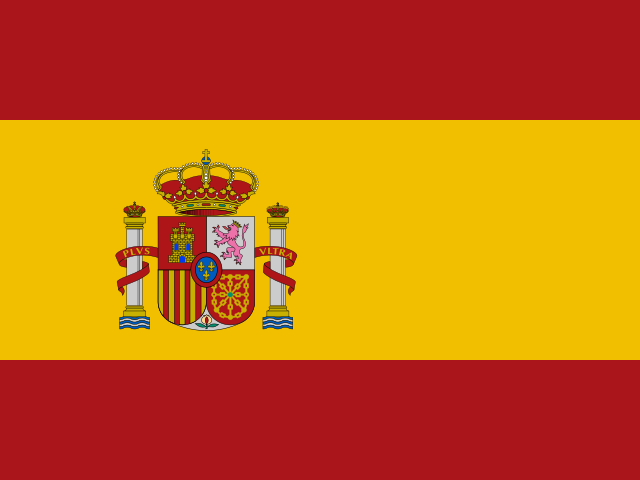
Flag lighting in Spain: night and light pollution
Published Written by Flagpole Guides
This page is an English translation of the Spanish original. Where the two versions differ, the Spanish text is the original.
In many countries the flag is lowered at sunset. In Spain there is no such rule for civil buildings: Law 39/1981 provides that the flag of Spain flies outside public buildings, without distinguishing between day and night. That is why many institutional and corporate flags stay up at night, and lighting becomes a practical and sometimes a regulatory matter. This guide brings together what the rules say.
Day and night
Law 39/1981 sets no times for civil buildings or private individuals. The Armed Forces do have times: under article 3 of the Regulation on Military Honours, the flag is raised at eight in the morning and lowered at sunset. The exception is national mourning, when the flag stays at half-mast day and night.
Why flags are lit
A flag that flies at night without light cannot be seen. Lighting it is a widespread custom on public buildings, monuments and company headquarters, and no State rule requires or prohibits it. On a freestanding flagpole, the light usually comes from recessed ground spotlights or projectors at the foot of the pole pointing upwards; on a façade, from the building’s own decorative lighting.
The outdoor lighting regulation
Royal Decree 1890/2008 approves the Regulation on energy efficiency in outdoor lighting installations. Under its article 2, it applies to installations of more than 1 kW of installed power, and among the types of lighting it regulates is decorative lighting, which the regulation defines as that of building façades and monuments. The regulation provides for operating cycles, with switching on and off, for decorative lighting, using astronomical clocks or equivalent systems. A domestic spotlight for a flag is normally well below 1 kW; the lighting of the façade of a large public building may not be.
Light pollution
Some autonomous communities have their own laws against light pollution. Catalonia’s Law 6/2001, on environmental regulation of lighting to protect the night-time environment, regulates outdoor and indoor lighting installations and fittings with regard to the light pollution they can produce, and divides the territory into zones with different levels of protection.
In the Canary Islands, Law 31/1988, known as the Sky Law, protects the astronomical quality of the observatories of the Instituto de Astrofísica de Canarias. Under its article 2, on the island of La Palma outdoor lighting avoids emitting light above the horizon and causes the least possible disturbance to astronomical observation. A spotlight lighting a flag from below shines precisely towards the sky, which this law seeks to avoid.
Local bylaws may add their own rules. The local council can say which rules apply in each municipality.
Technique
LED spotlights are common for their low energy use. Light aimed precisely at the flag, with narrow optics or lights at the top of the pole pointing downwards, reduces the light lost towards the sky. If the flagpole is aluminium, the electrical installation at its base may need earthing; according to ClickBanderas, an aluminium flagpole may need it depending on the installation. The guide to flagpole accessories covers the other parts.
Advertising flags
For illuminated advertising flags, the rules on outdoor advertising apply in addition to the lighting rules. The guide to flagpoles for businesses covers those requirements.
Frequently asked questions
May the flag fly at night in Spain?
Yes. Law 39/1981 provides that the flag of Spain flies outside public buildings without distinguishing between day and night, and sets no times for private individuals. Only in military units is it raised at eight in the morning and lowered at sunset, under the Regulation on Military Honours.
Does the flag have to be lit at night?
No State rule requires it. Lighting a flag that flies at night is a widespread custom on public buildings and company headquarters, so that it can be seen.
Which rules affect flag lighting?
The Regulation on energy efficiency in outdoor lighting installations (Royal Decree 1890/2008) applies to installations of more than 1 kW, including decorative lighting. Some communities also have laws against light pollution, such as Catalonia’s Law 6/2001, and on La Palma Law 31/1988 protects the astronomical quality of the observatories.
What does the Canary Islands Sky Law say?
Law 31/1988, on the protection of the astronomical quality of the observatories of the Instituto de Astrofísica de Canarias, provides that outdoor lighting on the island of La Palma avoids emitting light above the horizon and causes the least possible disturbance to astronomical observation.
Sources
This guide is based on the following sources, most of them in Spanish:
- Ley 39/1981, de 28 de octubre, por la que se regula el uso de la bandera de España y el de otras banderas y enseñas – Boletín Oficial del Estado
- Real Decreto 684/2010, de 20 de mayo, por el que se aprueba el Reglamento de Honores Militares – Boletín Oficial del Estado
- Real Decreto 1890/2008, de 14 de noviembre, por el que se aprueba el Reglamento de eficiencia energética en instalaciones de alumbrado exterior – Boletín Oficial del Estado
- Ley 31/1988, de 31 de octubre, sobre Protección de la Calidad Astronómica de los Observatorios del Instituto de Astrofísica de Canarias – Boletín Oficial del Estado
- Ley 6/2001, de 31 de mayo, de Ordenación Ambiental del Alumbrado para la Protección del Medio Nocturno (Cataluña) – Boletín Oficial del Estado
- Cómo calcular el tamaño de mástil correcto para tu bandera – ClickBanderas
Related guides
- Flagpole accessoriesThe accessories of a flagpole in Spain: halyard, cleat, pulley, snap hooks, counterweight, rotating arm, finial, bases and anchoring.
- Flag rulesThe flag rules in Spain: where the flag flies under Law 39/1981, regional and municipal flags, the place of honour, prohibited symbols and insults to the flag.
- Flagpole installationInstalling a flagpole in Spain: planning permission or a responsible declaration by region, historic heritage, airports, owners’ associations and foundations.
- Flagpoles for businessesFlagpoles and flags for businesses in Spain: logos and the flag of Spain, outdoor advertising, roads, paperwork, rotating arms and wind.