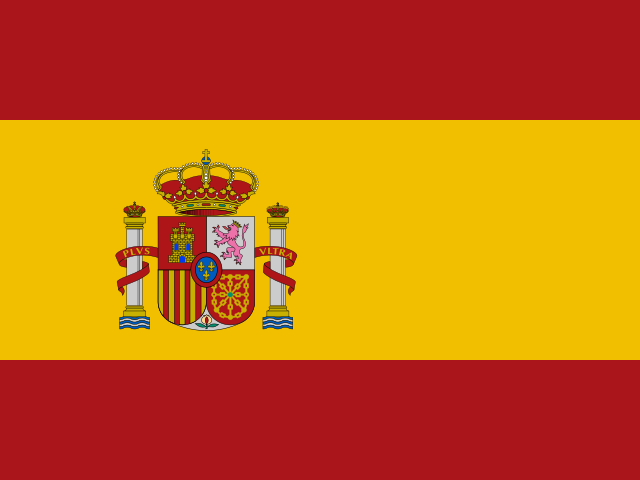
Flag types in Spain: national, regional and more
Published Written by Flagpole Guides
This page is an English translation of the Spanish original. Where the two versions differ, the Spanish text is the original.
Many flags coexist in Spain: the flag of Spain with and without the coat of arms, the flags of the seventeen autonomous communities and of Ceuta and Melilla, many municipal flags, military and naval ensigns and corporate and advertising flags. Some are described in detail in laws and regulations; others depend on each maker. This guide goes through the most common types.
The flag of Spain with the coat of arms
This is the flag of public buildings. Under article 2 of Law 39/1981, the coat of arms of Spain always appears on the flags of the buildings of the administrations, the seats of State bodies, the Armed Forces and security forces and diplomatic missions. Royal Decree 2964/1981 sets its position: in the centre of the yellow stripe, on both sides, two fifths of the width of the flag high.
The flag of Spain without the coat of arms
The coat of arms is compulsory only in those cases. For other uses, the law says that the coat of arms may be placed on the yellow stripe, so the flag without it is equally the flag of Spain. It is the one often seen on balconies, at sporting events and as hand flags. What may not be added to any flag of Spain are the symbols or initials of parties, trade unions, associations or private entities (article 8).
Regional flags
Under article 4.2 of the Constitution, the Statutes of Autonomy may recognise flags of the autonomous communities. Each Statute describes its own. Some examples:
- Andalusia: three horizontal stripes of equal width, green, white and green, as approved at the Assembly of Ronda in 1918 (article 3 of the Statute).
- Catalonia: the traditional flag of four red bars on a yellow field (article 8).
- Galicia: white with a blue diagonal band from the upper left corner to the lower right (article 6).
- Basque Country: the two-cross flag, with a green saltire, a white cross over it and a red field (article 5), known as the ikurriña.
On public buildings in their community, the regional flag flies next to that of Spain, no larger than it (Law 39/1981, articles 4 and 6).
Municipal and provincial flags
Many town councils and provincial councils have their own flag, approved under the rules of their autonomous community. Under article 5 of Law 39/1981, when they use it, they do so together with the flag of Spain.
Flags of vessels
Spanish ships fly the flag of Spain as their ensign (article 3.5 of Law 39/1981). The Flag Regulation (Royal Decree 1511/1977) describes variants:
- Private pleasure boats: the national flag with the Royal Crown in blue on the centre of the yellow stripe (rule 18).
- Jack (torrotito): a square flag with the quarters of the coat of arms that warships fly at the bow (rule 6).
- Pennant (gallardete): the long, narrow distinguishing mark of the commander of a warship.
Standards and guidons
The Flag Regulation calls the national flag in square form, with the coat of arms and a gold fringe on three sides, carried by some units of the Armed Forces, a standard (estandarte). The flags of units bear the embroidered coat of arms, the names of the arm and the unit and a ribbon in the national colours tied to the staff below the finial. The King has a personal guidon and standard, with a crimson field and the royal coat of arms, created by Royal Decree 527/2014.
Indoor flags
In offices, council chambers and assembly halls, indoor flags are mounted on a staff with a finial and a base, often with gold fringes and cords. They follow the same ordering rules as outdoor flags; the guide to flag protocol explains them.
Corporate and advertising flags
Businesses, hotels and car dealers use flags with their logo. According to the maker ClickBanderas, these are mounted on flagpoles with a rotating arm system, which keeps the flag extended at all times, or with a halyard, in which case the flag has rings and a reinforcing tape on the side and depends on the wind to unfurl. The guide to flagpoles for businesses covers this use.
Sizes
Flagpole flags almost always follow the 2:3 proportion, the normal proportion of the flag of Spain. According to La Tienda de las Banderas, 100 × 150 cm is one of the most widely used sizes, in offices, on façades, wide balconies and small flagpoles. The guide to flag sizes lists the official types of the Flag Regulation.
Frequently asked questions
Is the coat of arms compulsory on the flag of Spain?
Only in some cases. Under article 2 of Law 39/1981, the coat of arms may be placed on the yellow stripe and always appears on the flags of public buildings, State bodies, the Armed Forces and diplomatic missions. Outside those cases, the flag of Spain may be used without the coat of arms.
Which flag do pleasure boats fly?
Under rule 18 of the Flag Regulation (Royal Decree 1511/1977), the flag for privately owned pleasure boats and yachts is the national flag with the Royal Crown in blue on the centre of the yellow stripe, on both sides.
What is a standard (estandarte)?
In the Flag Regulation, a standard is the national flag in square form, with the coat of arms in the centre of the yellow stripe and a gold fringe on three sides, carried by some units of the Armed Forces. The King also has a personal guidon and standard, with a crimson field, created by Royal Decree 527/2014.
How many regional flags are there?
Each of the seventeen autonomous communities and the cities of Ceuta and Melilla has its flag, recognised in its Statute of Autonomy in accordance with article 4.2 of the Constitution. Examples are the green, white and green Andalusian flag, the ikurriña of the Basque Country and the white Galician flag with a blue diagonal band.
Sources
This guide is based on the following sources, most of them in Spanish:
- Ley 39/1981, de 28 de octubre, por la que se regula el uso de la bandera de España y el de otras banderas y enseñas – Boletín Oficial del Estado
- Real Decreto 1511/1977, de 21 de enero, por el que se aprueba el Reglamento de Banderas y Estandartes, Guiones, Insignias y Distintivos – Boletín Oficial del Estado
- Real Decreto 527/2014, de 20 de junio, por el que se crea el Guión y el Estandarte de Su Majestad el Rey Felipe VI – Boletín Oficial del Estado
- Ley Orgánica 3/1979, de 18 de diciembre, de Estatuto de Autonomía para el País Vasco (artículo 5) – Boletín Oficial del Estado
- Ley Orgánica 6/2006, de 19 de julio, de reforma del Estatuto de Autonomía de Cataluña (artículo 8) – Boletín Oficial del Estado
- Ley Orgánica 1/1981, de 6 de abril, de Estatuto de Autonomía para Galicia (artículo 6) – Boletín Oficial del Estado
- Ley Orgánica 2/2007, de 19 de marzo, de reforma del Estatuto de Autonomía para Andalucía (artículo 3) – Boletín Oficial del Estado
- Mástiles para banderas – ClickBanderas
- Qué tamaño de bandera elegir para cada mástil – La Tienda de las Banderas
Related guides
- Flag sizesThe dimensions of the flag of Spain: 2:3 proportion, stripes, coat of arms, the five official types of the Flag Regulation and the size for a flagpole.
- Flag symbolismWhat the flag of Spain symbolises under Law 39/1981, why it is red and yellow, and what the quarters, pillars and crowns of the coat of arms represent.
- History of the flagThe history of the flag of Spain: the naval ensign of Charles III in 1785, the Army in 1843, the tricolour of 1931, 1936 and the laws of 1978 and 1981.
- Price of a flagThe price of a flag in Spain: how size, fabric, coat of arms, finishing and customisation affect it, and the consumer’s rights of withdrawal and guarantee.