Irish flag protocol: place of honour and order of flags
Published Written by Flagpole Guides
Protocol decides where each flag goes when the tricolour flies with others: at a county hall with the EU flag, at a hotel with foreign flags, at a club with its own flag, or on a stage behind the speaker. In Ireland the rules are in the guidelines “The National Flag” of the Department of the Taoiseach. They are not law, but they are what State bodies, councils and many businesses follow.
The basic rules
The guidelines start from three principles:
- Nothing above it: no flag or pennant is flown above the National Flag.
- Only one: only one National Flag is displayed in each group of flags or at each location.
- The place of honour: in all cases, the National Flag is in the place of honour.
At a building or entrance where the National Flag flies with other flags of equal height, it is first on the right, which is on an observer’s left.
A row of flags
| Arrangement | Position of the National Flag | EU flag, if present |
|---|---|---|
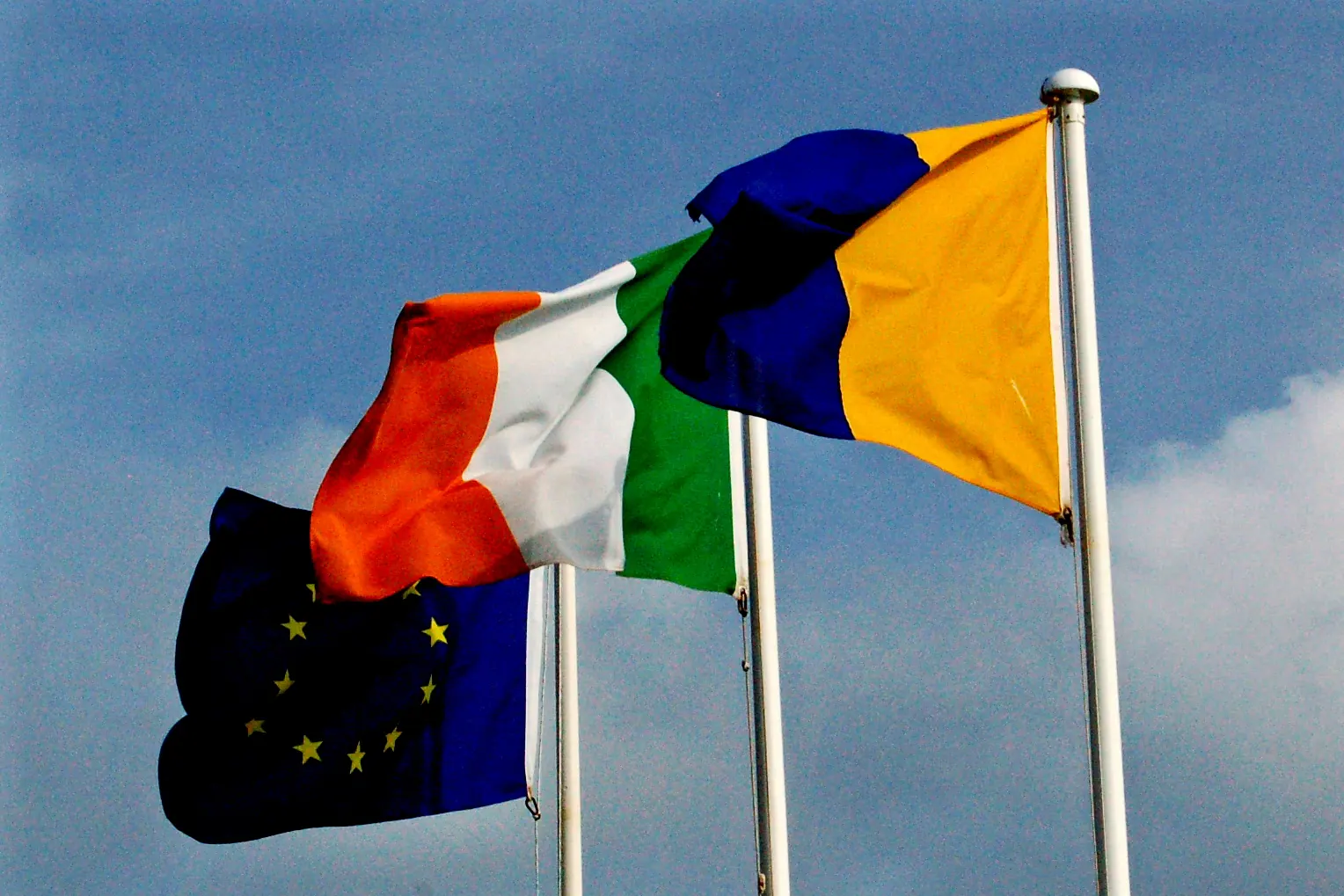
| Flags in line on staffs of equal height, even or odd number | First on the right of the line (observer’s left) | Immediately to the right of the National Flag as seen by an observer |
| Odd number, one central staff higher than the others | On the central, higher staff | On the first staff on the observer’s left |
| One flagpole higher than the rest | On the higher pole; no second National Flag is flown | – |
| Flags of all EU member states | In alphabetical order among them | On the first staff on the observer’s left |
When flags of other nations fly with the National Flag, each flag has the same width and flies from a separate flagpole of the same height. International protocol prohibits flying any nation’s flag higher than another in peacetime; if one pole happens to be higher, the National Flag is flown from it. The rules for foreign flags are described in the guide to foreign flags in Ireland.
The flags of the EU member states
When the flags of the European Union member states are flown, the sequence is alphabetical, based on each country’s name in its primary local language, with the EU flag on the first flagstaff from the observer’s left. The appendix of the guidelines follows the protocol order of the EU’s Interinstitutional Style Guide: Belgique/België, Bulgaria, Česko, Danmark, Deutschland, Eesti, Éire/Ireland, Greece, España, France, Hrvatska, Italia and so on to Suomi/Finland and Sverige. An alternative order starts on the left with the National Flag and places the EU flag on the far right of the group.
Carrying flags
When the National Flag is carried with another flag or flags, it is carried in the place of honour: on the marching right, which is on the left of an observer towards whom the flags are approaching. An EU flag is carried immediately to the right of the National Flag as seen by an observer. While carried, the flag is not dipped as a salute or compliment, except to the dead during memorial ceremonies.
Crossed staffs
In a display of crossed staffs, the National Flag is to the right and to the fore, which is to the left of an observer facing the flags, and its staff is in front of the other staff or staffs.
Walls, platforms and tables
- On a wall: displayed horizontally or vertically against a wall or other background, the green is on the right (the observer’s left) in the horizontal position, or uppermost in the vertical position.
- On a platform: the National Flag is above and behind the speaker’s desk. It is not used to cover the desk or draped over the platform.
- On a table: a small National Flag may be part of a table centrepiece. When it is used with the flags of other nations, the National Flag is also displayed in the place of honour on a nearby flagstaff.
Half-mast and mourning
Where the National Flag is flown at half-mast, no other flag is flown. That affects every site with several flagpoles, from council offices to hotels. The rules are in the guides to half-mast and flags in mourning.
Company and club flags
The guidelines do not deal separately with company, county or club flags, but the basic rules apply to them as well: the tricolour in the place of honour, nothing flown above it, and only one tricolour in the group. How businesses combine the National Flag with their own flags is described in the guide to flagpoles for businesses.
Frequently asked questions
Where does the Irish flag go in a row of flags?
According to the guidelines of the Department of the Taoiseach, the National Flag is first on the right of the line, which is on an observer’s left, when flags fly in line on staffs of equal height. When one staff is in the centre and higher than the others, the National Flag flies from the central staff.
Can a flag fly above the Irish flag?
No. According to the guidelines, no flag or pennant is flown above the National Flag. If one flagpole in a group is higher than the rest, the National Flag is flown from that pole.
How many Irish flags can fly in a group?
Only one. The guidelines state that only one National Flag is displayed in each group of flags or at each location, and it is always in the place of honour.
Where does the EU flag go next to the Irish flag?
In a line of flags on staffs of equal height, the European Union flag flies immediately to the right of the National Flag as seen by an observer. When the flags of all EU member states fly, the EU flag is on the first staff on the observer’s left, followed by the member states in alphabetical order of their names in their own languages.
How is the Irish flag hung on a wall?
According to the guidelines, when the National Flag is displayed horizontally or vertically against a wall or other background, the green is on the right, which is the observer’s left, in the horizontal position, or uppermost in the vertical position.
Sources
This guide is based on the following sources:
- The National Flag – Guidelines (September 2025), sections 4, 6 and 7 and appendix – Department of the Taoiseach
- Interinstitutional Style Guide – Publications Office of the European Union
Related guides
- Foreign flagsFlying the flag of another country in Ireland: same size and height, the place of honour for the tricolour, the EU flag, embassies and Northern Ireland.
- Flags in mourningThe Irish flag in times of mourning: half-mast on government buildings, the flag on a coffin with the green at the head, folding the flag and dipping it.
- Flags of IrelandThe flags and emblems of Ireland: the tricolour, the President’s flag with the harp, the EU flag, the historic green harp flag, county and provincial flags.
- Flagpoles for businessesCompany flags in Ireland: advertisement rules in the planning regulations, the roof flag exemption, the harp and State emblems, protocol and safety at work.