
How a flagpole works: halyard, truck, counterweight and hinge
Published Written by Flagpole Guides
A flagpole is a simple machine: a rope running over a pulley. Most of what makes one pole easier or safer to use than another comes down to how that rope runs, how it is held, and how the flag is changed. This guide explains the mechanics and how they relate to the way the National Flag is hoisted and lowered in Ireland.
Halyard and truck
The flag is attached to a rope called the halyard. It runs from the bottom of the pole up to the truck, the fitting at the top with a pulley, and back down again, forming a loop. Pulling one side raises the flag; pulling the other lowers it. At the top, a finial caps the pole. Many trucks rotate, so the flag can turn with the wind without wrapping around the pole.
The flag is fixed to the halyard by its finish: a rope loop and tail, or brass rings on the hoist side, attached with clips or toggles.
External halyard
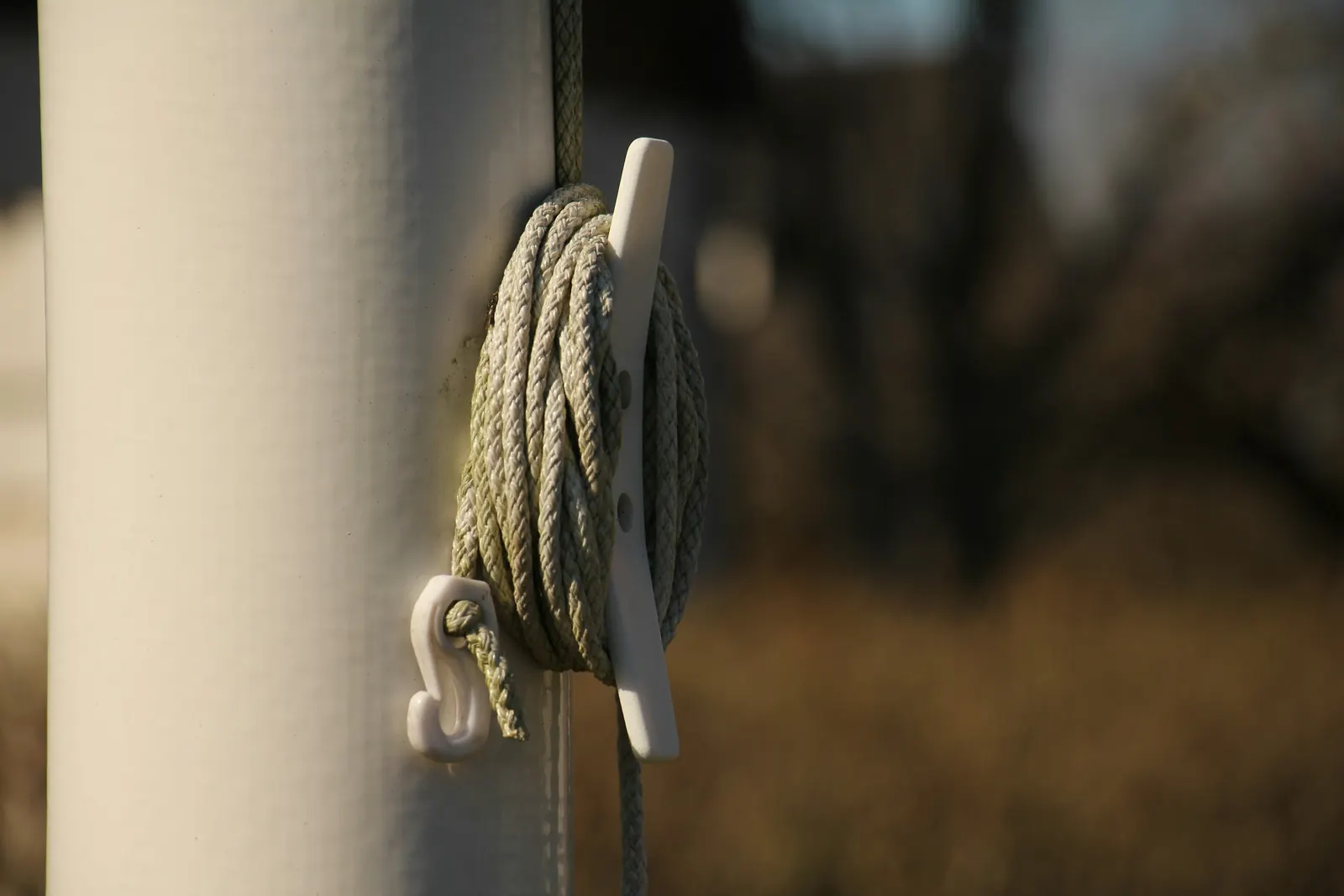
On an external system, the halyard runs on the outside of the pole and is tied off around a cleat low on the pole. It is simple to use and to repair, and the rope is easy to replace. According to FlagPoles Ireland, a Dublin supplier, an external halyard works well at homes or at business parks where there are no children around or the premises are locked at night. The rope can bang against the pole in the wind.
Internal halyard
On an internal system, the halyard runs inside the pole and is reached through a lockable door at the base. A counterweight, fitted either to the bottom of the flag or to the end of the rope, keeps the halyard taut. FlagPoles Ireland recommends internal systems mainly for health and safety, and calls them anti-vandal, since the rope cannot be cut and the flag cannot easily be stolen. At schools, where pupils often raise the flag in the morning and lower it in the afternoon, the supplier compares the need for an internal halyard to the rules for cords on classroom blinds. The counterweight can bang against the inside of the pole in the wind.
Sleeved and hinged bases
How the pole is fixed at the base affects how the flag and the fittings are reached:
- a sleeved pole stands in a ground sleeve in the foundation and is lifted out for major work
- a hinged-base pole pivots at the base and can be lowered to the ground, so flags and banner arms are changed with the pole lying flat, with a controlled pivot up and down
According to FlagPoles Ireland, hinged-base poles are common where flags are changed often, such as at motor dealerships.
Hoisting and lowering
The guidelines of the Department of the Taoiseach describe how the National Flag is handled on the pole:
| Step | According to the guidelines |
|---|---|
| Raising and lowering | The flag does not touch the ground |
| Hoisting to half-mast | First to the peak, then lowered to the half-mast position |
| Lowering from half-mast | First back to the peak, then lowered |
| Half-mast position | As a general guide, the top of the flag one flag depth below the top of the staff, never below the middle |
On ceremonial occasions, those present face the flag and stand to attention while it is hoisted or lowered. More in the guides to half-mast and flag flying rules.
One flag per pole
FlagPoles Ireland states that its flagpoles are designed for one flag per pole. Chaining several flags together on a taller pole stresses the pole, can break it and voids the warranty; the manufacturer can tell the cause of a break from the pattern of the glass fibres. The guidelines add their own rule: no flag or pennant is flown above the National Flag.
Weather
The supplier notes that the wind at the top of the pole is a great deal stronger than at ground level, and that a wet flag weighs about three to four times as much as a dry one. It advises against flying flags in strong winds or rain and never in force 7 or above, and states that flags are removed when there is a wind alert, as its warranty otherwise lapses. More in the guide to flagpole safety.
When something stops working
A halyard that jams, a truck that no longer turns or a door that will not open are the most common problems. According to FlagPoles Ireland, dirt and grime collect in the halyard system over time and can eventually make it jam. The parts are described in the guide to flagpole accessories, and faults in the guide to flagpole repair.
Frequently asked questions
How does a flag go up a flagpole?
The flag is clipped to a rope, the halyard, which runs up the pole, over a pulley in the truck at the top and back down. Pulling one side of the halyard raises the flag; the rope is then tied off on a cleat or locked inside the pole.
How does an internal halyard work?
The rope runs inside the pole and comes out behind a lockable door at the base. A counterweight, fitted to the bottom of the flag or to the end of the rope, keeps it taut. According to an Irish supplier, internal halyards are also known as anti-vandal systems.
How is a flag raised to half-mast?
According to the guidelines of the Department of the Taoiseach, the flag is first brought to the peak of the staff and then lowered to the half-mast position. Before it is lowered for the day, it is brought to the peak again.
How many flags can fly on one flagpole?
An Irish supplier states that flagpoles are designed for one flag per pole, and that chaining several flags together on a taller pole stresses the pole and can break it. The guidelines also state that no flag is flown above the National Flag.
Sources
This guide is based on the following sources:
- FAQs – FlagPoles Ireland
- Flagpole safety inspections – FlagPoles Ireland
- The National Flag – Guidelines (September 2025), sections 8, 10 and 13 – Department of the Taoiseach
Related guides
- Flagpole accessoriesThe parts and accessories of a flagpole in Ireland: finials, halyards, weights, cleats, doors, base covers, fixings, banner arms and LED lighting.
- Types of flagpolesThe main types of flagpole in Ireland: ground-mounted, sleeved and hinged-base poles, wall-mounted poles, indoor staffs, banner poles and roof flagstaffs.
- Flagpole repairCommon flagpole faults in Ireland and their causes: jammed halyards, flags stuck at the top, worn pulleys, broken poles, loose bases – and repair services.
- Flagpole safetyFlagpole safety in Ireland: Met Éireann wind warnings, overhead lines and ESB Networks, Dial Before You Dig, work at height rules and flagpoles at schools.