Flagpoles for businesses in Ireland: company flags and the rules
Published Written by Flagpole Guides
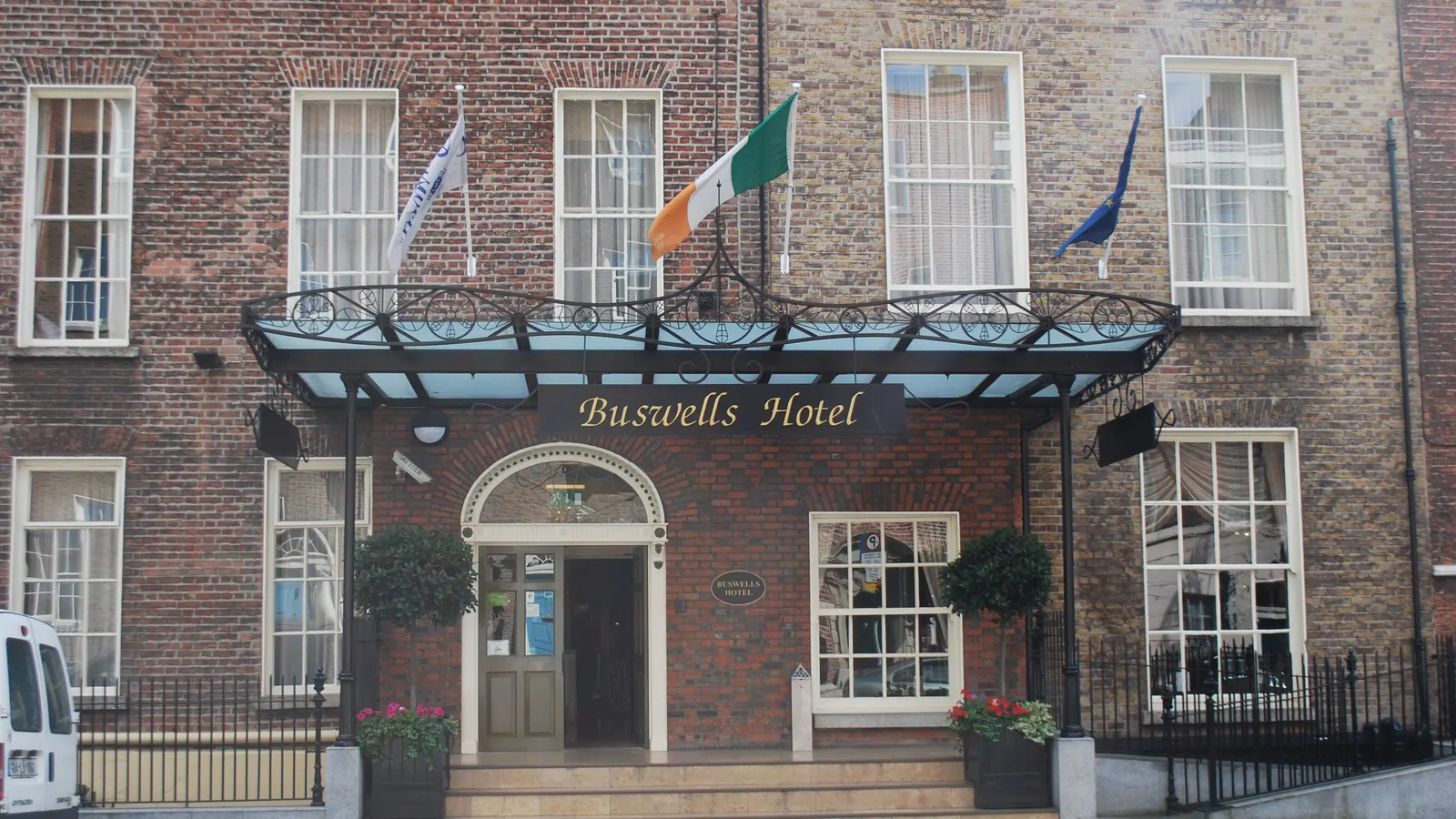
Flags are a common part of business premises in Ireland: a row of flagpoles outside a hotel, banner flags at a car dealership, a company flag over the entrance of a factory in a business park. For a business, the rules come from three places: planning law, which treats a company flag as an advertisement; trade mark law, which protects the State emblems; and the guidelines on the National Flag when the tricolour flies alongside. Health and safety law applies to the work of changing the flags.
A company flag is an advertisement
The Planning and Development Regulations 2001 deal with company flags as advertisements, in Part 2 of Schedule 2. One exemption concerns flags directly:
| Class | What is exempt | Condition |
|---|---|---|
| Part 2, Class 4 | An advertisement in the form of a flag attached to a single flagstaff fixed upright on the roof of a business premises, bearing no inscription or emblem other than the name, device or logo of a person or business occupying the premises | Not more than one such advertisement on a business premises |
A flagpole with a company flag in front of the building, a row of branded flagpoles, or banner flags on arms are not covered by this class. Under the Planning and Development Act 2000, development needs permission unless exempted. An Irish flagpole supplier states that in its experience a business flying branded flags most definitely needs planning permission, as this is branding. The council can give a section 5 declaration on whether a particular set-up is exempt; the process is described in the guide to installing a flagpole.
According to article 6 of the regulations, the exemptions for advertisements do not apply to an advertisement structure on a protected structure, or on the exterior of a structure in an architectural conservation area where it would materially affect the character of the area, with limited exceptions. In a Gaeltacht area, an exempt advertisement structure carries advertisements in Irish, or in Irish and other languages with prominence given to the Irish text and identical content in all versions.
The National Flag at work
Businesses fly the tricolour as well as their own flags. According to the guidelines of the Department of the Taoiseach:
- the National Flag is in the place of honour, first on the right of the line (the observer’s left)
- no flag or pennant is flown above the National Flag
- only one National Flag is displayed in each group of flags
- when the National Flag is at half-mast, no other flag is flown
- the National Flag is never defaced by slogans, logos, lettering or pictures
A company that wants the tricolour and its logo together therefore flies them on separate poles. The order of flags is explained in the guide to flag protocol, and flags of other countries, common at hotels and multinationals, in the guide to foreign flags in Ireland.
The harp and the shamrock
The harp and the shamrock are the official State emblems of Ireland. According to the Department of Enterprise, Tourism and Employment, a person or company that wants to use a State emblem in connection with any business, or to register a trade mark containing one, first obtains consent from the Minister under the Trade Marks Act 1996. There is no formal application form; requests go in writing or by email to the Department’s Intellectual Property Unit and are considered case by case. The Minister can act against unauthorised use in the course of business. A company flag with a harp therefore needs more than a designer. The emblems are described in the guide to flags of Ireland.
Banner flags and lighting
Motor dealerships and retail parks often use banner flags on rotating arms, usually on hinged-base poles so the flags can be changed with the pole lying on the ground. Lit flags draw attention after dark, and the regulations limit the area of illuminated advertisements in several of their classes. More in the guide to flag lighting.
Changing the flags
Company flags wear out, and many businesses have them changed on a schedule. FlagPoles Ireland offers a flag maintenance programme for corporate clients, with flag changes fortnightly, monthly or quarterly, which removes the need for the business to hire equipment for work at height.
When employees change the flags, the Safety, Health and Welfare at Work (General Application) Regulations 2007 apply. According to the Health and Safety Authority, employers do all that is reasonably practicable to prevent falls, and work at height is avoided where reasonably practicable, with equipment used to prevent falls where it is not. A hinged-base pole or an internal halyard that works from the ground keeps most of the work at ground level. More in the guide to flagpole safety.
Several poles
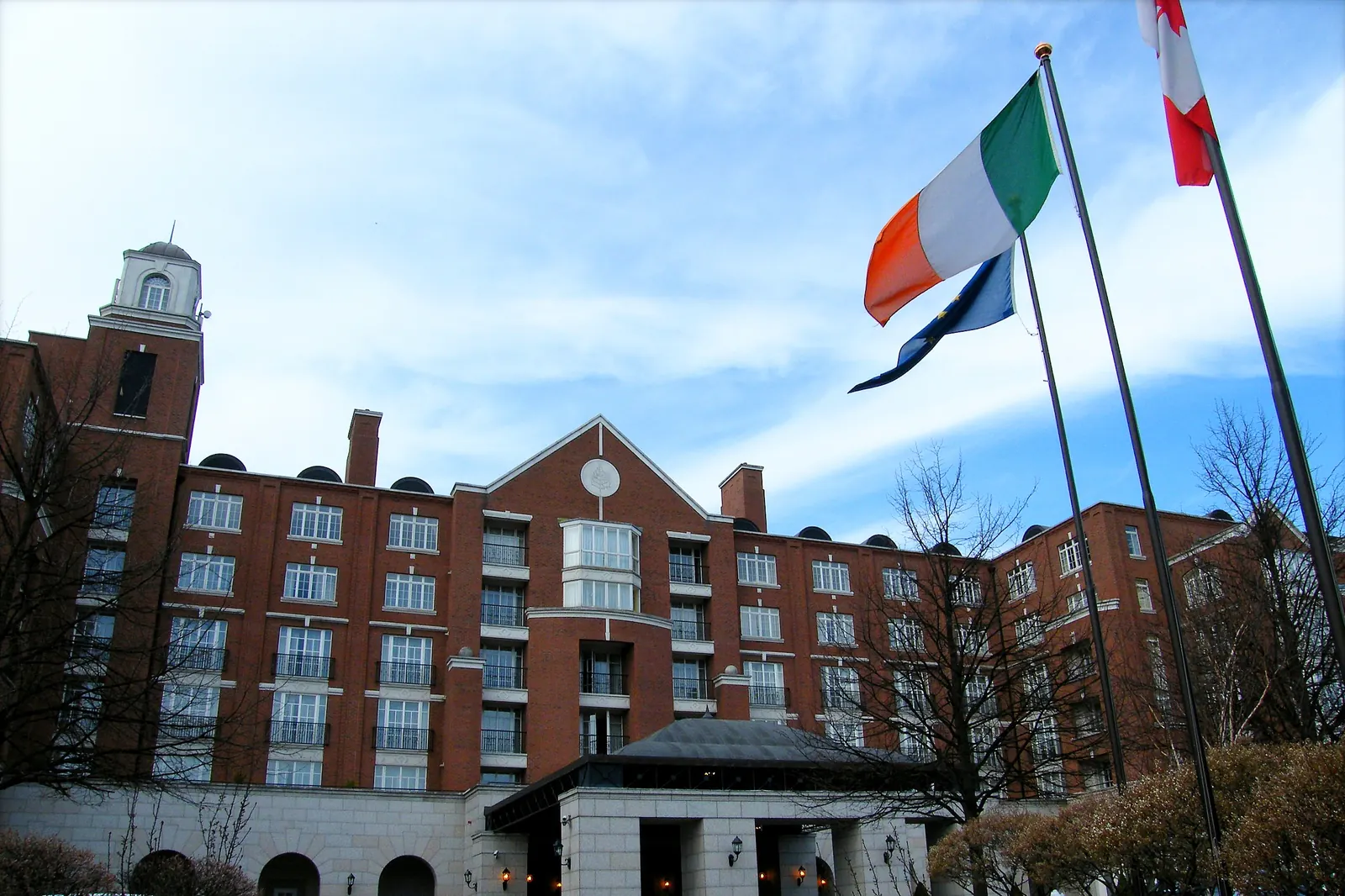
Hotels and business parks often have a row of poles. FlagPoles Ireland recommends at least 2 metres between flagpoles so the flags do not touch the neighbouring pole, and a flag size matched to the pole height; the chart is in the guide to flag sizes.
Frequently asked questions
Does a company flag need planning permission in Ireland?
A company flag is an advertisement in planning terms. The Planning and Development Regulations 2001 exempt one flag on a single upright flagstaff on the roof of a business premises, bearing only the name, device or logo of the business there. Other company flagpoles, for example in front of the building, are not specifically exempt, and the council can give a section 5 declaration.
Can a business use the Irish harp on its flag?
Only with consent. According to the Department of Enterprise, Tourism and Employment, anyone who wants to use a State emblem, such as the harp or the shamrock, in connection with any business first obtains consent from the Minister under the Trade Marks Act 1996.
Can a business fly the Irish flag next to its company flag?
Yes. According to the guidelines of the Department of the Taoiseach, the National Flag is then in the place of honour, no flag is flown above it, and only one National Flag is displayed in the group.
Can a logo be put on the Irish flag?
No. The guidelines state that the National Flag is never defaced by slogans, logos, lettering or pictures of any kind.
Sources
This guide is based on the following sources:
- Planning and Development Regulations 2001 (S.I. No. 600 of 2001), article 6 and Schedule 2, Part 2 – Irish Statute Book
- Section 5 declaration: check if a development requires planning permission – Dublin City Council
- Protection and use of State emblems – Department of Enterprise, Tourism and Employment
- The National Flag – Guidelines (September 2025), sections 4, 6 and 13 – Department of the Taoiseach
- FAQs – FlagPoles Ireland
- Flag maintenance programme – FlagPoles Ireland
- Guide to the Safety, Health and Welfare at Work (General Application) Regulations 2007, Part 4: Work at Height – Health and Safety Authority
Related guides
- Foreign flagsFlying the flag of another country in Ireland: same size and height, the place of honour for the tricolour, the EU flag, embassies and Northern Ireland.
- Flag lightingFlying the Irish flag at night: what the Taoiseach’s guidelines say about illumination, spotlights and pole-mounted LEDs, funerals, and planning for lit signs.
- Flag protocolIrish flag protocol: the place of honour, one National Flag per group, the tricolour with the EU flag, crossed staffs, platforms, parades and flags on walls.
- Flagpole safetyFlagpole safety in Ireland: Met Éireann wind warnings, overhead lines and ESB Networks, Dial Before You Dig, work at height rules and flagpoles at schools.