
How a flagpole works: halyard, truck, winch and half-staff
Published Written by Flagpole Guides
A flagpole is a simple machine: a rope over a pulley at the top of a tall pole. The details decide whether the flag can be locked, whether it turns with the wind and whether it can be lowered to half-staff. This guide explains the mechanics; the individual parts are listed in the guide to flagpole accessories.
The halyard and the truck
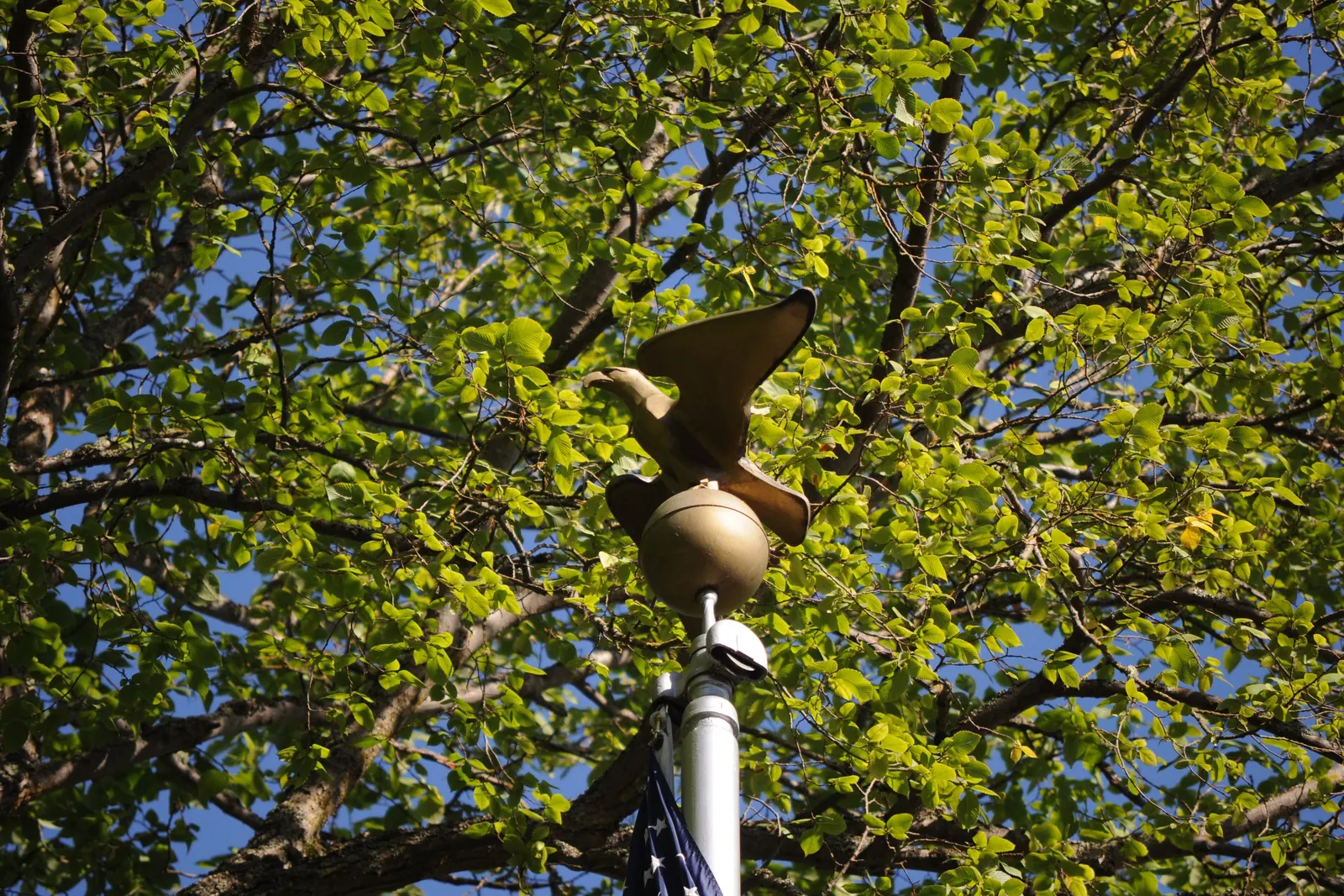
At the top of the pole sits the truck, a fitting with one or two pulleys. The halyard, a rope or a wire, runs up the pole, over the pulley and back down, forming a loop. The flag is clipped to the halyard with snaps at its grommets. Pulling one side of the loop raises the flag, pulling the other lowers it. Under the Flag Code, the flag is hoisted briskly and lowered ceremoniously (4 U.S.C. § 6(b)).
According to Concord American Flagpole, trucks are stationary, fixed so that they do not rotate, or revolving, so that the flag turns with the wind. A double revolving truck carries two halyards for two flags; on a single halyard with two flags, the Flag Code places the US flag at the peak (4 U.S.C. § 7(f)).
External halyard
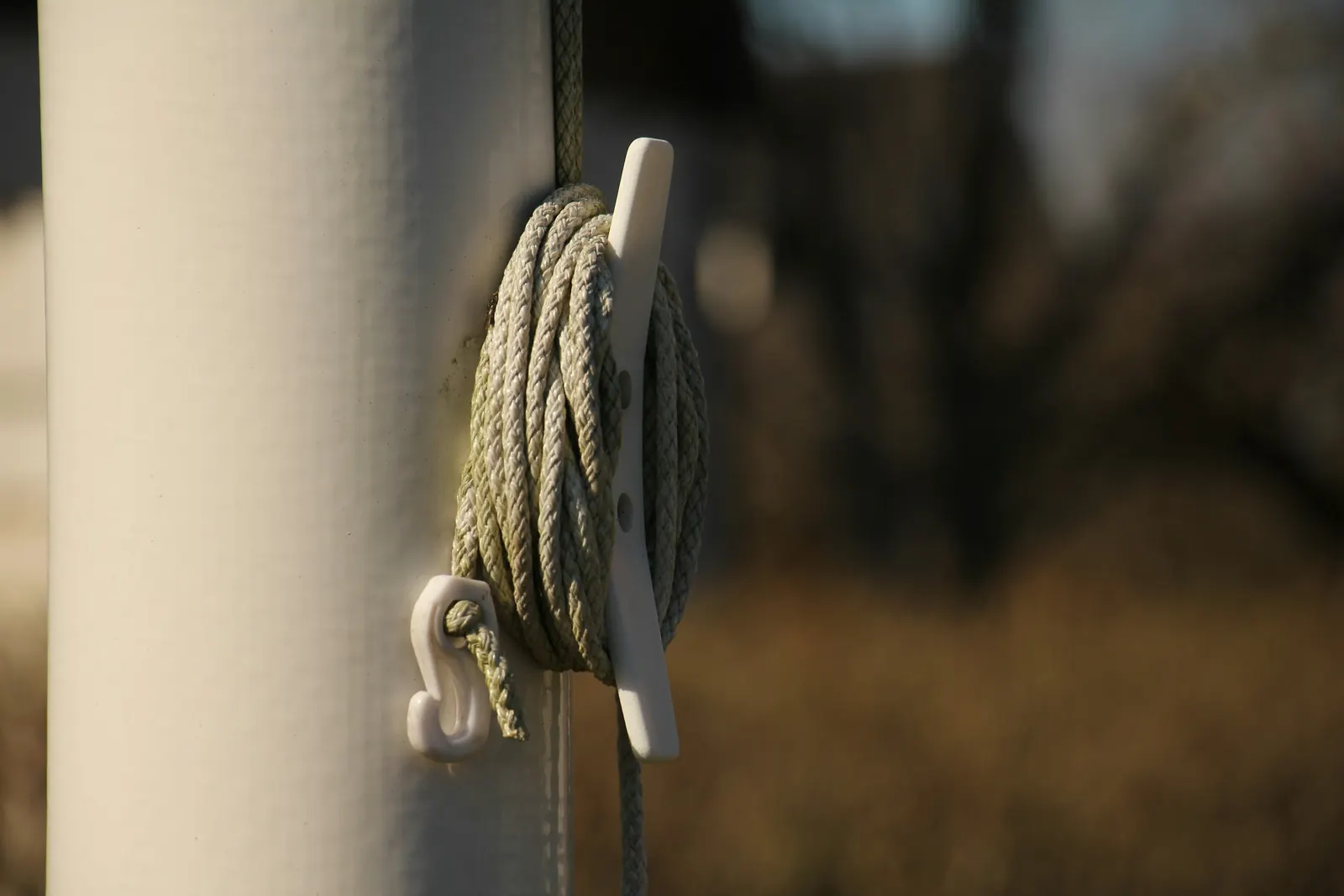
On an external halyard pole, the rope runs outside the pole. When the flag is up, the rope is wrapped around a cleat on the pole. The system is simple and easy to inspect, but the rope and cleat are within reach of anyone at the pole, and the rope can slap against the pole in the wind.
Internal halyard
On an internal halyard pole, the halyard runs inside the pole and comes out behind a lockable access door. Concord describes two systems:
| System | Halyard | How it holds the flag |
|---|---|---|
| Winch system | Wire | Wound on a gearless winch with a removable winch handle |
| Cam cleat system | Rope | Held in a heavy-duty cam-action cleat |
With a winch, the flag is raised and lowered by turning the handle, and the handle is taken away afterwards.
Telescoping poles
A telescoping pole has no halyard. According to the maker Flagsource, the flag is attached to the pole and raised section by section, each section locking with a push button, and a press of the release button lets the sections slide down again.
Half-staff
With a halyard, the flag can be held at any height. Under 4 U.S.C. § 7(m), half-staff is one-half the distance between the top and bottom of the staff, and the flag is first hoisted to the peak for an instant before it is lowered to that position; before it is lowered for the day, it is raised to the peak again. A flag fixed to a house-mounted pole cannot be held at half-staff. More in the guide to half-staff.
Height and parts
According to Concord American Flagpole, a flagpole’s mounting height is its exposed height above grade to the top of the shaft; the truck and ornament add 1 to 2 ft. A ground-set pole has part of its length below grade in the sleeve.
When something goes wrong
A frayed halyard, a stuck truck or a loose cleat stops the flag from being raised or lowered. Some local codes address the condition directly: in Durham, North Carolina, a flagpole with broken halyards is not used and torn or frayed flags are not displayed. Common faults are covered in the guide to flagpole repair, and safety in the guide to flagpole safety.
Frequently asked questions
How is a flag raised on a flagpole?
On most in-ground poles, the flag is attached to a halyard, a rope or wire that runs over a pulley in the truck at the top of the pole. Pulling one side of the halyard raises the flag; the rope is then tied off on a cleat or, on an internal halyard pole, held by a cam cleat or a winch.
How does a flag reach half-staff?
The halyard is used to hold the flag at the middle of the pole. Under 4 U.S.C. § 7(m), the flag is first hoisted to the peak for an instant and then lowered to the half-staff position, one-half the distance between the top and bottom of the staff, and raised to the peak again before it is lowered for the day.
What is a revolving truck?
A truck that rotates at the top of the pole so that the flag turns with the wind. According to Concord American Flagpole, trucks can be stationary, which do not rotate, or revolving, and double revolving trucks fly two flags.
What is the difference between a winch and a cam cleat?
Both are internal halyard systems behind a lockable door. According to Concord American Flagpole, a winch system uses a wire halyard wound on a gearless winch with a removable handle, while a cam cleat system uses a rope halyard held in a heavy-duty cam-action cleat.
Sources
This guide is based on the following sources:
- Halyard Options – Concord American Flagpole
- Flagpole Descriptions – Concord American Flagpole
- 4 U.S.C. § 6(b), § 7(f) and § 7(m) – U.S. Government Publishing Office
- Telescoping flagpoles – Flagsource
- Unified Development Ordinance, Sec. 7.7 Flagpoles and Flags – City and County of Durham, North Carolina
Related guides
- Flagpole accessoriesThe parts and accessories of a US flagpole: truck, finial and eagle, halyard, snaps, cleat, collar, security covers, brackets and lighting.
- Types of flagpolesThe main types of US flagpoles: house-mounted poles, telescoping poles, in-ground poles with external or internal halyards, and wall and roof poles.
- Flagpole repairCommon faults on US flagpoles – broken halyard, stuck truck, slipping winch, leaning pole, corrosion – their usual causes and the rules for repairs.
- Flagpole safetyThe main risks around a US flagpole: wind speed ratings and flag size, overhead power lines under OSHA rules, buried utilities and 811, and work at height.