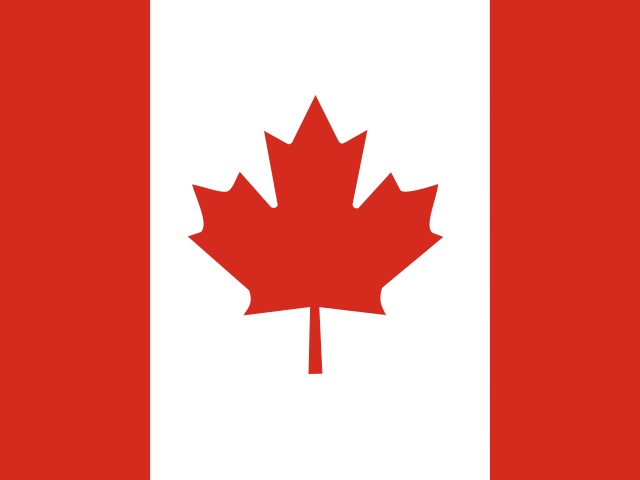
Flags of Canada: national, provincial, territorial and royal flags
Published Written by Flagpole Guides
Canada flies many flags beside the maple leaf. Each province and territory has its own flag, the Sovereign and the Governor General have personal flags, and the country’s earlier flags live on as historical flags. According to Canadian Heritage, the provincial and territorial flags reflect the heritage of each province or territory, represent all its people and are treated with the same respect as the National Flag.
The National Flag of Canada
The National Flag of Canada, often called the maple leaf flag, is a red flag twice as long as it is wide (2:1), with a white square in the centre the width of the flag and a single stylized 11-point red maple leaf. It was proclaimed by Queen Elizabeth II on 28 January 1965 and raised for the first time on 15 February 1965. Red and white are Canada’s national colours. The flag and its maple leaf are protected symbols under the Trademarks Act. Its design and history are in the guide to the Canadian flag.
The provincial and territorial flags
The table lists the flags in the order of precedence set by Canadian Heritage, with the year of adoption and the proportions (length by width) that the department gives.
| Province or territory | Flag | Adopted | Proportions |
|---|---|---|---|
| Ontario | Union Jack in the upper quarter at the staff, shield of Ontario on the fly | 1965 | 2:1 |
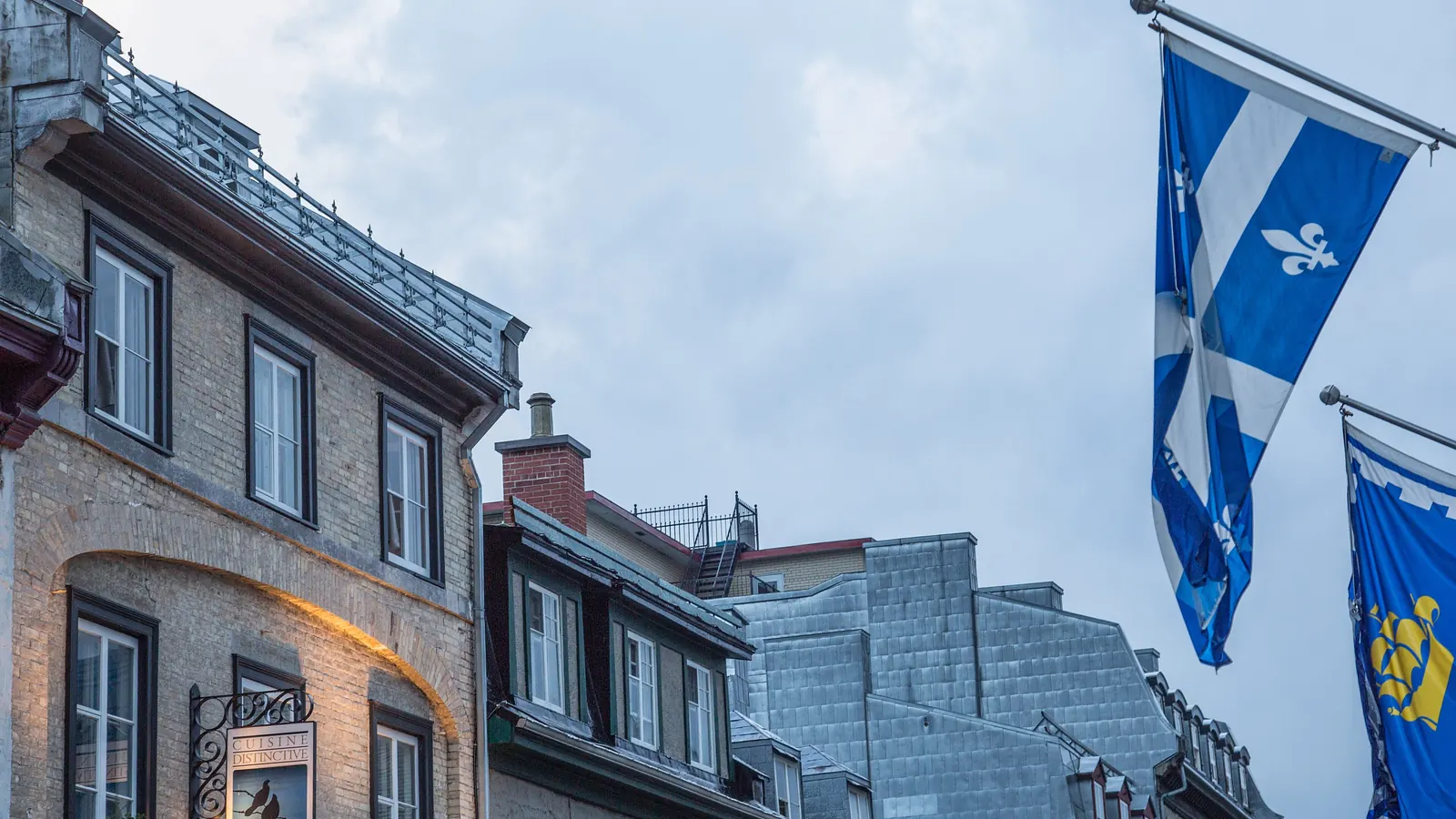
| Québec | The fleurdelisé: white cross on blue with four white fleurs-de-lis | 1948 | 3:2 |
| Nova Scotia | The provincial shield extended into a rectangle, from arms granted in 1625 | 1929 | 2:1 |
| New Brunswick | Gold lion above a galley, from the arms of 1868 | 1965 | 4 by 2½ |
| Manitoba | Union Jack in the upper quarter at the staff, provincial shield on the fly | 1965 | 2:1 |
| British Columbia | The design of the provincial shield, from the arms of 1906 | 1960 | 5:3 |
| Prince Edward Island | The arms in rectangular form, bordered by red and white bands | 1964 | 3:2 |
| Saskatchewan | Green and gold halves, shield of arms and western red lily | 1969 | 2:1 |
| Alberta | Shield of arms on royal ultramarine blue | 1968 | 2:1 |
| Newfoundland and Labrador | White, blue, red and gold design by Christopher Pratt | 1980 | 2:1 |
| Northwest Territories | Blue panels either side of a white centre with the territorial shield | 1969 | 2:1 |
| Yukon | Green, white and blue panels, coat of arms and fireweed | 1967 | 2:1 |
| Nunavut | White, blue and gold with the inuksuk and the Niqirtsituk star | 1999 | 2:1 |
A few details from Canadian Heritage: the flag of Nova Scotia was the first flag in the overseas Commonwealth authorized by royal charter; the flags of Ontario and Manitoba closely resemble the Canadian Red Ensign; the Saskatchewan flag came from a provincial design competition won by Anthony Drake; the Yukon flag was designed by Lynn Lambert, a student from Haines Junction, in Canada’s centennial year; and the Nunavut flag was granted by Governor General Roméo LeBlanc on 1 April 1999.
The flag of Québec
The fleurdelisé replaced the Union Jack on the central tower of the Hôtel du Parlement in Québec City on 21 January 1948, after the government had given it the status of official flag of Québec by decree that morning; the legislature confirmed it in 1950. The Gouvernement du Québec describes it heraldically as “d’azur à la croix d’argent cantonnée de quatre fleurs de lys du même”. It is 3:2, not 2:1 like the flag of Canada, and the Gouvernement du Québec points out that only flags of the legal format are appropriate. Common sizes are 60 × 90 cm, 90 × 135 cm, 120 × 180 cm and 180 × 270 cm; a standard of the Bureau de normalisation du Québec sets the requirements for dimensions, quality and manufacture.
Royal and vice-regal flags
According to Canadian Heritage, Canada was the first Commonwealth realm to create personal flags for members of the Royal Family other than the head of state. The designs are developed by the Canadian Heraldic Authority.
- The Sovereign’s Personal Canadian Flag is a banner of the Royal Arms of Canada: the lions of England and Scotland, the harp of Ireland, the fleurs-de-lis of France and maple leaves. It was unveiled in May 2023 for King Charles III and has a permanent design for future sovereigns. It marks the Sovereign’s presence in Canada.
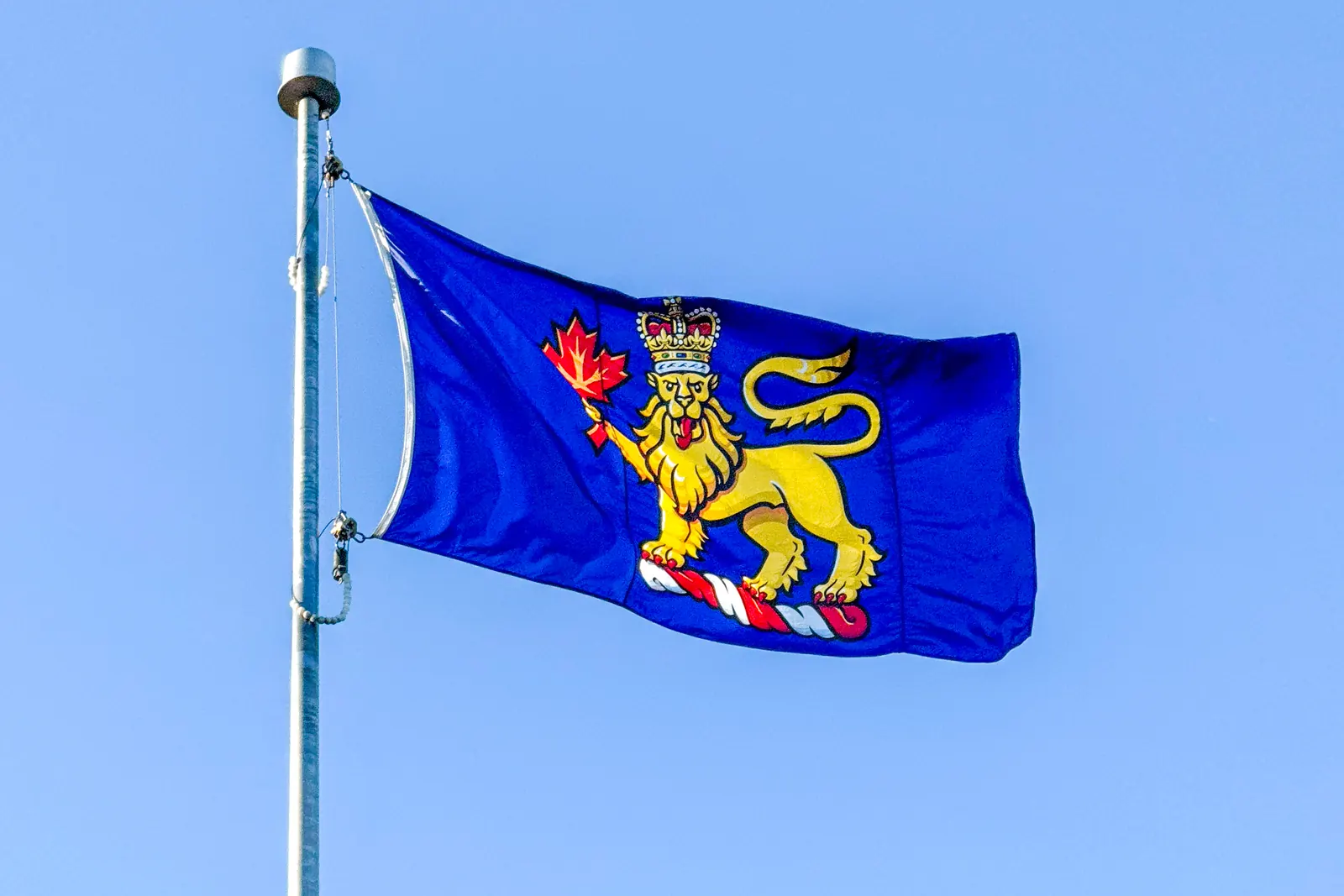
- The Governor General’s flag shows the crest of the Canada Coat of Arms – a crowned lion holding a red maple leaf – on a blue field. It was approved by Queen Elizabeth II in 1981 and stays the same from one Governor General to the next.
- The lieutenant governors of the provinces and the territorial commissioners have their own flags, and the Prince of Wales, the Duke of Edinburgh and the Princess Royal have Personal Canadian Flags.
These flags take precedence over the National Flag where their holders are present, except the commissioners’ flags. They are never flown at half-mast. More in the guide to flag protocol.
Historical flags
The Royal Union Flag was used across British North America and in Canada after Confederation until 1965. The Canadian Red Ensign, a red ensign with the Union Jack and the shield of Canada, was used unofficially at sea and on land from the 1870s and was flown from government buildings until the maple leaf flag replaced it in 1965, but was never formally adopted as the national flag. Under Canadian Heritage’s policy, historical flags are flown only with the National Flag, on their own pole, lower than and away from it, and preferably where research shows a meaningful link between the flag and the place, with information for the public. More in the guide to flagpole history.
Ensigns and other flags
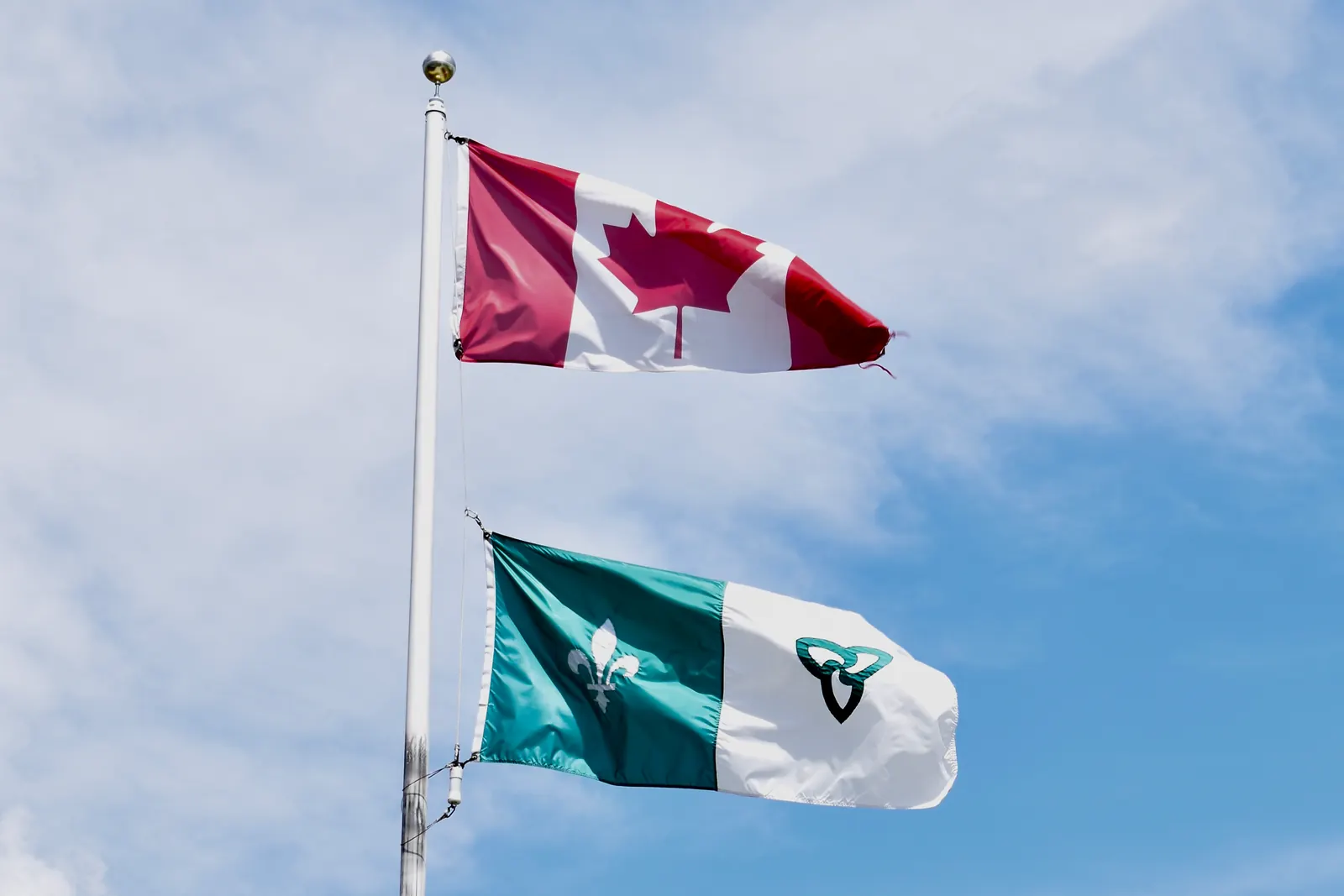
The National Flag of Canada is the proper national colours for Canadian ships and boats, including pleasure craft. The Canadian Armed Forces have their own flags and ensigns, regulated by the Directorate of History and Heritage. Municipalities, organizations and businesses fly their own flags, which rank after the national, provincial and territorial flags. Flag sizes are covered in the guide to flag sizes.
Frequently asked questions
Do all Canadian flags have the same proportions?
No. The National Flag of Canada is 2:1, twice as long as it is wide, and so are most provincial and territorial flags. According to Canadian Heritage, the flags of Québec and Prince Edward Island are 3:2, British Columbia’s is 5:3 and New Brunswick’s 4 by 2½.
Which provincial flags include the Union Jack?
The flags of Ontario, Manitoba and British Columbia. According to Canadian Heritage, the flags of Ontario and Manitoba closely resemble the Canadian Red Ensign, with the Union Jack in the upper quarter nearest the staff and the provincial shield on the fly.
Which is the oldest provincial flag?
According to Canadian Heritage, the flag of Nova Scotia received a royal warrant from King George V in 1929 and was the first flag in the overseas Commonwealth authorized by royal charter. Its design comes from arms granted in 1625. The flag of Québec was adopted in 1948.
What is the King’s Personal Canadian Flag?
A banner of the Royal Arms of Canada, unveiled in May 2023 at the start of the reign of King Charles III. According to Canadian Heritage, it marks the Sovereign’s presence in Canada and has a permanent design that will serve future sovereigns too.
Can the Canadian Red Ensign still be flown?
As a historical flag. According to Canadian Heritage, the Red Ensign was widely used as an emblem of Canada until 1965 but never formally adopted as the national flag, and it has no recognized precedence other than as a historical flag, flown lower than and away from the National Flag.
Sources
This guide is based on the following sources:
- Description of the National Flag of Canada – Canadian Heritage
- Provincial and territorial symbols – Canadian Heritage
- Canadian flags of the Royal Family – Canadian Heritage
- Governor general’s flag – Canadian Heritage
- Historical flags of Canada – Canadian Heritage
- Foreign flags in Canada – Canadian Heritage
- Histoire du drapeau du Québec – Gouvernement du Québec
- Format légal et dimensions courantes – Gouvernement du Québec
Related guides
- Flag sizesWhich flag suits which flagpole in Canada: the federal table of flag and pole sizes, the 2:1 Canadian flag, Québec’s 1:7 rule and sizes in feet.
- The Canadian flagWhat the maple leaf flag means, how it was chosen in the Great Flag Debate of 1964, why the leaf has 11 points, and the flag’s colours and proportions.
- Flag protocolThe order of precedence for flags in Canada, the position of honour with two, three or more flags, provincial and territorial flags and Québec’s rule.
- Flag flying rulesCanadian flag etiquette: who may fly the flag, day and night, on a flagpole, from a building or vertically, and how the flag’s dignity is kept.