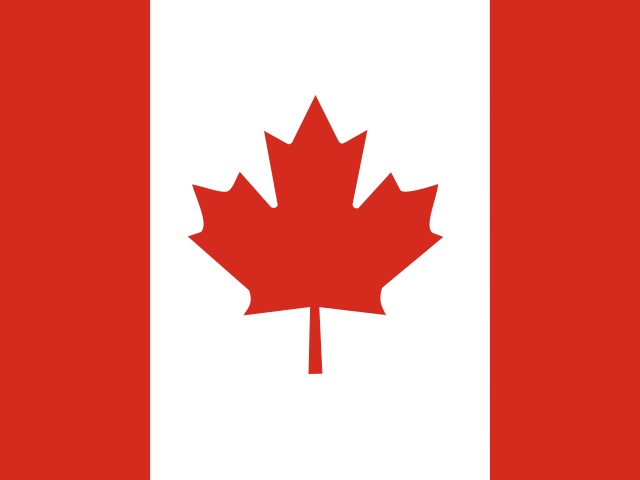
The Canadian flag: meaning, design and history
Published Written by Flagpole Guides

In the words of Canadian Heritage, the red and white maple leaf flag stands out at home and abroad as one of the most recognizable symbols of Canada, but it is relatively young. It was raised for the first time on 15 February 1965, after years of debate about which symbols could represent Canada. Canadian Heritage tells its history and publishes its technical description.
The design
According to Canadian Heritage, the National Flag of Canada is:
- a red flag, twice as long as it is wide (2:1, or 64 units long and 32 units wide in the official diagram)
- with a white square in the centre, the width of the flag
- bearing a single stylized 11-point red maple leaf in the centre
- horizontally symmetric
In heraldic language, its blazon is Gules on a Canadian pale Argent a maple leaf Gules: a red flag with a white vertical band in the middle – in fact a square – with a red maple leaf. Canadian Heritage adds that depictions of the flag respect the 2:1 proportions, the red and white colours and the 11-point leaf to be proper representations of the National Flag.
Red and white
Red and white are Canada’s national colours. According to Canadian Heritage, they have historically been used by many nations, including those that contributed to the founding of Canada. Many Canadians have come to see in them natural features of the country: the white of winter snows and the red of autumn maple leaves.
Why the maple leaf
The maple leaf emerged in the 19th century as a symbol of Canadian identity and appeared on books, songs, coins, badges and banners. During the First World War, it was the cap badge of the Canadian Expeditionary Force and became the most widely recognized emblem of the nation. A single maple leaf is carved on many headstones of Canadian service men and women who died in the two world wars. For many Canadians, it was a shared symbol of pride, courage and loyalty long before it appeared on the flag.
Before the maple leaf
Since the first days of the European presence, the flags of the European homelands, such as France, were displayed in what is now Canada. Before and after Confederation in 1867, Canada used the United Kingdom’s Royal Union Flag. The Canadian Red Ensign – the Union Jack with the shield of Canada – was used unofficially at sea and on land from the 1870s and became a popular patriotic emblem during the First World War. After King George V granted arms to Canada in 1921, the shield of the new coat of arms took its place on the Red Ensign, and this version represented Canada in the Second World War.
The search for a flag
Attempts to choose a new flag in 1925 and 1946 were shelved by Prime Minister William Lyon Mackenzie King, largely for fear of political instability. As a compromise, the Union Jack remained the national flag and the Red Ensign flew from government buildings. In 1956, Canadian peacekeepers in Egypt during the Suez Crisis flew the Red Ensign, which to Egyptian observers looked like the flag of an invading nation – a misunderstanding that, according to Canadian Heritage, strengthened the call for a distinctive Canadian flag.
The Great Flag Debate

In 1963, Prime Minister Lester B. Pearson promised to resolve the flag question in time for the centennial of Confederation in 1967. His own proposal, three red maple leaves on white between two blue stripes, developed by heraldic artist Alan Beddoe and known as the Pearson Pennant, met strong opposition in Parliament in 1964. A 15-member parliamentary committee was given six weeks to recommend a flag; it considered a few thousand designs sent in by Canadians and shortlisted three:
- the Pearson Pennant
- a design with a maple leaf, the Union Jack and the royal banner of France
- George Stanley’s single maple leaf between two red borders
Stanley, Dean of Arts at the Royal Military College in Kingston, had drawn on the college’s own red and white flag, itself inspired by the ribbon of the Canada General Service Medal. On 22 October 1964, the committee voted for his concept. The House of Commons approved it in the early hours of 15 December 1964 by 163 votes to 78, and member of Parliament John Matheson, one of the committee’s leading members, wrote to Stanley that night to congratulate him. The Senate approved shortly after.
Eleven points
Stanley’s concept, rendered by Alan Beddoe, had a leaf with 13 points. It lost its detail when seen from far away or in the wind, so graphic artist Jacques St-Cyr redesigned it with 11 points – the leaf on the flag today.
1965: the flag is raised
Queen Elizabeth II proclaimed the new flag on 28 January 1965. On 15 February 1965, thousands of people gathered on Parliament Hill as the Canadian Red Ensign was lowered and, at the stroke of noon, the maple leaf flag was raised. In 1967, Canada’s centennial year, it was showcased to the world at Expo 67. Since 1996, 15 February has been National Flag of Canada Day. More in the guide to flag days.
Standards for the flag
In 1971, the Canadian Government Specifications Board drew up technical drawings for the construction of physical flags. Today the Canadian General Standards Board maintains three National Standards of Canada for the flag: outdoor use (CAN/CGSB-98.1), indoor use (CAN/CGSB-98.2) and one-event use (CAN/CGSB-98.3). Under the National Flag of Canada Manufacturing Standards Act, federal departments buy flags that meet these standards, and compliant flags bear a mark showing it. More in the guide to buying a flag. The history of Canada’s flags and flagpoles is told in the guide to flagpole history.
Frequently asked questions
What do the colours of the Canadian flag mean?
Red and white are Canada’s national colours. According to Canadian Heritage, they have historically been used by many nations, including those that contributed to the founding of Canada, and many Canadians see in them the white of winter snows and the red of autumn maple leaves.
How many points does the maple leaf on the flag have?
Eleven. George Stanley’s original concept had a 13-point leaf, which was hard to recognize from a distance or in the wind. According to Canadian Heritage, graphic artist Jacques St-Cyr redesigned it with 11 points.
Who designed the Canadian flag?
The flag grew out of a concept by George Stanley, Dean of Arts at the Royal Military College in Kingston, inspired by the college’s red and white flag. A parliamentary committee chose it in October 1964, and it was refined by the committee’s graphic artists and design specialists.
When did the maple leaf flag become Canada’s flag?
The House of Commons approved it on 15 December 1964, followed by the Senate. Queen Elizabeth II proclaimed it on 28 January 1965, and it was raised for the first time on Parliament Hill at noon on 15 February 1965.
What flag did Canada have before 1965?
The Royal Union Flag was used in Canada before and after Confederation until 1965. The Canadian Red Ensign, with the Union Jack and the shield of Canada, was widely used as a national symbol from the 1870s and flown from government buildings, but was never formally adopted as the national flag.
Sources
This guide is based on the following sources:
- The history of the National Flag of Canada – Canadian Heritage
- Description of the National Flag of Canada – Canadian Heritage
- National Flag of Canada Day — February 15 – Canadian Heritage
- Foreign flags in Canada – Canadian Heritage
- National Flag of Canada Manufacturing Standards Act (R.S.C., 1985, c. N-9) – Justice Laws Website
Related guides
- Flagpole historyFlags and flagpoles in Canadian history: New France, the Red Ensign, the fleurdelisé of 1948, the maple leaf of 1965 and the Peace Tower flag.
- Flag typesThe flags of Canada: the maple leaf flag, the ten provincial and three territorial flags with years and proportions, royal and historical flags.
- Flag sizesWhich flag suits which flagpole in Canada: the federal table of flag and pole sizes, the 2:1 Canadian flag, Québec’s 1:7 rule and sizes in feet.
- Flag daysThe days on which the Canadian flag flies at half-mast, beside the Royal Union Flag or on its own anniversary in 2026 and 2027, with the rules behind each date.