How a flagpole works: halyard, pulley, yardarm and tilt base
Published Written by Flagpole Guides
A flagpole is a simple machine: a rope over a wheel. Canadian Heritage’s glossary names the parts – the halyard is the rope that raises or lowers the flag, the pulley the grooved wheel it passes over, the hoist the half of the flag nearest the halyard and the fly the half farthest from it. How these parts are arranged decides whether a flag can be half-masted, how many flags a pole can carry and how the pole is serviced.
Raising and lowering
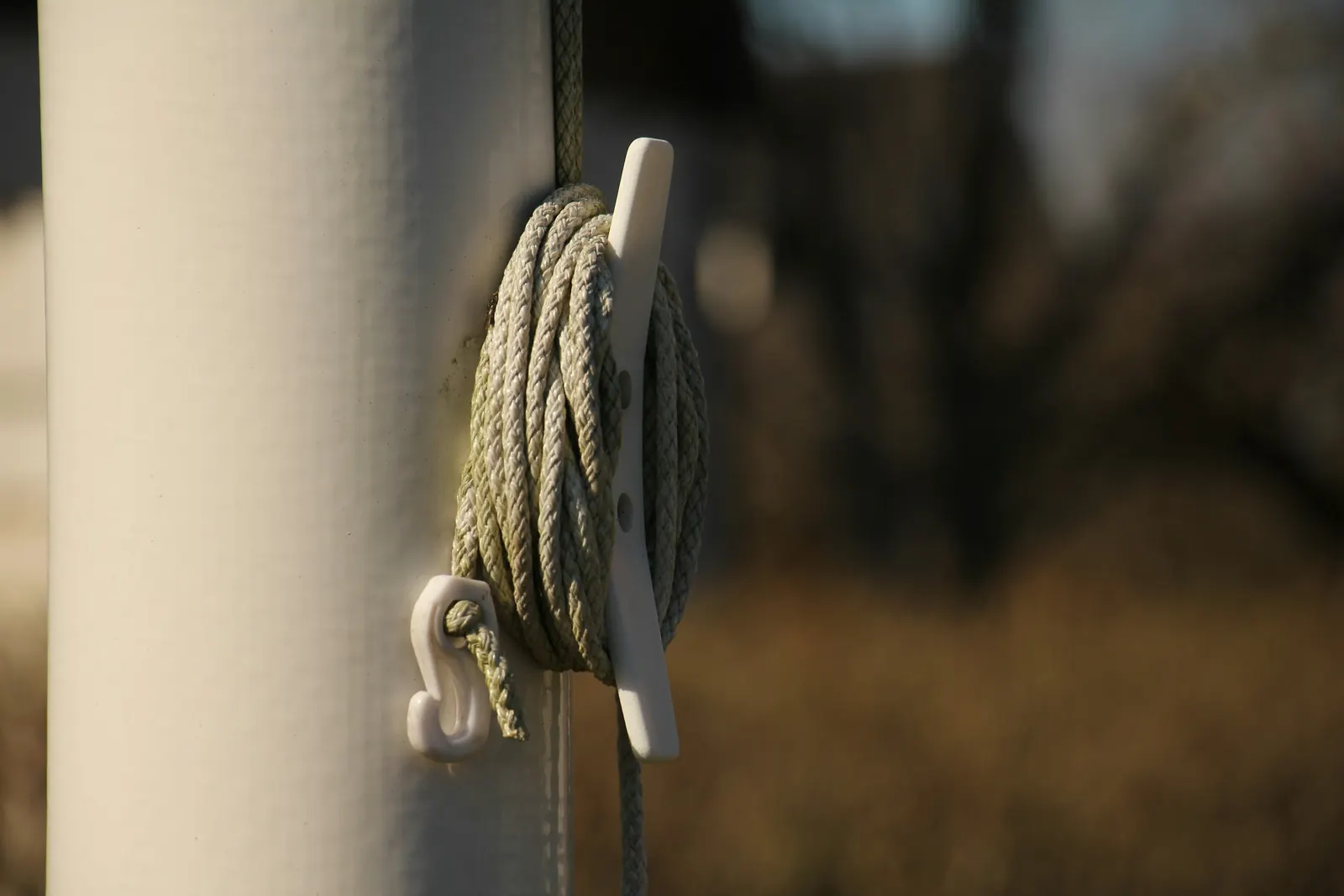
On a standard pole, the halyard is a continuous loop that runs from the base up to the pulley in the truck under the finial and back down. The flag is clipped to it at its top and bottom grommets. Pulling one side of the loop raises the flag; the other side lowers it. According to Canadian Heritage, the flag is raised with the canton as close as possible to the top and the rope taut, and flown with the sleeve or hoist nearest the pole.
- External halyard: the rope runs outside the pole and is tied off on a cleat near the base. According to Flag Outlet’s instructions, loops are tied in the rope so that the wooden toggle on the flag goes through one and the bottom of the flag attaches to the other.
- Internal halyard: a cable runs inside the pole. It is reached through a door opened with a key; a counterweight keeps it taut, and a ring holds the cable close to the pole. The halyard cannot be cut or untied from outside, which protects the flag.
Half-masting
To half-mast, the flag is first raised to the masthead and then lowered slowly until, as a general rule, its centre is halfway down the mast, according to the federal half-masting rules. To take it down, it is raised to the masthead again and then lowered completely. Only poles with a halyard and pulley can do this: flags on horizontal or angled poles without halyards, on which the flag is permanently attached, are not half-masted. More in the guide to half-mast.
A revolving truck
At the top, the truck carries the pulley. On a revolving truck, the top of the pole turns with the wind, so that the flag and halyard do not wrap around the pole. Outdoor poles typically have a ball finial, which according to Canadian Heritage keeps the flag from becoming tangled at the top in strong updrafts.
Yardarm and gaff
A pole with a yardarm – a cross arm – and a gaff – a spar angled up from the mast – can carry several flags, as on a ship. According to Canadian Heritage, flags on such a pole follow numbered positions, with position 1 as the position of honour; positions 3 and 4, at the left and right ends of the yardarm, are not places of honour and are used for a personal or corporate flag or a pennant or burgee. Flag Outlet describes nautical poles with several halyards for a national flag, a provincial flag and a club flag. According to Canadian Heritage, it is improper to fly the National Flag of Canada with another flag of any type on the same flagpole.
Tilt base
On a pole with a tilt base, a pin in the shoe acts as a hinge. According to Flag Outlet, the pole can be tilted down onto a support, the flag can be attached directly to the pole – which prevents theft – and the pole raised again. Work on the truck and pulley can then be done at ground level rather than at height. More in the guide to flagpole safety.
Indoor poles and parade poles
On an interior pole, the flag hangs from a sleeve slid over the pole and is not raised or lowered. Flags carried in procession are on poles of 2.10 to 2.40 m. In ceremonies, flag bearers break a flag – unfurl it with a tug on a string – to mark the arrival of a distinguished person, and military colours may be dipped to salute the Sovereign; the National Flag of Canada is never dipped, according to Canadian Heritage. The parts themselves are described in the guide to flagpole accessories.
Frequently asked questions
How is a flag raised on a flagpole?
The flag is attached to a halyard, a rope or cable that runs over a pulley at the top of the pole. Pulling one side of the halyard raises the flag, and the halyard is then tied off on a cleat or locked inside the pole. Canadian Heritage describes the canton as raised as close as possible to the top, with the rope taut.
Why are flags on some poles not half-masted?
Half-masting needs a halyard and pulley. According to Canadian Heritage, flags on horizontal or angled poles without halyards, on which the flag is permanently attached, are not half-masted.
What is the position of honour on a yardarm?
Canadian Heritage numbers the positions on a flagpole with a yardarm or gaff, with position 1 as the position of honour. The positions at the ends of the yardarm, 3 on the left and 4 on the right, are not the position of honour; they are used for a personal or corporate flag or a pennant or burgee.
What is a tilt base for?
A tilt base has a pin in the shoe that lets the pole be lowered to the ground. According to Flag Outlet, a Canadian flagpole maker, this makes it possible to attach the flag directly to the pole, which prevents theft, and to work on the top of the pole at ground level.
Sources
This guide is based on the following sources:
- Glossary of flag-related terms – Canadian Heritage
- Rules for flying the National Flag of Canada – Canadian Heritage
- Position of honour of the National Flag of Canada – Canadian Heritage
- Half-masting and flag etiquette in times of mourning – Canadian Heritage
- 25’ Flagpole Installation Instructions – Flag Outlet Ltd.
- Nautical Flagpoles – Flag Outlet Ltd.
Related guides
- Flagpole accessoriesThe parts of a flagpole in Canada: finials and their protocol, trucks and pulleys, halyards, snaps and toggles, cleats, sleeves and flag spreaders.
- Types of flagpolesFlagpole types in Canada: in-ground poles with a sleeve or tilt base, sectional and telescoping poles, roof and wall poles and nautical poles.
- Flagpole repairCommon flagpole faults in Canada and their causes: a pole leaning after frost heave, a jammed pulley, a frozen or frayed halyard and worn finishes.
- Flagpole safetyFlagpole safety in Canada: the three-metre rule near power lines, buried cables, Environment Canada’s wind warnings, ice, heights and vandalism.