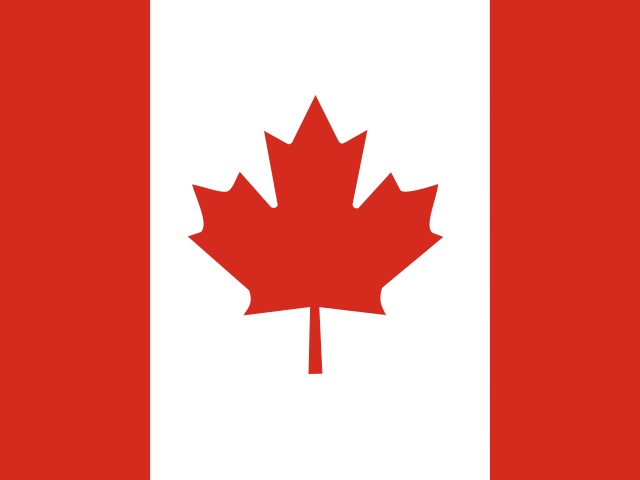
Canadian flag protocol: order of precedence and positions
Published Written by Flagpole Guides
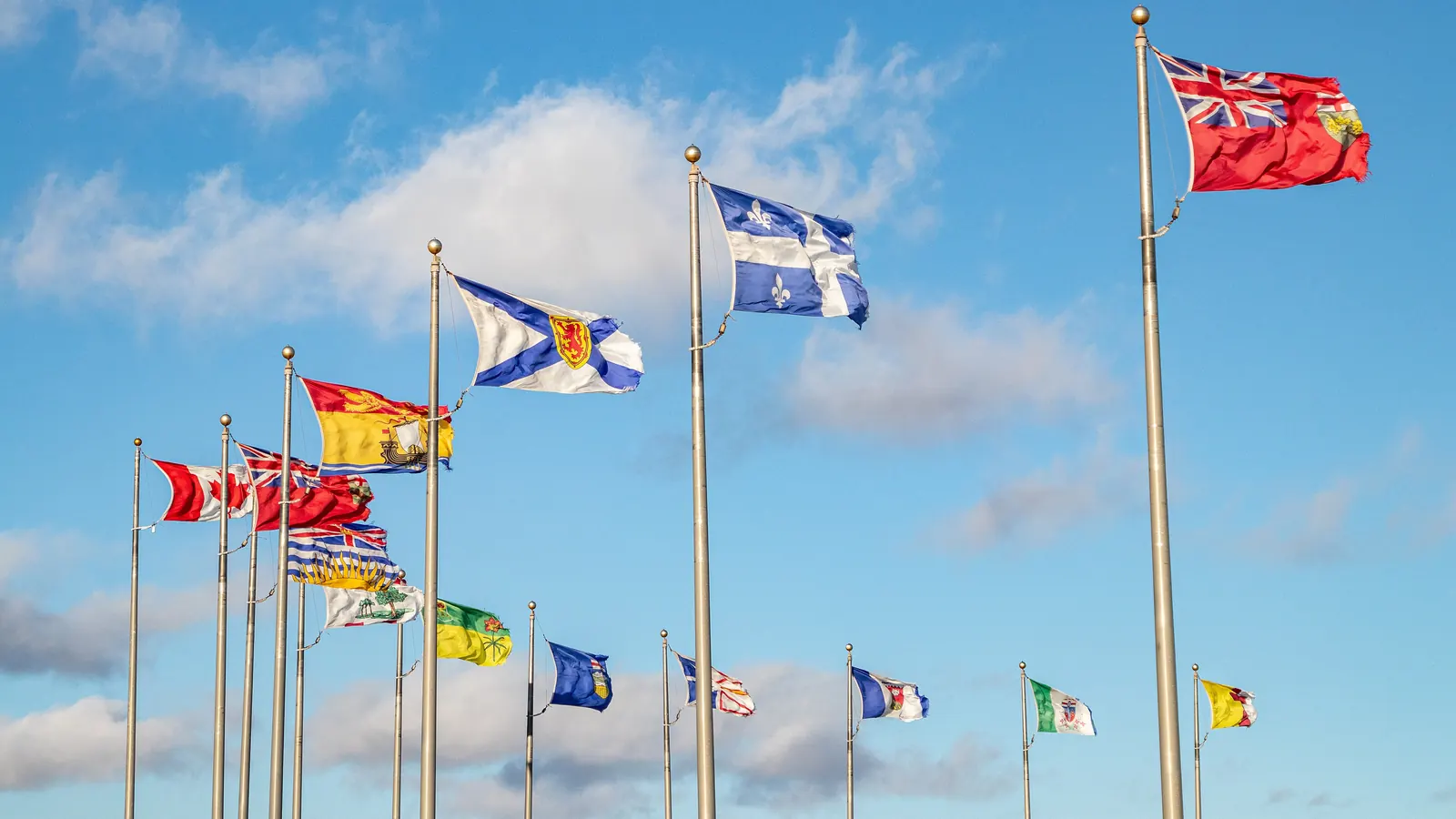
When several flags fly together, their order and position follow a protocol. In Canada, Canadian Heritage sets the order of precedence for federal buildings and institutions, and its rules serve as a guide for provinces, municipalities, schools, businesses and private owners. The Gouvernement du Québec has its own rules for the flag of Québec, and they differ in one important respect.
The order of precedence
According to Canadian Heritage, the order of precedence for flags in Canada is:
- the National Flag of Canada
- the flags of other sovereign nations, in alphabetical order
- the flags of the provinces, in the order in which they joined Confederation
- the flags of the territories, in the order in which they joined Confederation
- the flags of municipalities and cities
- the flags and banners of organizations
- historical flags
Among organizations, the order is international, national, provincial, territorial, regional, municipal and then commercial or private organizations. On Canadian soil, the National Flag takes precedence over all other national flags. No flag may fly higher than the National Flag, except the personal flags described below.
The position of honour
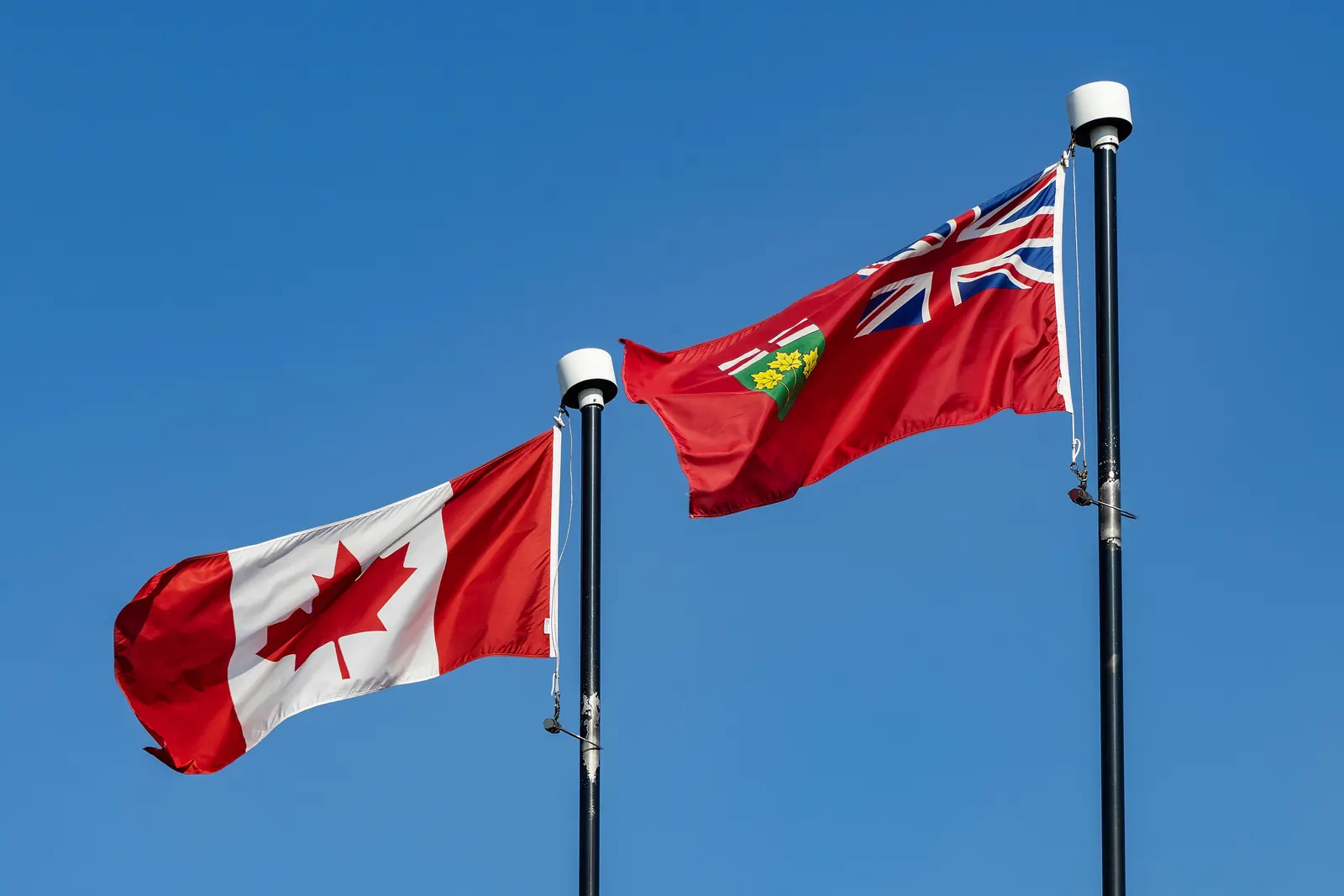
Where the place of honour lies depends on how many flags are displayed:
| Number of flags | Position of honour, seen by an observer facing them |
|---|---|
| 2 | Farthest to the left |
| 3 | In the centre; the second flag to the left, the third to the right |
| More than 3 | Farthest to the left, the others following in order of precedence |
A common set is the National Flag with a provincial or territorial flag and a municipal or organizational flag: the National Flag in the centre, the provincial flag to its left and the municipal or organizational flag to its right, as seen from the front. When there is no order of precedence between the two other flags, they are placed in alphabetical order.
When several national flags are flown, they follow the United Nations order, which uses English alphabetical order, with the National Flag of Canada first on Canadian soil. A second Canadian flag may be added at the right end of a long row to show the symbolic equality of the nations.
Flags of the same size at the same height
All flags in a display fly on separate flagpoles, at the same height, and are about the same size, without changing their proportions. The National Flag is raised first and lowered last, unless all flags can be raised and lowered together. On a row of flagpoles of unequal height, all flags are flown at the same level, with the National Flag in the position of honour. Poles without flags are disregarded when working out the order.
Rows of flagpoles outside a building
- A row of flagpoles ideally runs parallel to the building’s frontage, in order of precedence as seen by approaching visitors.
- In a row perpendicular to the frontage, approached from the front, the first flag seen by visitors has precedence.
- In a semi-circle, the National Flag is in the leftmost position as seen from the main approach; in a closed circle, it is in the central, most prominent position.
- When a single National Flag flies at a building with several poles, it is flown on the pole identified as the place of honour.
- Where a group of buildings functions as a unit, a single flag or display of flags can represent the whole complex.
The provincial and territorial flags
According to Canadian Heritage, provincial flags follow the date of entry into Confederation, and for provinces that joined on the same date, their population at the time of entry. The territories follow in order of creation:
| Order | Province or territory | Entry |
|---|---|---|
| 1 | Ontario | 1867 |
| 2 | Québec | 1867 |
| 3 | Nova Scotia | 1867 |
| 4 | New Brunswick | 1867 |
| 5 | Manitoba | 1870 |
| 6 | British Columbia | 1871 |
| 7 | Prince Edward Island | 1873 |
| 8 | Saskatchewan | 1905 |
| 9 | Alberta | 1905 |
| 10 | Newfoundland and Labrador | 1949 |
| 11 | Northwest Territories | 1870 |
| 12 | Yukon | 1898 |
| 13 | Nunavut | 1999 |
Along a wall, the National Flag starts on the left, followed by the provinces and territories. Flanking an entrance or in a “V”, the National Flag is at the start or in the centre, and the others alternate sides, starting from the left.
Personal flags
A few flags take precedence over the National Flag, on the buildings where their holders are in residence or attending a function: The King’s Personal Canadian Flag, the Governor General’s flag, the lieutenant governors’ flags within their provinces and the Personal Canadian Flags of other members of the Royal Family. When The King arrives on Parliament Hill, for instance, His Majesty’s flag replaces the National Flag on the Peace Tower for the duration of the visit. The territorial commissioners’ flags do not displace the National Flag or the territorial flag. More in the guide to flag types.
The rule in Québec
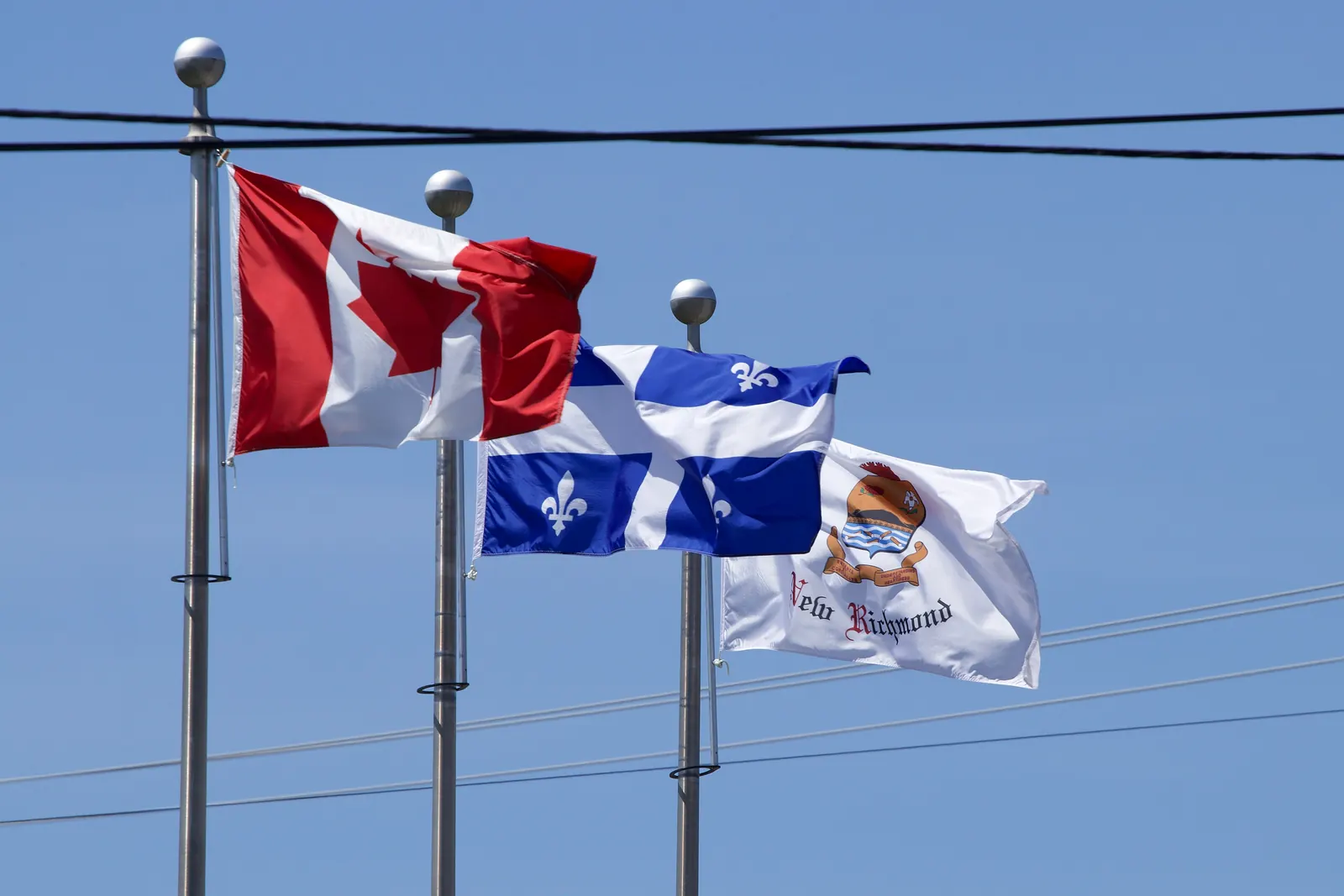
According to Canadian Heritage, the Government of Québec has decreed that on all buildings under its authority in Québec – ministries, boards, schools and others, as well as city halls – the flag of Québec takes precedence over the National Flag of Canada and occupies the place of honour. This does not apply to federal property in Québec, where the National Flag keeps precedence.
The Gouvernement du Québec’s own rules use the same positions: to the left of the observer with two flags, in the centre with three, and at the left end of the row with more than three. With more than three flags, however, the others follow French alphabetical order by the country’s usual name. Canadian provinces and territories are placed by their date of entry into Confederation, not alphabetically. For questions about flags other than the flag of Québec, the Protocole of the Ministère des Relations internationales et de la Francophonie advises public bodies.
Historical flags
Historical flags, such as the Canadian Red Ensign or the flags of New France, are flown lower than and away from the National Flag, according to Canadian Heritage’s policy on historical flags: the top edge of a historical flag never rises above the lower edge of the National Flag, and the National Flag is always flown when historical flags are. More about other nations’ flags is in the guide to foreign flags in Canada.
Frequently asked questions
What is the order of precedence for flags in Canada?
According to Canadian Heritage: the National Flag of Canada, the flags of other sovereign nations in alphabetical order, the provincial flags in the order the provinces joined Confederation, the territorial flags, the flags of municipalities, the flags and banners of organizations, and historical flags.
Where is the position of honour?
With two flags, it is the flag farthest to the left as seen by an observer facing them. With three flags, it is the centre. With more than three, it is again the farthest to the left, according to Canadian Heritage.
In what order are the provincial flags flown?
In the order the provinces joined Confederation: Ontario, Québec, Nova Scotia and New Brunswick (1867), Manitoba (1870), British Columbia (1871), Prince Edward Island (1873), Saskatchewan and Alberta (1905), Newfoundland and Labrador (1949), followed by the Northwest Territories, Yukon and Nunavut.
Does the flag of Québec take precedence over the Canadian flag?
On buildings under the authority of the Government of Québec, including city halls, yes. According to Canadian Heritage, the Government of Québec has decreed that the flag of Québec occupies the place of honour there; on federal property in Québec, the National Flag of Canada keeps precedence.
Which flags rank above the Canadian flag?
Only personal flags: the King’s Personal Canadian Flag, the Governor General’s flag, the lieutenant governors’ flags within their provinces and the Personal Canadian Flags of other members of the Royal Family, on the buildings where they are in residence or attending a function, according to Canadian Heritage.
Sources
This guide is based on the following sources:
- Position of honour of the National Flag of Canada – Canadian Heritage
- Historical flags of Canada – Canadian Heritage
- Governor general’s flag – Canadian Heritage
- Place d’honneur – Gouvernement du Québec
- Règles générales d’utilisation du drapeau national – Gouvernement du Québec
Related guides
- Foreign flags in CanadaHow flags of other nations are flown in Canada: the Canadian flag’s place, the Union Jack’s three roles, the UN, NATO and Commonwealth flags.
- Flags in mourningFlags in mourning in Canada: half-masting for the Sovereign and public figures, the flag on a casket, the black cravat and flags given to families.
- Flag typesThe flags of Canada: the maple leaf flag, the ten provincial and three territorial flags with years and proportions, royal and historical flags.
- Flagpoles for businessesCompany flags at Canadian businesses: the order beside national and provincial flags, sign bylaws for flag signs and the Trademarks Act.