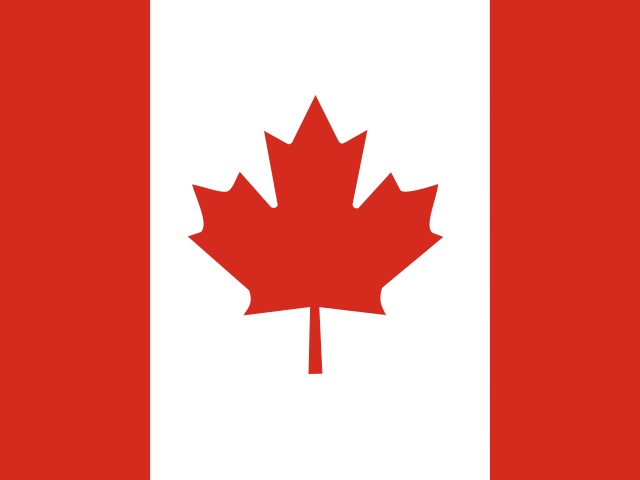
Foreign flags in Canada
Published Written by Flagpole Guides

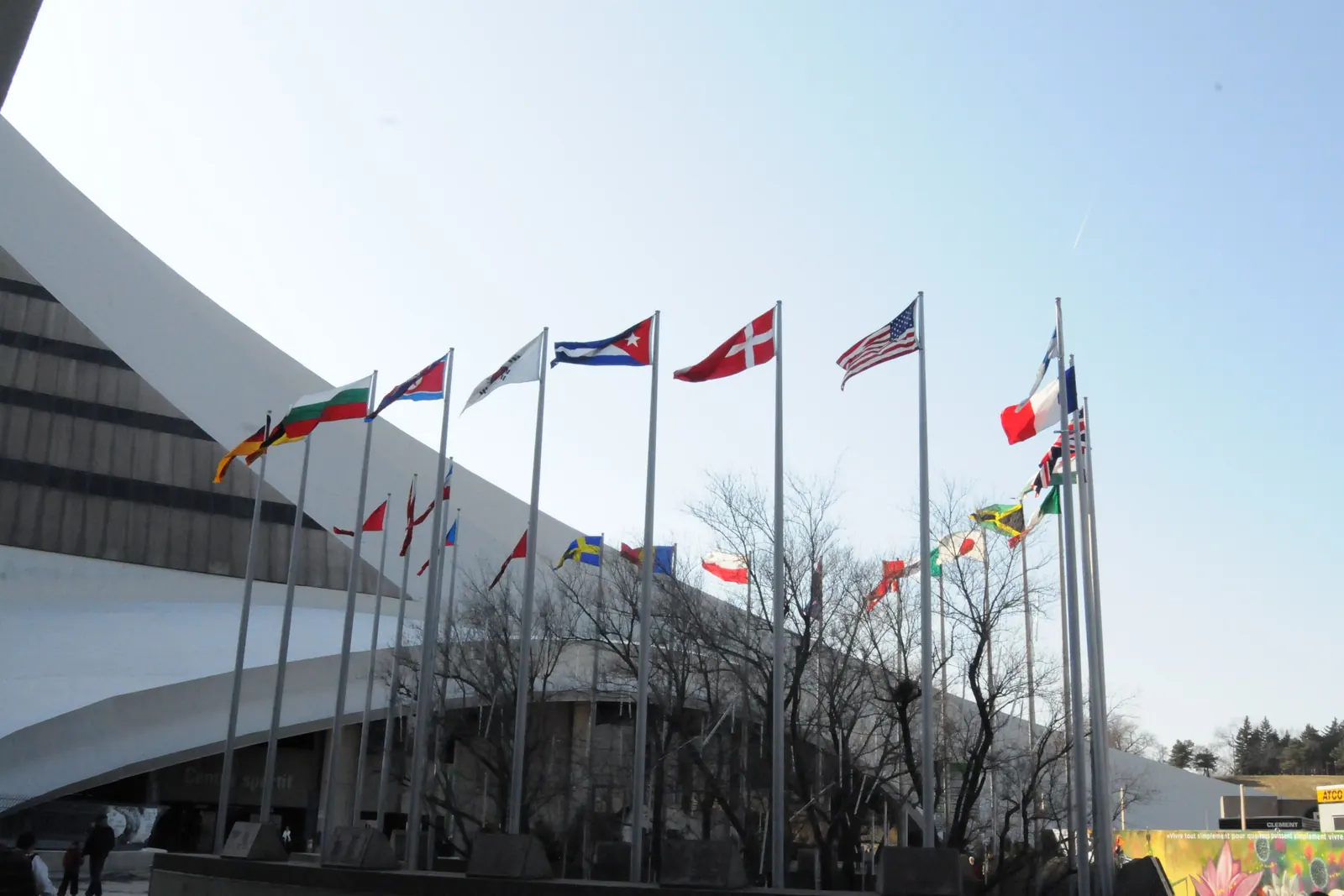
Flags of other nations fly in Canada at embassies and consulates, international meetings, sports events, cultural festivals, hotels and businesses. Canadian Heritage sets out how foreign flags are displayed with the National Flag of Canada at federal buildings, and its rules are widely used as a guide by others.
The Canadian flag first
According to Canadian Heritage, the National Flag of Canada always takes precedence over all other national flags when flown on Canadian soil. When flags of several nations are displayed:
- every flag, including the National Flag, flies on its own flagpole
- all flags fly at the same height and are about the same size, without changing their proportions
- the National Flag is in the position of honour: farthest to the left with two flags, in the centre with three, and farthest to the left with more than three, as seen by an observer facing them
- the other national flags follow the United Nations order, which uses English alphabetical order
- a second Canadian flag may be added at the right end of a long row to show the symbolic equality of the nations
- the National Flag is raised first and lowered last, unless all flags can be raised and lowered together
The full order of precedence, from national flags to provincial, municipal and organizational flags, is in the guide to flag protocol.
The Royal Union Flag
The Royal Union Flag, commonly called the Union Jack, has three roles in Canada, according to Canadian Heritage:
- It is the national flag of the United Kingdom. In this role, it takes precedence over the provincial and territorial flags, like any sovereign nation’s flag.
- It is flown as a symbol of Canada’s membership in the Commonwealth and allegiance to the Crown, for example during a royal visit. In this role, the provincial and territorial flags take precedence over it.
- It is a historical flag, used by Canada as a national flag before 1965. In this role, it has no precedence over flags in current use.
Where there are at least two flagpoles, the Union Jack flies beside the National Flag at federal buildings, airports and military bases from sunrise to sunset on Commonwealth Day (the second Monday in March), Victoria Day and 11 December, the anniversary of the Statute of Westminster. It may also fly at the National War Memorial and similar places at ceremonies marking events in which the Canadian Armed Forces served with other Commonwealth forces. The National Flag is never replaced by it. The Union Jack also lives on in the provincial flags of Ontario, Manitoba and British Columbia.
The Canadian Red Ensign, widely used as an emblem of Canada from Confederation until 1965, was never formally adopted as the national flag. According to Canadian Heritage, it has no recognized precedence today other than as a historical flag.
Flags of international organizations
- United Nations: the UN flag is flown with the National Flag on Parliament Hill on United Nations Day, 24 October, and by special arrangement, such as visits by the Secretary-General.
- NATO: Canada has been a member since the treaty was signed on 4 April 1949. According to Canadian Heritage, the NATO flag is not flown on any specific day.
- Commonwealth: the Commonwealth flag has no official status and is flown at the Commonwealth Secretariat and at Commonwealth events. As the Union Jack is flown on Commonwealth Day, there is no specific day for the Commonwealth flag in Canada.
Finials on poles with foreign flags
On indoor flagpoles, the finial matters. According to Canadian Heritage, foreign flags are mounted on poles with a spear point or acorn finial, not a maple leaf finial, and it is not appropriate to fly the flag of a sovereign nation from a pole bearing a maple leaf. When Canadian and foreign flags are displayed together, it is preferable for all poles to have the same finial. More in the guide to flagpole accessories.
Half-mast and foreign flags
When the National Flag of Canada is half-masted, all flags in the immediate vicinity or part of the same flag group are half-masted as well. On the death of a foreign head of state or head of government, the Prime Minister may approve half-masting on the Peace Tower, and Canada’s embassies and high commissions abroad may half-mast the flag in line with the practice of the host country.
Foreign flags in Québec
For displays with the flag of Québec, the Gouvernement du Québec places the flag of Québec in the position of honour; with more than three flags, the other flags follow French alphabetical order by the country’s usual name. The Protocole of the Ministère des Relations internationales et de la Francophonie advises public bodies on displaying flags other than the flag of Québec, particularly flags of international organizations and federated states. Company and event flags are covered in the guide to flagpoles for businesses.
Frequently asked questions
Can a foreign flag be flown in Canada?
Yes. Canadian Heritage’s rules describe how foreign flags are displayed with the National Flag. According to the department, the National Flag of Canada always takes precedence over other national flags on Canadian soil, so when the two fly together the Canadian flag is in the position of honour, on its own pole and at the same height.
Is the Union Jack a foreign flag in Canada?
It has three roles, according to Canadian Heritage: the national flag of the United Kingdom, a symbol of Canada’s membership in the Commonwealth and allegiance to the Crown, and a historical flag used by Canada before 1965. Its precedence depends on the role in which it is flown.
In what order are several foreign flags flown?
According to Canadian Heritage, several national flags follow the United Nations order of precedence, which uses English alphabetical order, with the National Flag of Canada first on Canadian soil. The Gouvernement du Québec’s rules for the flag of Québec use French alphabetical order instead.
Can a foreign flag fly on a pole with a maple leaf finial?
According to Canadian Heritage, it is not appropriate to fly the flag of a sovereign nation from a flagpole bearing a maple leaf finial. Foreign flags on interior poles are mounted on poles with a spear point or acorn finial, and in a mixed display all poles preferably have the same finial.
When is the United Nations flag flown in Canada?
According to Canadian Heritage, the United Nations flag is flown with the National Flag of Canada on Parliament Hill on United Nations Day, 24 October, and by special arrangement on other occasions, such as visits by the UN Secretary-General.
Sources
This guide is based on the following sources:
- Foreign flags in Canada – Canadian Heritage
- Position of honour of the National Flag of Canada – Canadian Heritage
- Rules for flying the National Flag of Canada – Flagpole finials – Canadian Heritage
- Rules for half-masting the National Flag of Canada – Canadian Heritage
- Place d’honneur – Gouvernement du Québec
Related guides
- Flag protocolThe order of precedence for flags in Canada, the position of honour with two, three or more flags, provincial and territorial flags and Québec’s rule.
- Flagpoles for businessesCompany flags at Canadian businesses: the order beside national and provincial flags, sign bylaws for flag signs and the Trademarks Act.
- Flag daysThe days on which the Canadian flag flies at half-mast, beside the Royal Union Flag or on its own anniversary in 2026 and 2027, with the rules behind each date.
- Flag flying rulesCanadian flag etiquette: who may fly the flag, day and night, on a flagpole, from a building or vertically, and how the flag’s dignity is kept.