Flying flags on public holidays in Canada
Published Written by Flagpole Guides

Public holidays in Canada are set at two levels. The federal Holidays Act makes three days legal holidays throughout Canada: Canada Day, Victoria Day and Remembrance Day. Which days are paid holidays for workers is decided by the Canada Labour Code for federally regulated workplaces and by provincial and territorial employment laws for everyone else. How the flag is flown on these days follows the federal flag rules of Canadian Heritage, which apply to federal buildings and are widely followed by others.
The federal general holidays
Section 166 of the Canada Labour Code lists the general holidays for federally regulated workplaces. The table shows how the National Flag is flown on each of them at federal buildings.
| Holiday | Date | The flag on federal buildings |
|---|---|---|
| New Year’s Day | 1 January | National Flag |
| Good Friday | Friday before Easter | National Flag |
| Victoria Day | Monday before 25 May | Full mast, with the Royal Union Flag beside it where there are two poles |
| Canada Day | 1 July | Full mast, even during a period of half-masting |
| Labour Day | First Monday in September | National Flag |
| National Day for Truth and Reconciliation | 30 September | Half-mast from sunrise to sunset |
| Thanksgiving Day | Second Monday in October | National Flag |
| Remembrance Day | 11 November | Half-mast |
| Christmas Day | 25 December | National Flag |
| Boxing Day | 26 December | National Flag |
The Canada Revenue Agency also recognizes Easter Monday and, outside Québec, the Civic Holiday on the first Monday in August, and in Québec the Saint-Jean-Baptiste Day on 24 June.
Canada Day
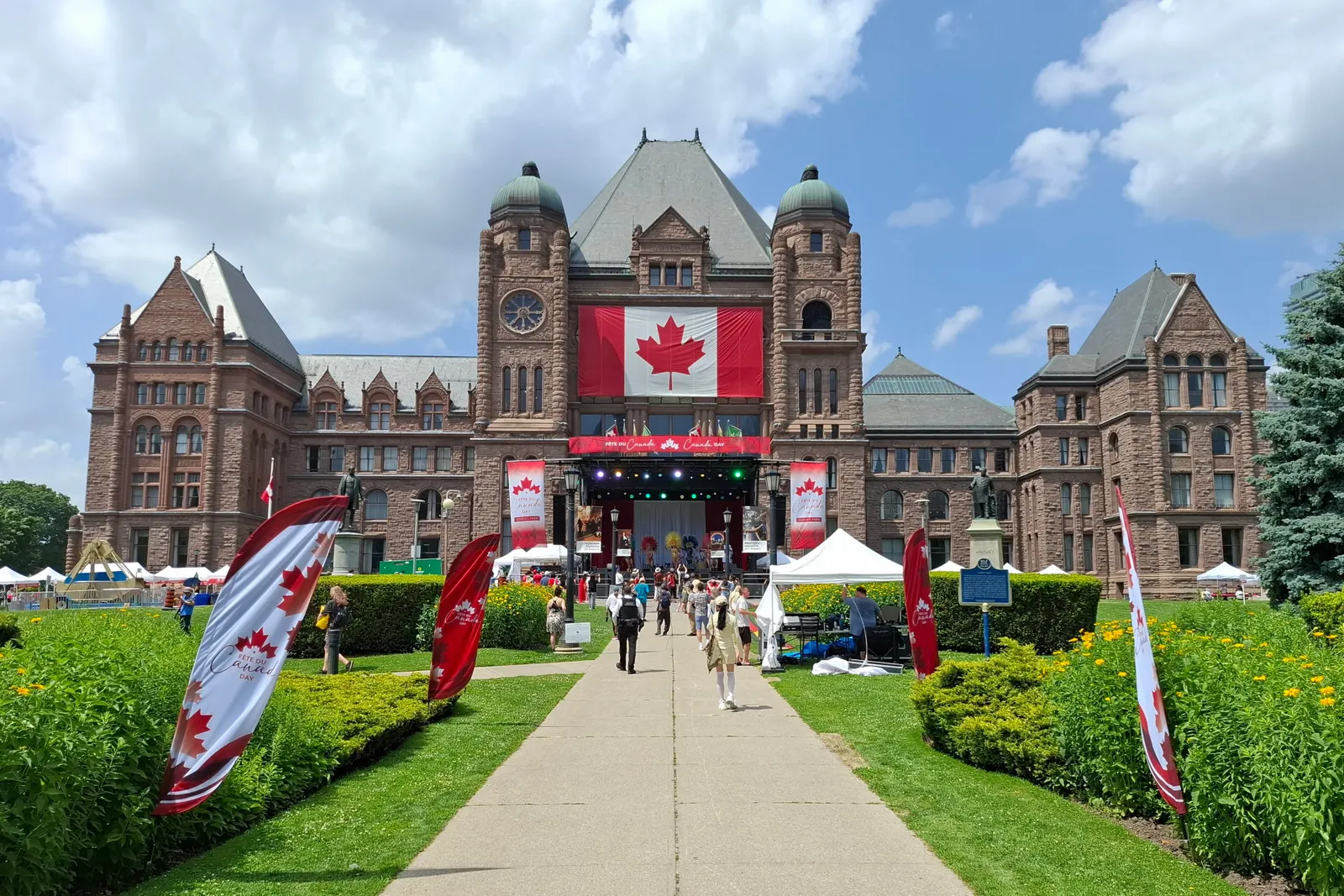
Canada Day is 1 July. Under the Holidays Act, when 1 July falls on a Sunday, 2 July is the legal holiday. Section 19 of the federal half-masting rules keeps the flag at full mast on Canada Day even while it is otherwise half-masted – unless the half-masting is for the death of the Sovereign, the Governor General or the Prime Minister.
Victoria Day
Victoria Day, the Monday immediately preceding 25 May, is the official observance of the Sovereign’s birthday. On that day, the Royal Union Flag flies beside the National Flag from sunrise to sunset at federal buildings, airports and military bases where there are at least two flagpoles, according to Canadian Heritage. Like Canada Day, Victoria Day is a day of full mast under section 19 of the half-masting rules. More in the guide to foreign flags in Canada.
Remembrance Day
Remembrance Day, 11 November, marks the armistice of 1918. The federal rules list it among the half-masting days: the flag flies at half-mast from sunrise to sunset on federal buildings, while at the National War Memorial and other places where remembrance is observed, half-masting can take place at 11:00 or according to the order of service. The dates of all half-masting days are in the guide to flag days.
The National Day for Truth and Reconciliation
Since 2021, 30 September has been the National Day for Truth and Reconciliation, created by an act of Parliament in response to call to action number 80 of the Truth and Reconciliation Commission, to honour First Nations, Inuit and Métis survivors of residential schools and their families and communities. It is a general holiday under the Canada Labour Code, and the federal rules list it among the half-masting days, from sunrise to sunset.
Provincial holidays
Beyond the federal holidays, each province and territory sets its own. The Canada Revenue Agency’s list of public holidays names Saint-Jean-Baptiste Day on 24 June in Québec, the Fête nationale, and the Civic Holiday in August outside Québec. The federal flag rules have no special provisions for provincial holidays; provincial governments set the flag protocol for their own buildings. The provincial and territorial flags are presented in the guide to flag types.
On Parliament Hill
According to Canadian Heritage, the flags on Parliament Hill are not changed on statutory holidays, nor during poor weather such as snowstorms or high winds, for safety reasons. On working days, the flag on the Peace Tower is replaced every day, and the others once a week. More in the guide to flag flying rules.
Frequently asked questions
Which public holidays apply everywhere in Canada?
The Holidays Act makes Canada Day, Victoria Day and Remembrance Day legal holidays throughout Canada. Which days are paid holidays for workers is set by the Canada Labour Code for federally regulated workplaces and by provincial and territorial law for everyone else.
Is the flag at half-mast on Remembrance Day?
Yes, on federal buildings. The Rules for half-masting the National Flag of Canada list 11 November among the special days, from sunrise to sunset. At the National War Memorial and other places where remembrance is observed, half-masting can take place at 11:00 or according to the order of service.
Is the flag at full mast on Canada Day even during mourning?
Under section 19 of the federal half-masting rules, a flag at half-mast is nevertheless flown at full mast on Victoria Day and Canada Day. The exception does not apply after the death of the Sovereign, the Governor General or the Prime Minister.
What happens to the flag on the National Day for Truth and Reconciliation?
On 30 September, the National Flag of Canada flies at half-mast from sunrise to sunset on all federal buildings and establishments, including the Peace Tower, under section 11 of the federal half-masting rules. The day is also a general holiday under the Canada Labour Code.
Are Parliament Hill flags changed on holidays?
According to Canadian Heritage, the Parliament Hill flags are not changed on statutory holidays or, for safety reasons, during poor weather such as snowstorms or high winds. On working days, the flag on the Peace Tower is changed every day.
Sources
This guide is based on the following sources:
- Holidays Act (R.S.C., 1985, c. H-5) – Justice Laws Website
- Canada Labour Code, section 166 – Justice Laws Website
- Public holidays – Canada Revenue Agency
- Rules for half-masting the National Flag of Canada – Canadian Heritage
- Parliament Hill flags – Canadian Heritage
- An Act to amend the Bills of Exchange Act, the Interpretation Act and the Canada Labour Code (National Day for Truth and Reconciliation) – Justice Laws Website
Related guides
- Flag daysThe days on which the Canadian flag flies at half-mast, beside the Royal Union Flag or on its own anniversary in 2026 and 2027, with the rules behind each date.
- Flag flying rulesCanadian flag etiquette: who may fly the flag, day and night, on a flagpole, from a building or vertically, and how the flag’s dignity is kept.
- Flag typesThe flags of Canada: the maple leaf flag, the ten provincial and three territorial flags with years and proportions, royal and historical flags.
- Flag lightingCan the Canadian flag fly at night without lights? What Canadian Heritage and Québec say, and who may do outdoor electrical work in Ontario and Québec.