
Types of flagpoles in Canada – an overview
Published Written by Flagpole Guides
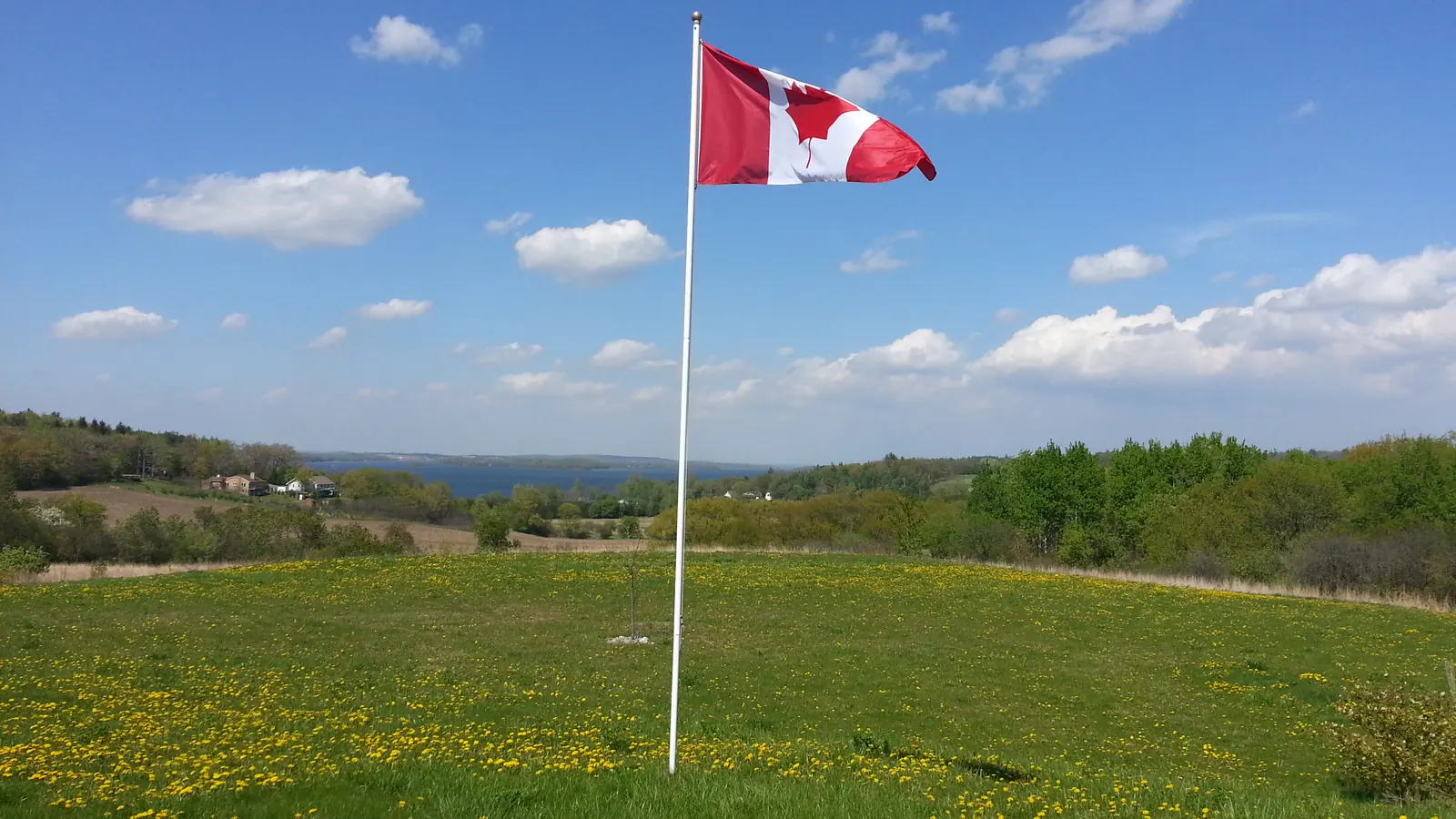
A flagpole in Canada can be anything from a sectional pole on a cottage dock to a 15-metre pole in front of a city hall. Canadian Heritage divides flagpoles into three broad categories: exterior permanent poles, located outside a building, on top of it or on the adjacent grounds; exterior portable poles; and interior poles. Within the first category, poles differ in how they are anchored, how the flag is raised and how many flags they carry.
In-ground poles with a sleeve or anchor base
The most common permanent pole stands in the ground on a concrete footing. There are two usual ways of anchoring it:
- Ground sleeve: a tube is set in concrete, and the pole is inserted into it. The pole can later be lifted out for maintenance or replacement.
- Anchor base: anchor bolts are cast in the concrete, and the pole’s shoe is bolted onto them. According to the installation instructions of Flag Outlet, a flagpole maker in Coquitlam, B.C., the anchor bolt assembly is set level in the wet concrete and the pole is later placed on it by crane or tilted up.
With a tilt base, a pin in the shoe lets the pole be lowered to the ground. Flag Outlet notes that a flag can then be attached directly to the pole, which prevents theft. In a country with cold winters, the depth of the footing matters; the guide to installing a flagpole covers footings and the frost line.
Straight and tapered poles
Poles are either straight along their whole length or tapered, narrower at the top. Flag Outlet makes cone-tapered and step-tapered poles: a cone-tapered aluminum pole narrows by one inch for every 5.5 feet, and a step-tapered pole is made of sections of decreasing diameter. Tapered poles are often used for taller commercial and institutional poles.
Sectional and telescoping poles
Sectional poles come in parts that join together; telescoping poles slide into each other. According to Flag Outlet, its 18- and 22-foot sectional poles are designed for condo and townhouse sales offices, residential backyards, cottages and docks, and its 20-foot telescoping pole for events, trade shows and homes, with a collar that prevents the pole from being lowered without permission. They are easy to carry and store. More in the guide to transporting a flagpole.
Roof, wall and angled poles

On large buildings, the Gouvernement du Québec’s guidance for public buildings prefers the roof, at the highest point, the centre of the building or above its main façade, well clear of the roof line. The mast is fixed directly to the roof or, if attached to a parapet, to its inner face. On tall buildings, and on small buildings such as a local office, an angled staff (hampe oblique) above or near the entrance keeps the flag visible to passers-by. Zoning bylaws can set limits: in residential zones in Toronto, a flagpole on a roof may exceed the building’s permitted height by 1.5 metres.
Canadian Heritage points out that flags on horizontal or angled poles without halyards, on which the flag is permanently attached, are not half-masted. A flag hung at an angle from a window or balcony is hung as on a pole, with the canton at the top and the maple leaf pointing outward.
Nautical poles with yardarm and gaff
A nautical flagpole is modelled on a ship’s mast, with a yardarm, a cross arm, and often a gaff. According to Canadian Heritage, adding a yardarm or gaff lets a single pole display more flags, a practice frequently used by naval establishments on land and inspired by flags on board ships; the flags then follow a set order of positions. Flag Outlet describes nautical poles as suited to coastal and island regions, yacht clubs and marine businesses, with several halyards for the national flag, a provincial flag and a club flag.
External or internal halyard
- External halyard: the rope runs outside the pole, through a pulley at the top, and is tied to a cleat. It is simple and easy to reach, but the rope can slap against the pole in the wind.
- Internal halyard: a cable runs inside the pole and is reached through a locked door. The Gouvernement du Québec’s guidance suggests an internal halyard with a locking device wherever a pole is accessible to the public, to protect the mechanism and prevent vandalism.
Canadian Heritage recommends that exterior permanent poles be fitted with a hoisting device such as a halyard and pulley, so that flags can easily be raised, lowered and half-masted. How the parts work is explained in the guide to how a flagpole works.
Portable and interior poles
Portable poles on weighted bases are used for events and temporary sales. Interior poles stand in offices, council chambers, schools and places of worship; the flag hangs from them rather than flies, and the pole is topped by a finial. Flags carried in procession are on poles of 2.10 to 2.40 m. Materials are compared in the guide to flagpole materials.
Frequently asked questions
What types of flagpoles are there?
Canadian Heritage divides flagpoles into exterior permanent poles, on or beside a building, exterior portable poles and interior poles. Among permanent poles, the main types are in-ground poles set in a sleeve or on an anchor base, sectional and telescoping poles, roof and wall-mounted poles and nautical poles with a yardarm.
What is the difference between an internal and an external halyard?
With an external halyard, the rope runs outside the pole and is tied to a cleat. With an internal halyard, a cable runs inside the pole and is reached through a door with a key. The Gouvernement du Québec’s guidance for public buildings suggests an internal halyard with a locking device where the pole is accessible to the public, to prevent vandalism.
What is a nautical flagpole?
A flagpole in the style of a ship’s mast, with a yardarm, a cross arm, and often a gaff. It can carry several flags. According to Canadian Heritage, this arrangement is often used by naval establishments on land and is inspired by the display of flags on board ships.
Can a flagpole be put on a roof?
Yes. The Gouvernement du Québec’s guidance for public buildings prefers the roof where possible, with the mast fixed directly to the roof or to the inner face of a parapet, and the height of the building and the capacity of the structure taken into account. Municipal zoning bylaws may limit how far a rooftop pole rises above the building.
Sources
This guide is based on the following sources:
- Rules for flying the National Flag of Canada – On a flagpole – Canadian Heritage
- Déploiement du drapeau à l’extérieur d’un édifice – Gouvernement du Québec
- Sectional & Telescoping Flagpoles – Flag Outlet Ltd.
- Nautical Flagpoles – Flag Outlet Ltd.
- 25’ Flagpole Installation Instructions – Flag Outlet Ltd.
- City of Toronto Zoning By-law 569-2013, Chapter 10 – City of Toronto
Related guides
- Flagpole materialsFlagpole materials in Canada – aluminum, fibreglass, steel and wood – how they differ, which finishes exist and what the Canadian climate means.
- Flagpole heightsCommon flagpole heights in Canada in metres and feet, the federal table of pole lengths and flag sizes, and examples of municipal height limits.
- How a flagpole worksHow a flagpole works: raising the flag with a halyard and pulley, internal and external halyards, half-masting, yardarms and tilt bases.
- Flagpole accessoriesThe parts of a flagpole in Canada: finials and their protocol, trucks and pulleys, halyards, snaps and toggles, cleats, sleeves and flag spreaders.