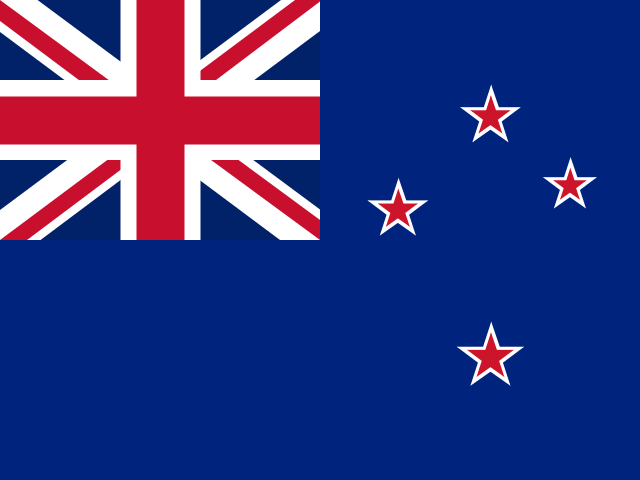
New Zealand flag protocol: position of honour and order of flags
Published Written by Flagpole Guides

When several flags fly together, the display rules of Manatū Taonga – Ministry for Culture and Heritage (MCH) set out which flag goes where. The basic rule is that, except when flown with royal or vice-regal flags, the New Zealand flag is always given the position of honour in New Zealand and takes precedence over all other national flags and house flags. International practice, MCH adds, forbids flying the flag of one country above the flag of another in peacetime.
The order of flags

From left to right, as seen by a person facing the flags, MCH gives this order:
- The New Zealand flag
- Flags of other countries, in alphabetical order
- House flags, the flags of companies, clubs and other organisations.
In special circumstances, the flags of Commonwealth countries may take precedence over other foreign flags, also in alphabetical order. The Governor-General’s flag is flown on all occasions when the Governor-General is present and takes precedence over the New Zealand flag. The Union Jack is of equal rank with other national flags, and according to MCH it is only appropriate to fly it where a direct link with the United Kingdom exists or to recognise a distinguished British visitor.
Flagpoles at a building
MCH describes two situations:
- Two or more flagpoles parallel to the building line: the New Zealand flag is the first flag on the left as seen by a person looking at the main entrance.
- Two or more flagpoles on a forecourt at an angle to the main entrance: the New Zealand flag flies on the outermost pole when the flagpoles are to the left of the entrance, and on the innermost pole when they are to the right.
Circles of flags
- Semi-circle of flags representing a number of nations: the New Zealand flag is in the centre.
- Enclosed circle: the New Zealand flag flies on the pole immediately opposite the main entrance to the venue.
Yardarms and gaffs
On a flagpole with a yardarm, displayed with the flag of another nation, the New Zealand flag is on the left side of the yardarm as viewed from the front. If the flagpole is fitted with a gaff, the New Zealand flag is flown from the gaff and above any other flag. Nautical flagpoles are described in the guide to types of flagpoles.
One pole, two flags
According to MCH, a house flag may fly beneath the New Zealand flag on the same flagpole. When the New Zealand flag is at half-mast, other flags are not flown above it.
The Tino Rangatiratanga flag
According to MCH, the Tino Rangatiratanga flag, the national Māori flag, is flown in a way that:
- respects the status of the New Zealand flag as the symbol of the Realm, Government and people of New Zealand
- expresses a spirit of mutual respect and nationhood
- respects its status as the preferred national Māori flag.
It is flown with the black section at the top, the top part of the koru closest to the flagpole and the red section at the bottom. Other protocols follow the display rules for the New Zealand flag. Whanganui District Council, for example, applies this in its flag guidelines: on multiple poles, the New Zealand flag flies from the pole on the left as seen by a viewer and the Māori flag from the next pole, at equal height; on a single pole, the New Zealand flag flies above the Māori flag.
Processions and crossed flags
- In a single file of flags, the New Zealand flag always leads.
- When two or more flags are carried side by side, the New Zealand flag takes the position of honour at the right-hand end of the line, facing the direction of movement.
- The first quarter of the flag is nearest the top of the pike, which is held straight up so that the flag hangs free.
- Crossed with the flag of another nation, the New Zealand flag is on the left as seen by a viewer, with its staff in front of the other flag’s staff.
Marae and the red ensign
Section 9 of the Flags, Emblems, and Names Protection Act 1981 protects the customary use of the New Zealand Red Ensign, with or without letters or emblems on it, on places or occasions of Māori significance. According to MCH, it has sometimes been flown in the belief that it is the national flag, which it is not. More in the guide to flag types.
Flags of other countries are covered in the guide to foreign flags in New Zealand, mourning in the guide to flags in mourning, and company flags in the guide to flagpoles for businesses.
Frequently asked questions
Which flag takes precedence in New Zealand?
According to Manatū Taonga, the New Zealand flag is always given the position of honour and takes precedence over all other national flags and house flags. The exceptions are royal and vice-regal flags: the Governor-General’s flag, for example, takes precedence over the New Zealand flag when the Governor-General is present.
Where does the New Zealand flag fly in a row of flags?
In a line of national and house flags, the New Zealand flag flies in the position of honour, on the left as seen by a person facing the flags. From left to right, the order is the New Zealand flag, flags of other countries in alphabetical order, and house flags.
How are the New Zealand flag and the Tino Rangatiratanga flag flown together?
According to Manatū Taonga, the Tino Rangatiratanga flag is flown in a way that respects the status of the New Zealand flag as the symbol of the Realm, Government and people of New Zealand. Council guidelines that follow this, such as Whanganui’s, put the New Zealand flag on the left pole as seen by a viewer and the Māori flag on the next pole at equal height, or the New Zealand flag above the Māori flag on a single pole.
Can a company flag fly on the same pole as the New Zealand flag?
Yes. According to Manatū Taonga, a house flag may fly beneath the New Zealand flag on the same flagpole. When the New Zealand flag is at half-mast, no other flag is flown above it.
Where does the flag fly on a pole with a gaff?
According to Manatū Taonga, if the flagpole is fitted with a gaff, the New Zealand flag is flown from the gaff and above any other flag. On a yardarm, with the flag of another nation, the New Zealand flag is on the left side of the yardarm as viewed from the front.
Sources
This guide is based on the following sources:
- Display rules for the New Zealand flag – Manatū Taonga – Ministry for Culture and Heritage
- Tino rangatiratanga flag – Manatū Taonga – Ministry for Culture and Heritage
- Other official New Zealand flags – Manatū Taonga – Ministry for Culture and Heritage
- Guidelines for flying flags outside Council buildings – Whanganui District Council
- Flags, Emblems, and Names Protection Act 1981, sections 5 and 9 – New Zealand Legislation
Related guides
- Foreign flags in New ZealandFlying the flag of another country in New Zealand: position beside the New Zealand flag, the order of several national flags, the Union Jack and flag hire.
- Flags in mourningHow flags are used in mourning in New Zealand: the death of the Sovereign, former prime ministers, tragedies, local deaths and the flag on a coffin.
- Flag typesThe official flags of New Zealand: the national flag, the red and white ensigns, the air ensigns, the Governor-General’s flag and the Tino Rangatiratanga flag.
- Flagpoles for businessesFlagpoles for New Zealand businesses: house flags beside the national flag, the flag in advertising, flags as signs, half-masting and health and safety duties.