
How a flagpole works: halyard, truck, gaff and folding spigot
Published Written by Flagpole Guides
A flagpole works on a simple principle: a rope running over a pulley at the top of the pole. The rope, the halyard, carries the flag up and down; the pulley sits in the truck at the top; and the halyard is secured near the base so that the flag stays in place. The details differ between poles, and they decide how smoothly the flag moves and how well the pole resists wind, wear and vandalism.
The halyard and the pulley
The halyard is a continuous loop. According to the glossary of Manatū Taonga – Ministry for Culture and Heritage (MCH), it is the rope by which a flag is raised and lowered. The flag is attached to it at the top and bottom of its hoist, the half of the flag nearest the halyard, with rope and toggle or sister clips, the most common fittings according to the Flag & Banner Company. Pulling one side of the loop sends the flag up; pulling the other brings it down. At the top, the halyard runs over a pulley in the truck.
External halyard
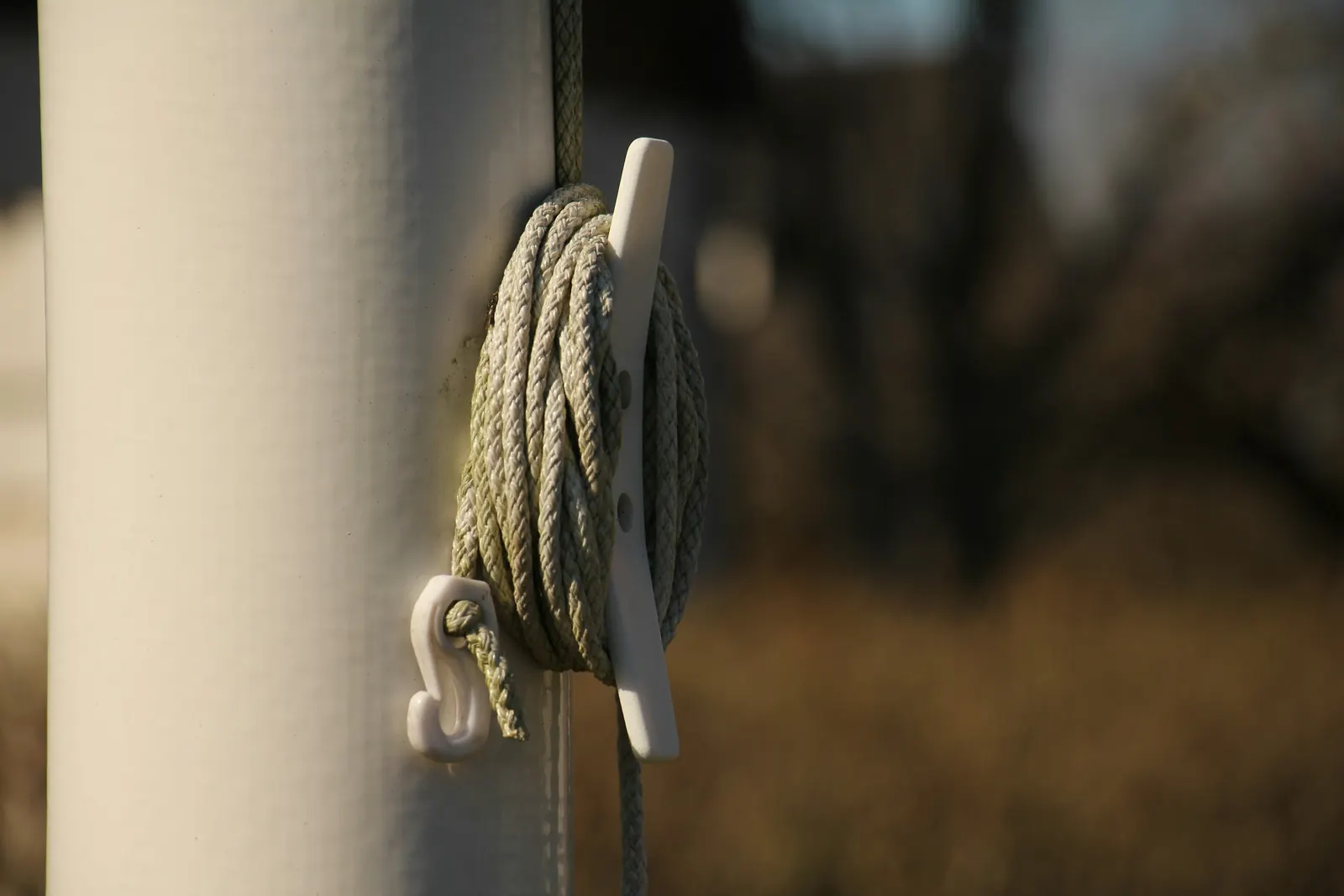
On a pole with an external halyard, the loop runs on the outside of the pole and is tied off on a cleat near the base. It is simple, cheap to replace and easy to check, but the rope is exposed to the weather and within reach of passers-by, and it can slap against the pole in the wind.
Internal halyard
On a pole with an internal halyard, the rope runs inside the pole and is reached through a lockable access point near the base, as on Flagmakers’ internal halyard poles. This protects against theft and vandalism and reduces rope noise. According to the Flag & Banner Company, it needs a pole section of at least 3 inches, 76.25 mm.
Raising and flying the flag
MCH’s display rules describe how the New Zealand flag sits on the halyard:
- The first quarter is uppermost and as close as possible to the top of the mast, tight with the flagpole.
- A flag is broken when it is allowed to break free at the top of the pole after being furled and hoisted.
- A house flag may fly beneath the New Zealand flag on the same flagpole.
For half-mast, the flag is raised to the top and then slowly lowered to a position more than its own depth from the top. At the end of the day it is raised to the top again before it is lowered. More in the guide to half-mast.
Folding the flag
When the flag comes down, MCH describes folding it in half horizontally and in half again, folding it lengthwise twice, bringing the ends together, folding it concertina-style towards the hoist and keeping it bundled by winding the halyard around and under itself. The method comes from the New Zealand flag booklet of the Department of Internal Affairs.
Yardarm and gaff
On a flag mast, a yardarm and a gaff each have their own halyards, so several flags can fly from one mast. According to MCH, if a flagpole is fitted with a gaff, the New Zealand flag flies from the gaff and above any other flag. More in the guide to types of flagpoles.
The base
The base holds the pole upright. According to the Flag & Banner Company, it can be a spigot concreted into the ground, a plinth-type spigot, a folding spigot or a fixing to a wall or post. A folding spigot makes it possible to replace the halyard or service the truck on the ground rather than at height, which is covered in the guide to flagpole safety.
When something stops working
A stuck halyard, a seized pulley or a flag that winds around the pole are the most common problems. Their causes are described in the guide to flagpole repair, and the individual parts in the guide to flagpole accessories.
Frequently asked questions
How is a flag raised on a flagpole?
The flag is attached to the halyard, a rope that runs in a loop over a pulley in the truck at the top of the pole. Pulling one side of the loop raises the flag; pulling the other lowers it. The halyard is then tied off on a cleat or secured inside the pole.
What does it mean to break a flag?
According to the glossary of Manatū Taonga, a flag is said to be broken when it is allowed to break free at the top of a flagpole after having been furled and hoisted to the top of the pole.
Where on the halyard does the flag sit?
According to Manatū Taonga, the first quarter of the New Zealand flag is uppermost and as close as possible to the top of the mast, tight with the flagpole. A house flag may fly beneath it on the same halyard.
What is a folding spigot?
A folding spigot is a hinged mount at the base that allows the pole to be lowered to the ground, for example to replace the halyard. The Flag & Banner Company lists it among the ways of mounting a flagpole.
Sources
This guide is based on the following sources:
- Display rules for the New Zealand flag – Glossary, flagpole, half-masting and folding – Manatū Taonga – Ministry for Culture and Heritage
- Flagpoles – Flag & Banner Company
- Flag & Banner Company – FAQ – Flag & Banner Company
- Supreme internal halyard flag pole – Flagmakers
Related guides
- Flagpole accessoriesThe parts of a flagpole explained: truck and pulley, halyard, toggles and sister clips, cleat, lockable halyard access, yardarm, gaff, spigot and lighting.
- Types of flagpolesFlagpole types in New Zealand: in-ground poles on a spigot, folding spigots, base and parapet mounts, tapered poles, and flag masts with yardarm and gaff.
- Flagpole repairCommon flagpole faults in New Zealand and their causes: broken or stuck halyards, seized pulleys, wrapped flags, corrosion, loose mounts and storm damage.
- Flagpole safetyFlagpole safety in New Zealand: wind zones, storm flags, overhead power lines and NZECP 34, underground services, work at height and duties under HSWA.