The New Zealand flag: meaning, design and colours
Published Written by Flagpole Guides
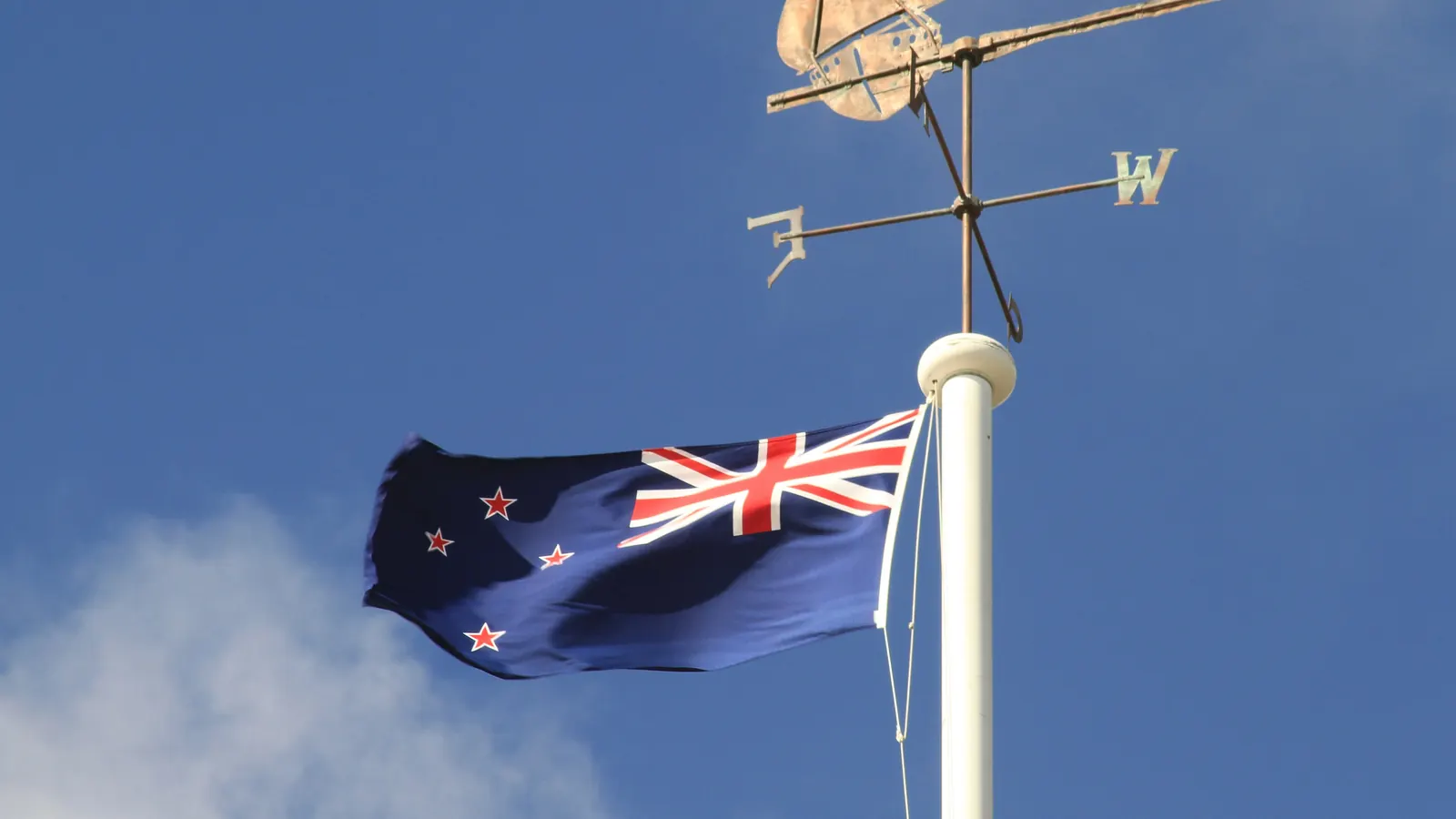
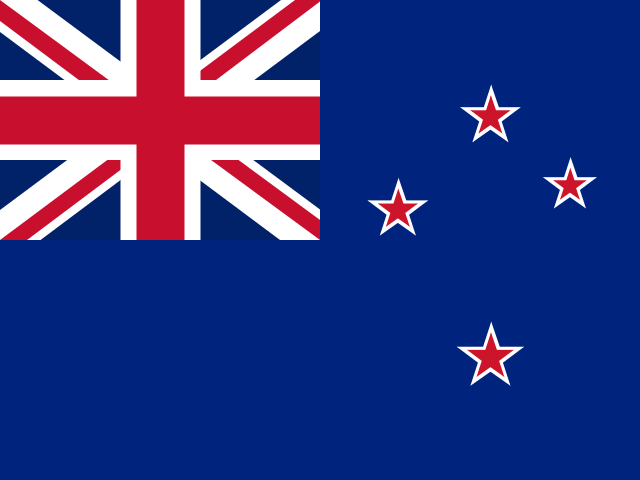
The New Zealand flag has three elements on a royal blue field: the Union Jack, and the Southern Cross as four red stars with white borders. Its design is fixed in Schedule 1 of the Flags, Emblems, and Names Protection Act 1981, which declares it the symbol of the Realm, Government and people of New Zealand. Manatū Taonga – Ministry for Culture and Heritage (MCH) explains its meaning and publishes its technical details.
The royal blue
According to MCH, the blue of the background is reminiscent of the blue sea and sky surrounding New Zealand. NZHistory adds that the royal blue is derived from the ensign of the Blue Squadron of the Royal Navy: the flag began as a blue ensign for the colony’s government ships.
The Union Jack
The Union Jack is in the first quarter, the upper corner next to the staff, and fills half of the hoist side. According to NZHistory, it recognises New Zealand’s historical origins as a British colony and dominion. MCH describes it as red and white crosses on a blue background: the red cross on white in front, and two diagonal crosses behind, the red superimposed over the white.
The Southern Cross
The right half of the flag, the fly, carries four stars in the formation of the Southern Cross constellation. According to MCH, they signify New Zealand’s place in the South Pacific Ocean. Each star has five points and is red with a white border. MCH notes that there was debate over including the fifth, smaller star of the constellation; New Zealand used only the four stars that mark the points of the compass. The colours of the stars were chosen to complement the colours of the Union Jack.
The design of 1902
The positions and sizes of the stars were described in the New Zealand Gazette on 27 June 1902, in fractions of the hoist, the height of the flag:
| Element | Measurement |
|---|---|
| Distance between the centres of the stars in the long limb of the cross | 36/60 of the hoist |
| Star nearest the edge of the fly | 5/60 of the hoist across its red points |
| Star at the top and star nearest the Union Jack | 6/60 of the hoist |
| Star at the bottom | 7/60 of the hoist |
| White borders | 1/120 of the hoist |
The stars of the long limb are on a vertical line midway between the Union Jack and the edge of the fly, and the short limb crosses it at an angle of 82 degrees. The flag was designed in 1869 by Admiral Sir Albert Hastings Markham of the Royal Navy, according to MCH.
The colours
According to MCH, the colours for official reproduction are PANTONE white, PANTONE 186C red and PANTONE 280C blue. The approximate digital equivalents are:
| Colour | RGB | HEX | CMYK |
|---|---|---|---|
| Red | 201, 18, 53 | #C91235 | 0, 100, 80, 5 |
| Blue | 2, 33, 110 | #02216E | 100, 85, 0, 39 |
The flag can be made to any size, with the length always twice the width. More in the guide to flag sizes.
Protection of the flag
Section 11 of the Act makes it an offence to alter the flag without lawful authority by placing any letter, emblem or representation on it, or to use, display, destroy or damage it in or within view of a public place with the intention of dishonouring it. Section 8 keeps the Sovereign’s power to approve an altered flag for official purposes. The protocol for flying the flag is guidance from MCH, described in the guide to flag flying rules.
The flag referendums
In 2014, the government announced a two-stage referendum on the flag. In the first referendum, a postal vote in November 2015, voters ranked five alternative designs and chose the Silver Fern (Black, White and Blue) by Kyle Lockwood; turnout was 48.78 percent. In the second, in March 2016, voters chose between that design and the current flag, and nearly 57 percent preferred the current flag, with a turnout of 67.78 percent, according to NZHistory.
The flag in history
The flag goes back to the blue ensign that colonial government ships had to fly after 1865, with the Southern Cross added in 1869, and it became the national flag in law in 1902. The story is told in the guide to flagpole history, and the other official flags in the guide to flag types.
Frequently asked questions
What do the stars on the New Zealand flag mean?
The four stars represent the Southern Cross constellation. According to Manatū Taonga, they signify New Zealand’s place in the South Pacific Ocean. They are red with white borders and have five points each.
Why does the New Zealand flag have four stars and the Australian flag more?
According to Manatū Taonga, there was some debate in New Zealand as to whether the fifth, smaller star of the Southern Cross should be included, and it was decided to use only the four stars that mark the points of the compass. The Australian flag also has the seven-pointed Federation Star below the Union Jack.
What are the official colours of the New Zealand flag?
According to Manatū Taonga, the colours for official reproduction are PANTONE white, PANTONE 186C red and PANTONE 280C blue. Approximate digital equivalents are #C91235 for the red and #02216E for the blue.
Did New Zealand vote on changing its flag?
Yes. In two referendums in 2015 and 2016, voters first chose a silver fern design as the preferred alternative and then chose between it and the current flag. In March 2016, nearly 57 percent preferred the current flag, according to NZHistory.
Sources
This guide is based on the following sources:
- New Zealand flag – Flag design and technical details – Manatū Taonga – Ministry for Culture and Heritage
- Flags, Emblems, and Names Protection Act 1981, sections 5, 8 and 11 and Schedule 1 – New Zealand Legislation
- Flags of New Zealand – NZHistory, Manatū Taonga – Ministry for Culture and Heritage
- Flags of New Zealand – Flag referenda – NZHistory, Manatū Taonga – Ministry for Culture and Heritage
Related guides
- Flagpole historyThe history of flags in New Zealand: the United Tribes flag of 1834, the Union Jack and the flagstaff at Kororāreka, the ensign of 1869 and the referendums.
- Flag typesThe official flags of New Zealand: the national flag, the red and white ensigns, the air ensigns, the Governor-General’s flag and the Tino Rangatiratanga flag.
- Flag sizesThe five standard New Zealand flag sizes from 1 to 3 yards, the 1:2 proportions of the national flag and Manatū Taonga’s guide for matching flag and pole.
- Flag daysAll days of national commemoration on which the New Zealand flag is flown in 2026 and 2027, from Waitangi Day and Anzac Day to Matariki and Labour Day.