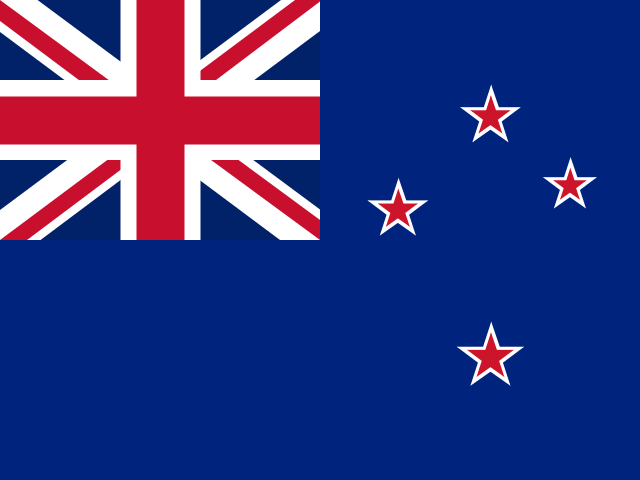
Half-mast in New Zealand – position, procedure and occasions
Published Written by Flagpole Guides
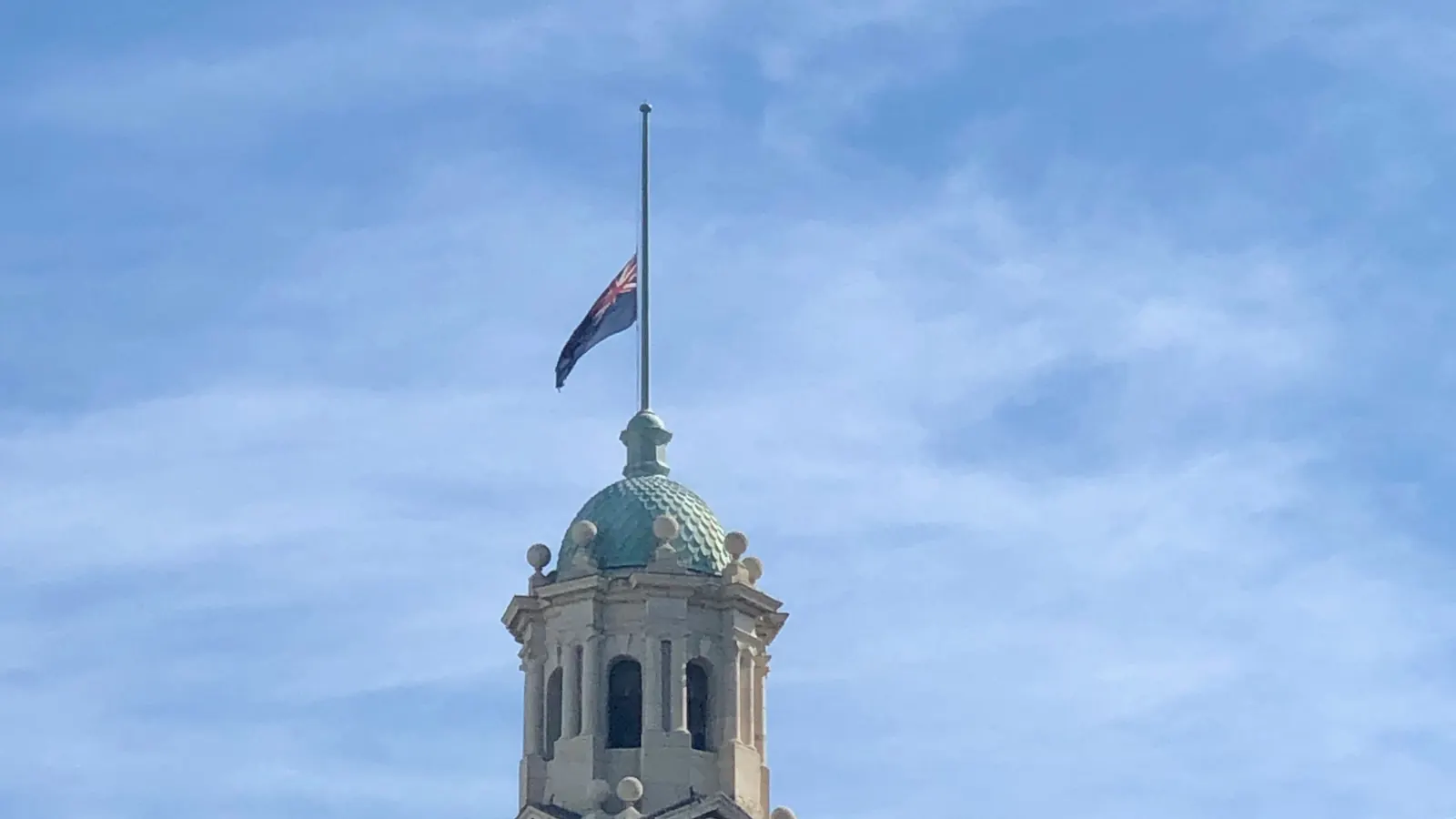
A flag at half-mast is the most visible sign of national mourning in New Zealand. The occasions for government buildings are set in the New Zealand Flag Notice 2024, and Manatū Taonga – Ministry for Culture and Heritage (MCH) describes the procedure and issues a directive each time the flag is to be lowered. Private flag owners are not bound by these directives, but many follow them.
How far down
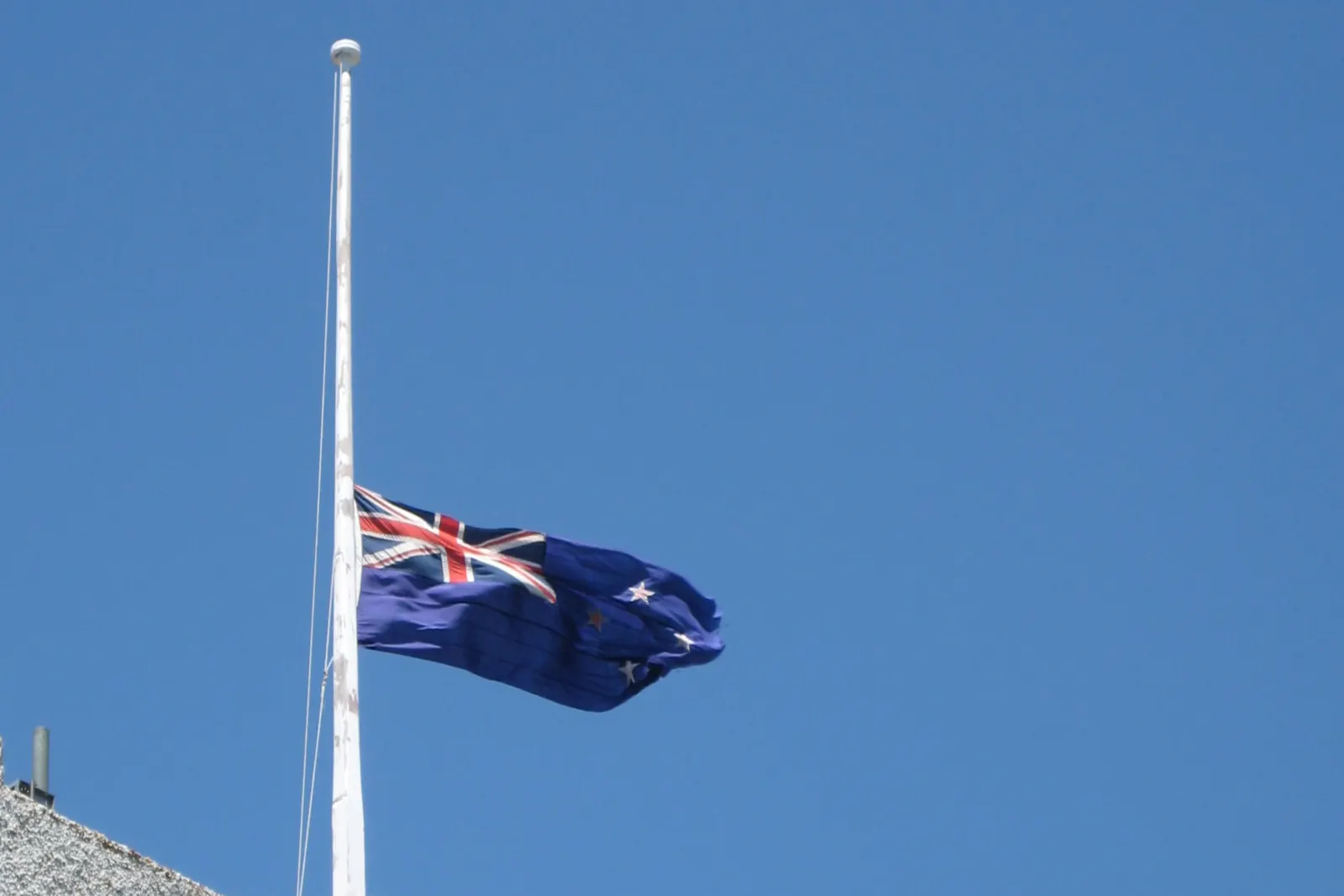
According to MCH, the half-mast position depends on the size of the flag and the length of the flagpole. The rule of thumb is that the flag is lowered to a position more than its own depth from the top of the flagpole, so that it does not look as though it has accidentally fallen down. A flag 900 mm high, for example, has its top edge more than 900 mm below the top of the pole.
| Flag (length × height) | Top of the flag at least this far below the top of the pole |
|---|---|
| 1350 × 675 mm | 0.7 m |
| 1800 × 900 mm | 0.9 m |
| 2250 × 1125 mm | 1.15 m |
| 2700 × 1350 mm | 1.35 m |
The procedure
MCH describes the following sequence:
- The flag is raised to the top of the mast.
- It is then slowly lowered to the half-mast position.
- While it is at half-mast, no other flag is flown above it.
- At the end of the day, the flag is raised to the top again before it is lowered for the day.
Who issues directives
The flying of the flag at half-mast is covered by section 10 of the Flags, Emblems, and Names Protection Act 1981 and the Flag Notice 2024. According to MCH, the directive to lower flags on government buildings is generally issued on the direction of the Minister for Arts, Culture and Heritage, and the Minister and the Prime Minister keep the discretion to direct half-masting on non-standard occasions of mourning of particular significance. MCH lets subscribed individuals and organisations know by email whenever the flag is to be half-masted.
Government buildings are required to follow the directives. Local government, schools, private entities and private individuals can follow them, but are not required to, according to MCH.
When the flag flies at half-mast
Clause 5 of the Flag Notice 2024 lists the occasions:
| Death of | Half-mast on government buildings |
|---|---|
| The Sovereign | From the announcement of the death up to and including the day of the funeral, except Proclamation Day, when flags fly from the top of the mast |
| The Governor-General, a former Governor-General, the Prime Minister or a former Prime Minister | The day of the announcement of the death and the day of the funeral |
| A member of the Royal Family | The day of the funeral |
| A Commonwealth governor-general or prime minister, or a Commonwealth or foreign head of state | The day of the funeral |
MCH adds that half-masting for a member of the Royal Family is subject to special command from the Sovereign or the Governor-General. Other occasions, such as the deaths of members of Parliament and police officers killed in the line of duty, or the anniversaries of national tragedies, have been marked by directives of their own; examples are in the guide to flags in mourning.
Anzac Day
On Anzac Day, 25 April, the flag flies at full mast. According to the Flag Notice and MCH, it is appropriate to lower it to half-mast for the duration of a memorial service at places where commemorative services are held. More in the guide to flag days.
Local flags and house flags
According to MCH, local authorities can fly their local flag at half-mast after the death of a prominent local citizen, appropriately on the day or part of the day of the funeral, and the same etiquette applies to the house flag of a company or organisation. In these cases, the New Zealand flag remains at full mast; clause 8 of the Flag Notice states that it is then flown separately at full mast. Council guidelines, such as those of Whanganui District Council, follow this practice.
Half-mast on a private flagpole
On poles with an external or internal halyard, the flag can be held at any height. On a flag that is fixed to a short staff, such as some wall-mounted staffs, it cannot be lowered. How halyards work is explained in the guide to how a flagpole works.
Frequently asked questions
How far down is a flag at half-mast?
According to Manatū Taonga, the half-mast position depends on the size of the flag and the length of the flagpole, but the flag is lowered to a position more than its own depth from the top of the pole, to avoid looking as though it has accidentally fallen down.
Why is the flag raised to the top before half-mast?
According to Manatū Taonga, the flag is half-masted by raising it to the top of the mast and then slowly lowering it to the half-mast position. At the end of the day, it is raised to the top again before it is lowered for the day.
Who decides when flags fly at half-mast in New Zealand?
Manatū Taonga issues half-masting directives for government buildings, generally on the direction of the Minister for Arts, Culture and Heritage, under section 10 of the Flags, Emblems, and Names Protection Act 1981 and the New Zealand Flag Notice 2024. The Minister and the Prime Minister can also direct half-masting on other occasions of mourning of particular significance.
Do private flag owners have to follow half-masting directives?
No. According to Manatū Taonga, government buildings fly the flag at half-mast when a directive is issued, while local government, schools, private entities and private individuals can follow the directives but are not required to. Manatū Taonga notifies subscribers by email when the flag is to be half-masted.
Can a council or company lower its own flag for a local death?
Yes. According to Manatū Taonga, a council can fly its local flag at half-mast after the death of a prominent local citizen, appropriately on the day or part of the day of the funeral, and the same applies to a company’s house flag. In these cases the New Zealand flag remains at full mast.
Sources
This guide is based on the following sources:
- Display rules for the New Zealand flag – Half-masting – Manatū Taonga – Ministry for Culture and Heritage
- New Zealand Flag Notice 2024, clauses 3, 5 and 8 – New Zealand Gazette
- Flags, Emblems, and Names Protection Act 1981, section 10 – New Zealand Legislation
- Guidelines for flying flags outside Council buildings – Whanganui District Council
Related guides
- Flags in mourningHow flags are used in mourning in New Zealand: the death of the Sovereign, former prime ministers, tragedies, local deaths and the flag on a coffin.
- Flag daysAll days of national commemoration on which the New Zealand flag is flown in 2026 and 2027, from Waitangi Day and Anzac Day to Matariki and Labour Day.
- Flag flying rulesThe rules for flying the New Zealand flag: who may fly it, flying at night, the flag’s condition and disposal, advertising and the offences in the Flags Act.
- How a flagpole worksHow a flagpole works: the halyard and truck, internal and external halyards, breaking a flag at the top, half-masting, yardarms and gaffs, and folding spigots.