
Flagpole repair: common faults and their causes
Published Written by Flagpole Guides
Most faults on a flagpole do not affect the pole itself but the moving parts: halyard, pulley, clips and top fitting. They wear with wind, sun and use and can usually be replaced. Faults in the pole or foundation are more serious, because they affect whether the pole stands safely, and the occupier of premises owes visitors a duty of care under the Occupiers’ Liability Act 1957.
Common faults at a glance
| Problem | Common cause | Usual solution |
|---|---|---|
| Halyard broken | wear at the pulley, UV ageing | new halyard, a new pulley if needed |
| Halyard off the pulley | wind, slack halyard | refitting the halyard, checking the pulley |
| Pulley jammed | dirt, wear, ice | cleaning or a new pulley |
| Flag wraps around the pole | top no longer rotates | cleaning or replacing the rotating top |
| Rattling | halyard or clips slapping the pole | tighter halyard, covered clips |
| Frayed flag | wind, flying every day | a new flag |
| Pole wobbles | loose bolts on the hinged base | tightening to the manufacturer’s specification |
| Pole leans | foundation moving, pole bent | assessment by a specialist, possibly a new foundation |
| Cracks at the base | fatigue, corrosion | assessment by a specialist |
Working at the top
Many repairs involve the top of the pole, the part hardest to reach. The options depend on the design:
- Hinged pole: the pole is lowered and the pulley, top and halyard can be reached on the ground. Larger poles often take two people.
- Fixed pole: access platforms or specialist flagpole firms are common.
- Ladder: the Health and Safety Executive describes ladders as a sensible option for low-risk, short-duration tasks, but not automatically the first choice. A narrow, flexible pole is a poor support for a ladder.
Broken or slipped halyard
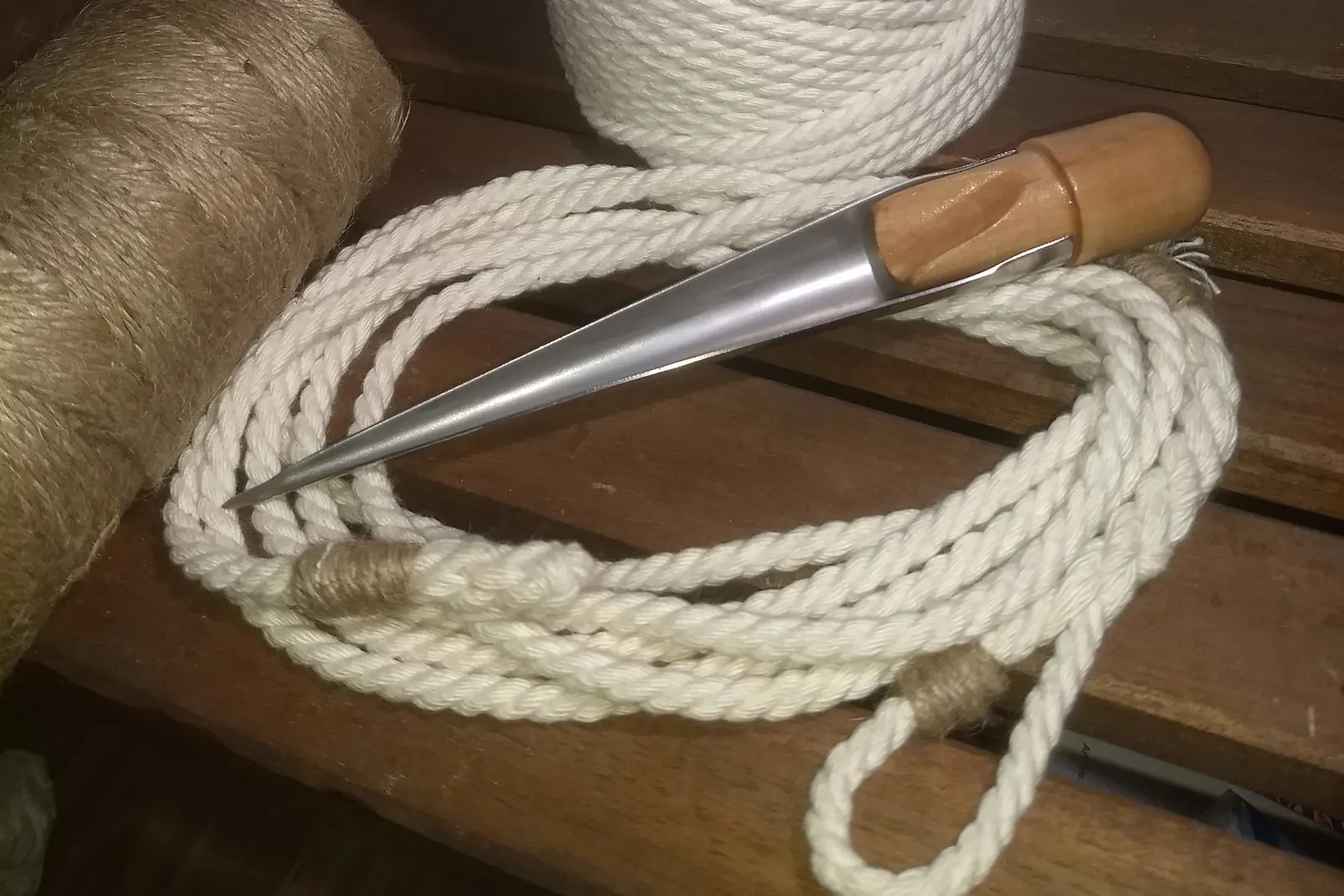
A broken halyard is a typical fault. On a pole with an external halyard, a new rope is threaded over the pulley at the top and joined into a loop. With an internal halyard this is more involved, because the rope runs inside the pole; some manufacturers offer threading tools or a service. If the halyard keeps jumping off the pulley, the pulley may be worn or the rope too thin.
Top fitting and rotation
If the flag keeps wrapping around the pole, the top often no longer turns freely. Dirt, corrosion or a worn bearing are typical causes. Many top fittings can be replaced as a unit, matched to the diameter of the pole.
Damage to the pole and foundation
Cracks, heavy corrosion, dents or a leaning pole are signs that the pole may no longer stand safely. Such damage is usually assessed by the manufacturer or a specialist. Until then, it is common to take the flag down so that the wind does not add to the load, and to keep people away from the area around the pole. A pole with a cracked base can fall in the next gust.
Noise and neighbours
Rattling clips and a slapping halyard carry far at night. Under section 79 of the Environmental Protection Act 1990, noise emitted from premises so as to be prejudicial to health or a nuisance can be a statutory nuisance, which the council investigates. Common remedies are a tighter halyard, covered clips, halyard retainers that hold the rope away from the pole, or an internal halyard.
More about regular checks is in the guide to flagpole maintenance, and about the individual parts in the guide to flagpole accessories.
Frequently asked questions
The halyard has broken – what are the options?
On a hinged pole, the pole can be lowered and the new halyard threaded over the pulley on the ground. On fixed poles, access platforms or specialist flagpole firms are common. The Health and Safety Executive describes ladders as a sensible option for low-risk, short-duration tasks, but not automatically the first choice.
Why does my flagpole rattle at night?
Usually the halyard or clips slap against the pole in the wind. A tighter halyard, covered or plastic clips and an internal halyard reduce the noise. Under section 79 of the Environmental Protection Act 1990, noise emitted from premises so as to be a nuisance can be a statutory nuisance.
Can a leaning flagpole be repaired?
It depends on the cause. Loose bolts on a hinged base can be tightened. If the foundation moves, or the pole itself is bent or cracked, its safety is affected, and the manufacturer or a specialist firm can assess the damage.
Is it worth repairing or replacing a flagpole?
Halyards, pulleys, clips and top fittings are wearing parts and are usually replaced individually. A pole that is cracked, badly corroded or bent is often replaced as a whole. Whether the old foundation can be reused depends on whether the new pole fits the existing socket or hinged base.
Sources
This guide is based on the following sources:
- Safe use of ladders and stepladders – Health and Safety Executive
- Environmental Protection Act 1990, section 79 – legislation.gov.uk
- Occupiers’ Liability Act 1957, section 2 – legislation.gov.uk
Related guides
- Flagpole maintenanceWhat is usually checked when a flagpole is maintained – pole, foundation, halyard, pulley and flag – why upkeep matters for liability, and retiring old flags.
- How a flagpole worksHow a flagpole works: external and internal halyards, the pulley and rotating truck, yardarms, hinged bases and the forces the wind puts on pole and foundation.
- Flagpole accessoriesFinial, truck, pulley, halyard, clips, toggle and rope, cleat, ground socket, hinged base and yardarm: the parts of a flagpole and what each one does.
- Lifespan and sustainabilityWhat decides how long a flagpole and a flag last, the signs of wear, and how aluminium, glass fibre and flag fabric are recycled or disposed of.