
How a flagpole works: halyard, pulley and hinged base
Published Written by Flagpole Guides
A flagpole is simple technology, but it has to cope with a lot: wind from changing directions, rain, frost, UV light and thousands of hoists. Knowing how the halyard, pulley and base work together makes it easier to spot problems early and to see why some designs suit some uses better.
The external halyard
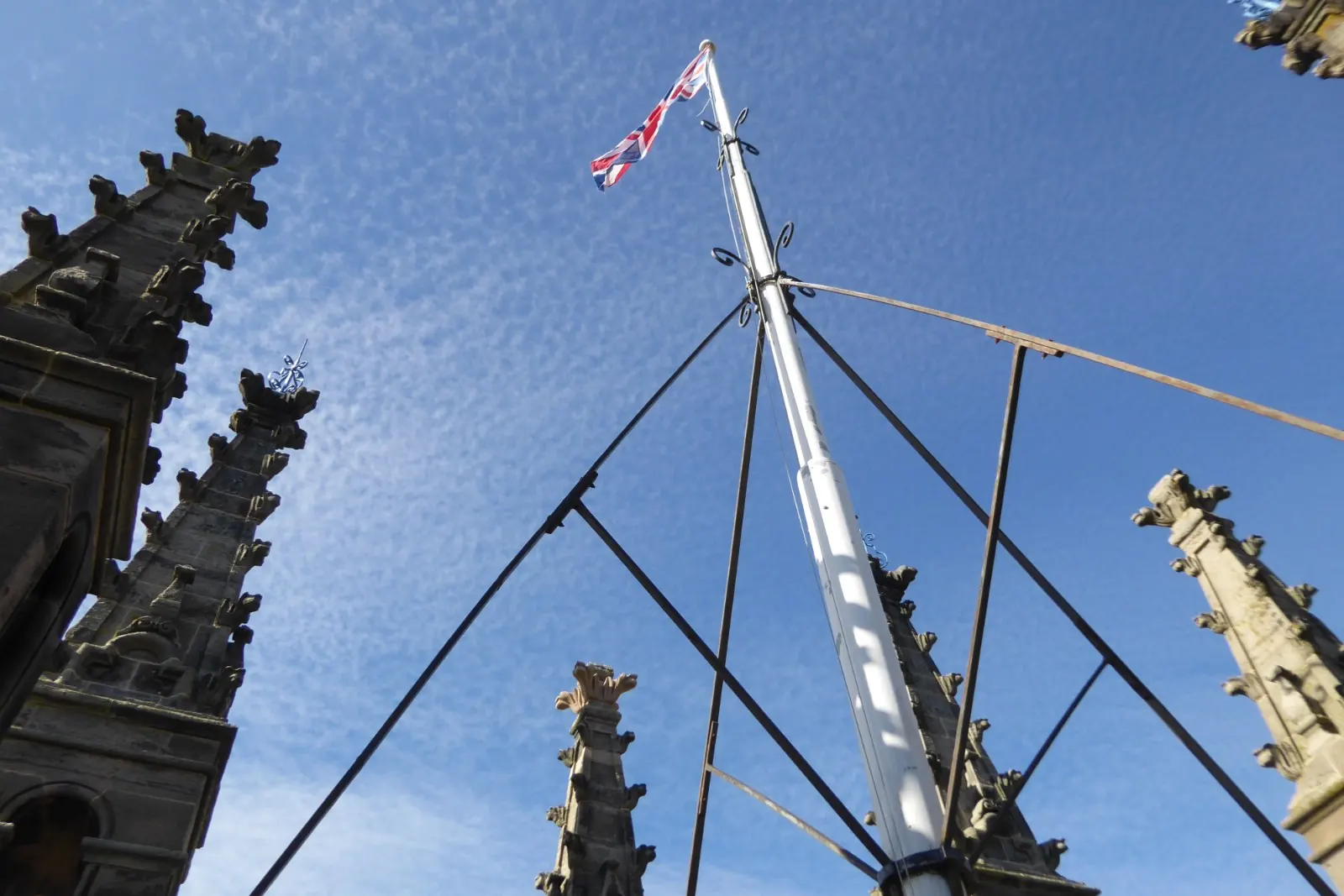
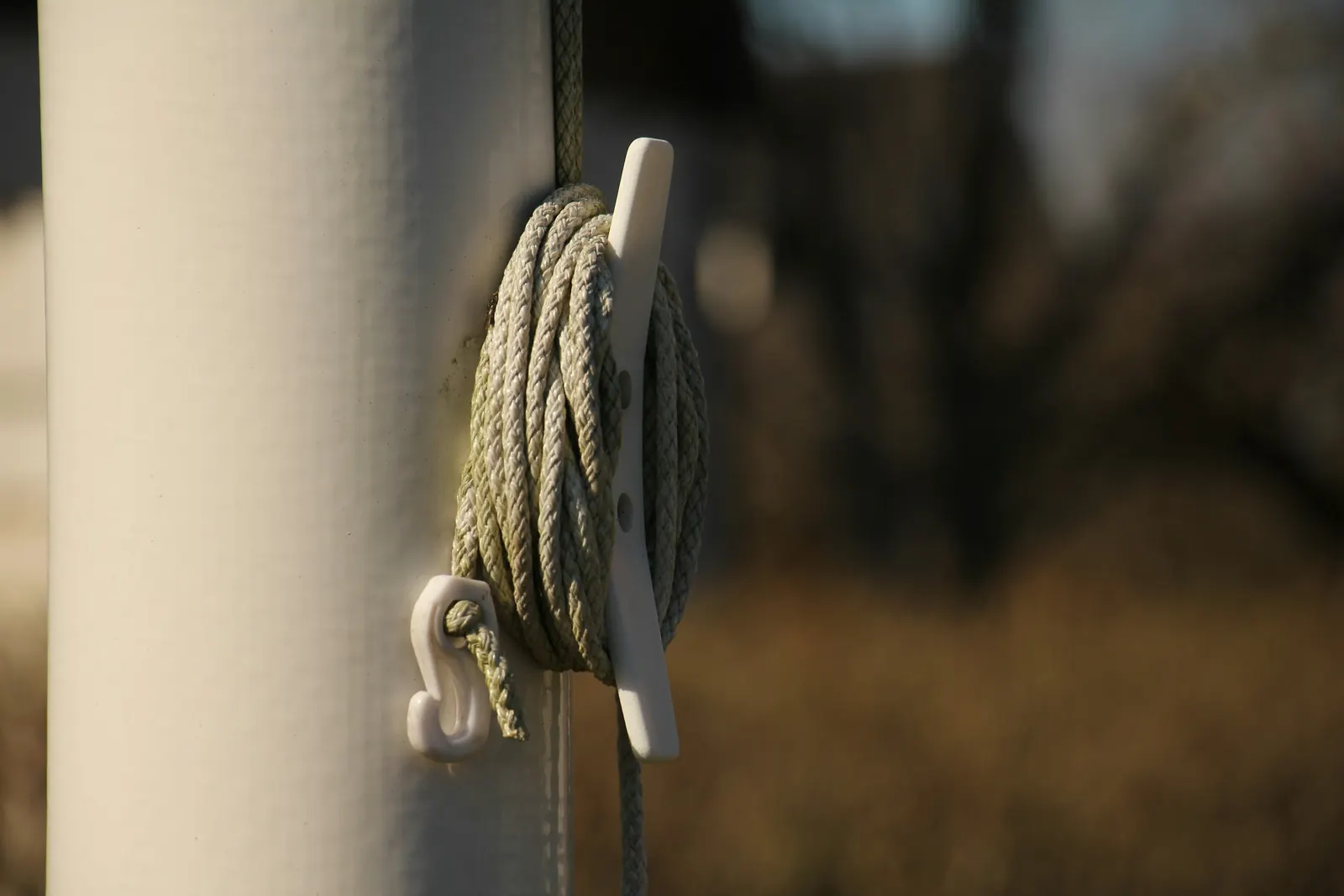
On the classic flagpole, the halyard runs as a closed loop over a pulley at the top. The flag is clipped to one side of the loop. Pulling the other side makes the flag rise while the free side comes down. At the top, the halyard is secured on a cleat. Because the loop is closed, the flag can be held at any height, including half-mast. According to the Flag Institute, half-mast means two-thirds of the way up, with at least the height of the flag between its top and the top of the pole.
The internal halyard
With an internal halyard, the rope runs inside the pole. It leaves through an opening near the top and is reached through a lockable door near the base. A counterweight inside the pole keeps it taut. The advantages are protection against theft and less noise; the drawback is that a broken halyard is harder to replace.
Rotating truck and finial
When the wind changes direction, the flag can wrap around the pole. A rotating truck at the top lets the flag’s attachment points turn with the wind. Keeping the rotating parts clean and free-running reduces the problem.
Yardarm and gaff
Nautical flagpoles carry a yardarm, a horizontal cross-piece, and sometimes a gaff. Each has its own halyards, so several flags can fly from one pole. According to the Flag Institute, the senior ensign flies from the gaff, or, if there is none, the senior national flag from the starboard yardarm.
The hinged base
Many flagpoles are not set rigidly in concrete but stand on a hinged base. A hinge at the foot allows the pole to be lowered once the fixings are released, so the pulley, halyard and top can be serviced on the ground. Larger poles are often lowered by two people or with lifting equipment, as a long pole creates a large leverage force when it is tipped.
The alternative, working at the top of a standing pole, is risky. The Health and Safety Executive describes ladders as a sensible and practical option for low-risk, short-duration tasks, but not automatically the first choice. For work at height on tall poles, access platforms or specialist firms are common. More in the guide to flagpole safety.
The forces of the wind
Wind pressure rises with the square of the wind speed: at twice the wind speed, roughly four times the force acts on pole and flag. The flag adds many times the area of the pole itself and flutters, which creates additional dynamic loads. At the foot of the pole this produces a large bending moment that the pole and foundation have to carry. Manufacturers state which wind loads and flag sizes their poles are designed for, and the Met Office issues weather warnings for strong winds.
Common weak points
| Part | Typical problem |
|---|---|
| Pulley | runs stiffly or jams, halyard jumps off |
| Halyard | frays, becomes brittle in UV light |
| Clips | slap against the pole, corrode |
| Rotating truck | becomes stiff |
| Hinge and bolts | loosen or corrode |
| Base of the pole | moisture, corrosion, cracks |
How these problems are recognised and fixed is described in the guides to flagpole repair and flagpole accessories.
Frequently asked questions
How does a flagpole halyard work?
The halyard runs as a closed loop over a pulley at the top of the pole. The flag is clipped to one side of the loop; pulling the other side raises it. Near the base, the halyard is secured on a cleat or behind a door.
Why does the flag wrap around the pole?
When the wind changes direction, a flag can wrap around the pole, especially if the top fitting does not rotate. A rotating truck lets the flag turn with the wind and reduces the problem.
What is a hinged flagpole?
A hinged flagpole stands on a base with a hinge. Once released, it can be lowered so that the top, pulley and halyard can be reached from the ground, instead of working at height.
How much force does the wind put on a flagpole?
Wind pressure rises with the square of the wind speed: at twice the wind speed, roughly four times the force acts on pole and flag. The flag adds a large area to the pole. Manufacturers state which wind loads and flag sizes their poles are designed for.
Sources
This guide is based on the following sources:
- UK flag protocol – The Flag Institute
- Safe use of ladders and stepladders – Health and Safety Executive
- UK weather warnings – Met Office
Related guides
- Flagpole accessoriesFinial, truck, pulley, halyard, clips, toggle and rope, cleat, ground socket, hinged base and yardarm: the parts of a flagpole and what each one does.
- Types of flagpolesGround-mounted, roof-mounted, wall-mounted, telescopic and nautical flagpoles with yardarm and gaff: the main types of flagpole and how UK planning treats them.
- Flagpole repairBroken halyard, jammed pulley, rattling clips, a leaning pole or cracks at the base: common flagpole faults, their causes and who usually deals with them.
- Flagpole safetyFlagpole safety in the UK: wind loads and weather warnings, occupiers’ liability, overhead lines, safe conditions for flags and the rules for work at height.