The Australian flag: meaning, design and colours
Published Written by Flagpole Guides
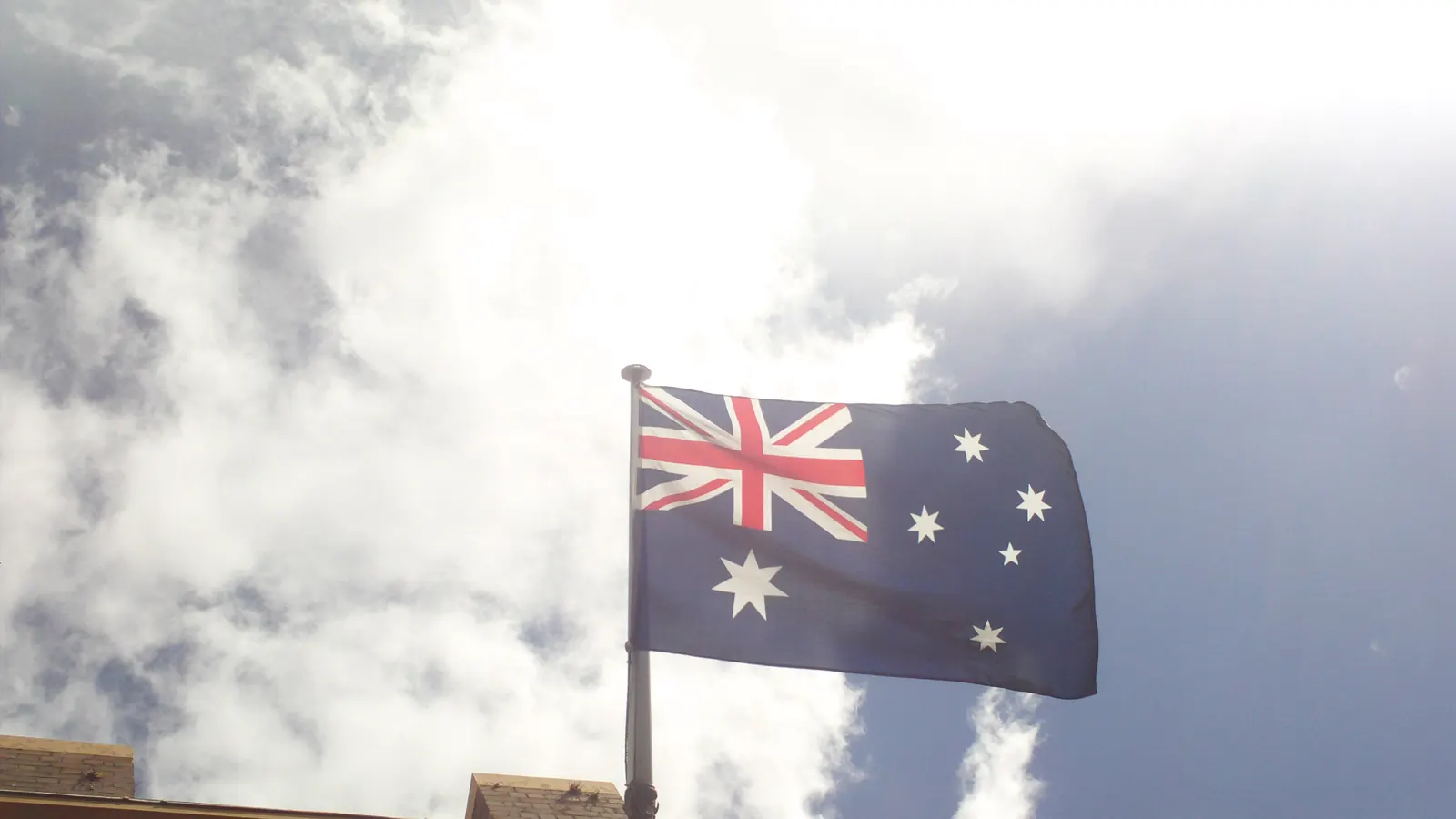
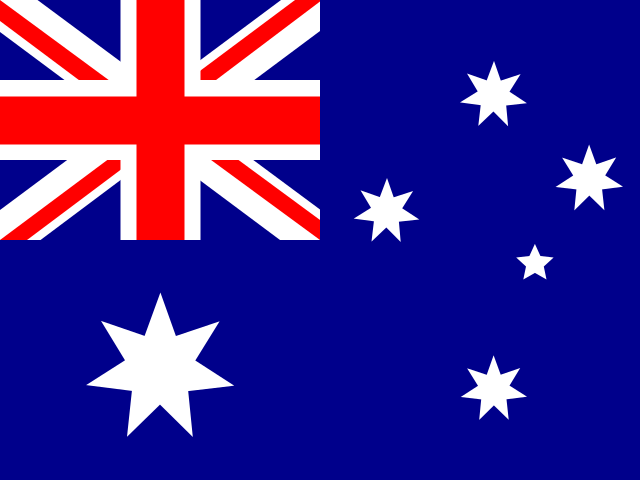
The Australian National Flag consists of three elements, according to the Department of the Prime Minister and Cabinet (PM&C): the Union Jack, the Commonwealth Star and the Southern Cross, on a dark blue field. Its design is fixed by law in Schedule 1 of the Flags Act 1953, which describes each star by its position, size and number of points.
The Union Jack
The Union Jack occupies the upper quarter next to the staff, the canton. According to PM&C, it acknowledges the history of British settlement in Australia. The Union Jack, the common name of the Union Flag of the United Kingdom, combines the red cross of St George for England, the white diagonal cross of St Andrew for Scotland and, since 1801, the red diagonal cross of St Patrick for Ireland.
The Commonwealth Star
Below the Union Jack is a large white star with seven points. According to the Flags Act, it represents the six states of Australia and the territories, and it points to the centre of the St George’s Cross in the Union Jack. PM&C explains that the star had six points on the flag of 1901, one for each former colony, and that the seventh point was added in 1908 to represent the Commonwealth territories and to match the star on the Commonwealth Coat of Arms. The star is sometimes called the Federation Star.
The Southern Cross

The five white stars in the fly represent the Southern Cross, a constellation that can be easily seen in the night skies of the Southern Hemisphere, according to PM&C. Its formal name is Crux Australis, and its stars are named Alpha, Beta, Gamma, Delta and Epsilon in order of brightness. Four of them have seven points; the smallest, Epsilon, has five. In the winning designs of 1901, each star had a different number of points, from nine to five, to show its brightness; the design was simplified in 1903.
The design in the Flags Act
Schedule 1 of the Flags Act gives the dimensions as fractions of the width of the flag, which it defines as the measurement of the hoist edge:
| Element | Outer diameter | Points |
|---|---|---|
| Commonwealth Star | Three-tenths of the width | 7 |
| Alpha, Beta, Gamma and Delta Crucis | One-seventh of the width | 7 |
| Epsilon Crucis | One-twelfth of the width | 5 |
The inner diameter of each star is four-ninths of its outer diameter. The flag is made in the proportions 1:2. More in the guide to flag sizes.
The colours
According to PM&C, the colour references are PANTONE 280 for the blue and PANTONE 185 for the red. Victoria’s state flag and the Northern Territory flag use a different Southern Cross, with stars of different numbers of points to show their brightness.
Protection of the flag
Since the Flags Amendment Act 1998, section 3 of the Flags Act states that the flag ceases to be the Australian National Flag only if a new flag is chosen by a majority of the electors voting in every state and territory, with the existing flag among the choices put to them. Parliament decides how such a vote is held.
Apart from rules on importing goods that bear the flag and on registering it in trade marks, the law does not regulate how the flag is flown. The protocol for its use, including the rule that it is not flown upside down or used as a cover, is guidance from PM&C, described in the guide to flag flying rules.
The flag in history
The design goes back to the competition held after Federation in 1901, in which five almost identical designs shared the prize. The flag first flew on 3 September 1901, now Australian National Flag Day, and became the national flag in law in 1954. The story is told in the guide to flagpole history, and the other official flags in the guide to flag types.
Frequently asked questions
What do the stars on the Australian flag mean?
The large seven-pointed Commonwealth Star below the Union Jack represents the six states and the territories, according to the Flags Act 1953. The five stars in the fly represent the Southern Cross, a constellation that can be seen in the night skies of the Southern Hemisphere.
Why does the Australian flag have seven points on the large star?
According to PM&C, the Commonwealth Star had six points in 1901, one for each state. The seventh point was added in 1908 to represent the Commonwealth territories, and also to match the star on the Commonwealth Coat of Arms.
Why is the Union Jack on the Australian flag?
According to PM&C, the Union Jack in the upper left-hand quarter acknowledges the history of British settlement in Australia. It combines the crosses of St George, St Andrew and St Patrick.
Can the Australian flag be changed?
Only by a vote of the people. Since the Flags Amendment Act 1998, section 3 of the Flags Act 1953 states that the flag ceases to be the Australian National Flag only if a new flag is chosen by a majority of the electors voting, with the existing flag among the choices.
What are the official colours of the Australian flag?
According to PM&C, the colour references for the Australian National Flag are PANTONE 280 for the blue and PANTONE 185 for the red. The stars and the white parts of the Union Jack are white.
Sources
This guide is based on the following sources:
- Flags Act 1953, section 3 and Schedule 1 – Federal Register of Legislation
- Australian Flags booklet – Part 1: The Australian National Flag – Department of the Prime Minister and Cabinet
- Australian Flags booklet – How the Australian National flag was chosen – Department of the Prime Minister and Cabinet
- Australian National Flag – Department of the Prime Minister and Cabinet
Related guides
- Flagpole historyThe history of flags in Australia: the Union Jack in 1770 and 1788, the Eureka flag, the 1901 flag competition, the Flags Act 1953 and the Aboriginal flag.
- Flag typesThe official flags of Australia: the national flag, the red ensign, the Aboriginal and Torres Strait Islander flags, Defence ensigns and state flags.
- Flag sizesStandard Australian flag sizes from 900 × 450 mm to 3600 × 1800 mm, the 1:2 proportions of the national flag and which size suits which flagpole height.
- Flag daysAll days on which flying the Australian flag is encouraged in 2026 and 2027, from Australia Day and Anzac Day to NAIDOC Week and Remembrance Day.