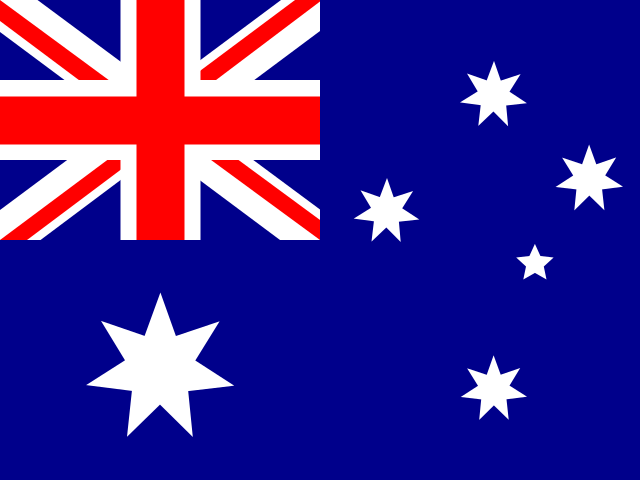
History of flags and flagpoles in Australia
Published Written by Flagpole Guides
Flags came to Australia on ships. The history of Australian flags runs from the Union Jack raised by explorers and governors, through the colonial and protest flags of the 19th century, to the competition that produced the national flag in 1901, a law that settled its status in 1954 and the recognition of the Aboriginal and Torres Strait Islander flags in 1995. The account below follows the booklet Australian Flags from the Department of the Prime Minister and Cabinet (PM&C).
The Union Jack in Australia
According to PM&C, the Union Jack was first raised in Australia on 29 April 1770 by Captain Cook at Stingray Harbour, later renamed Botany Bay, and again at Possession Island off Cape York on 22 August 1770. Governor Phillip hoisted it at Sydney Cove on 26 January 1788, marking the first European settlement. The Union Jack in its current form, with the cross of St Patrick, was first flown in Australia in 1801. Before Federation, the colonies flew the flags of the United Kingdom.
Colonial and early Australian flags
As a sense of Australian identity grew, many unofficial flags appeared, most of them with the Southern Cross:
| Year | Flag |
|---|---|
| 1823–24 | The national colonial flag, attributed to Captains Bingle and Nicholson |
| 1851 | The flag of the Australasian Anti-Transportation League, kept in Launceston |
| 1850s | The Murray River flag, flown on paddle-steamers |
| 1854 | The Eureka flag, raised at the Eureka Stockade at Ballarat |
| 1880s–1890s | The Australian federation flag |
The Eureka flag was raised by gold miners at Bakery Hill on 29 November 1854, when they swore an oath to defend their rights. According to PM&C, it is important because of its early use of the Southern Cross but not of the Union Jack. From 1870, each colony adopted a British blue ensign with its own badge, the origin of today’s state flags.
The competition of 1901
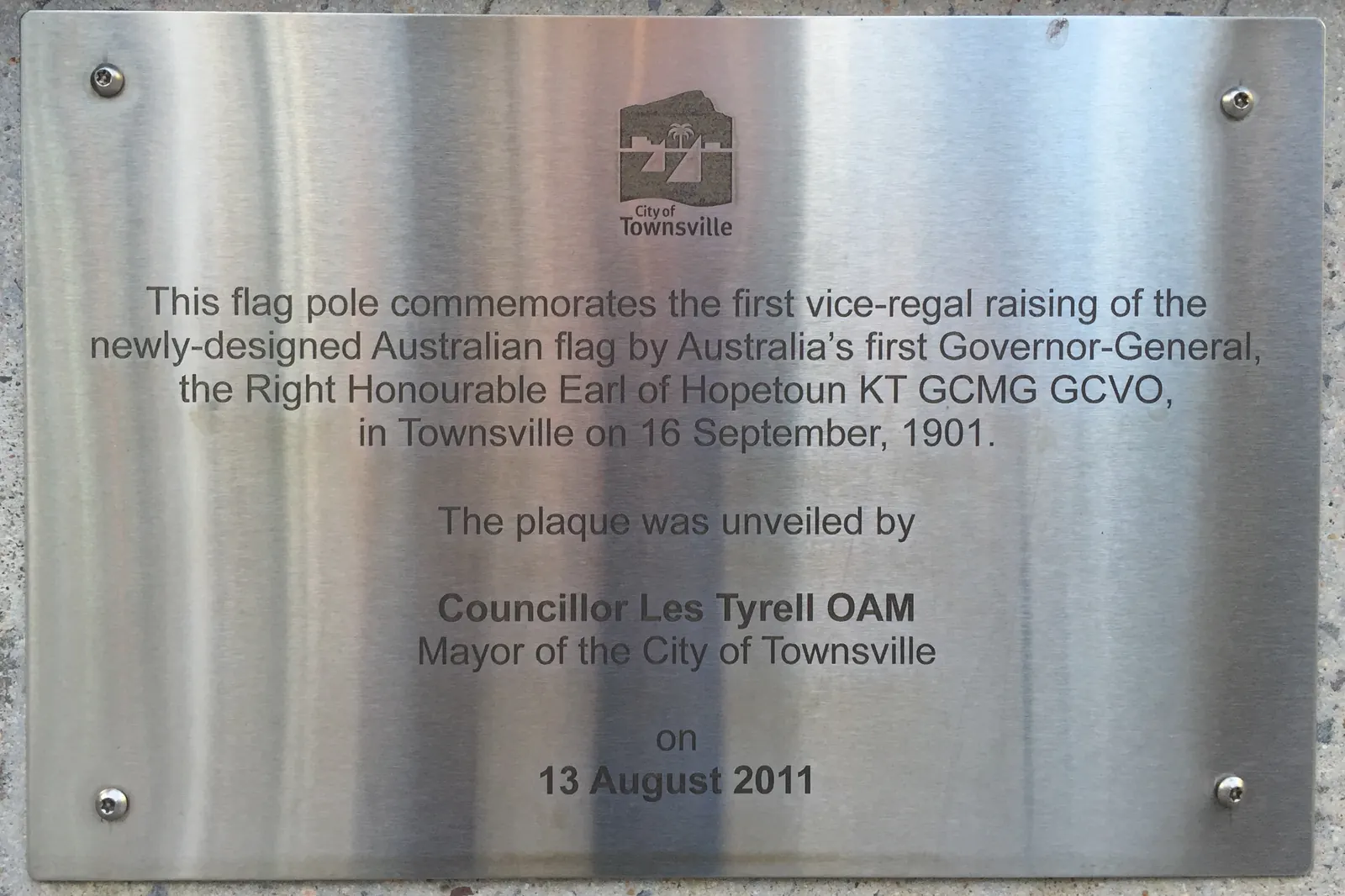
After Federation on 1 January 1901, the Commonwealth Government held a flag competition, combined with one run by the Melbourne journal Review of Reviews. There were 32,823 entries, from postage-stamp size to one using about 60 square metres of bunting. The judges chose five almost identical designs and divided the £200 prize between Annie Dorrington, Ivor Evans, Leslie Hawkins, Egbert Nuttall and William Stevens.
The flag was first flown on 3 September 1901, over the dome of the Exhibition Building in Melbourne: a large flag of 5.5 by 11 metres. The design was simplified in 1903, and in 1908 the Commonwealth Star gained its seventh point for the territories.
Blue or red ensign
For decades there was confusion over the two versions. The blue ensign was meant for official and naval use and the red ensign for merchant ships, but the public also flew the red ensign on land, and the Union Jack remained widely used. In 1941, Prime Minister Robert Menzies encouraged the public to fly the blue ensign, and in 1947 Ben Chifley supported this. The Flags Act 1953 took effect on 14 April 1954 and declared the blue ensign to be the Australian National Flag and the red ensign the flag of merchant ships.
Later milestones
- 1971: the Australian Aboriginal Flag, designed by Harold Thomas, is first raised in Adelaide.
- 1992: the Torres Strait Islander Flag is adopted.
- 1995: both flags are proclaimed flags of Australia under the Flags Act.
- 1996: 3 September is proclaimed Australian National Flag Day.
- 1998: the Flags Act is amended so that the national flag can only be changed by a vote of the electors.
- 2022: the copyright of the Aboriginal flag passes to the Commonwealth.
From timber masts to aluminium poles
Traditionally, flagpoles and flag masts were made of timber, and much of their vocabulary, such as yardarm, gaff and halyard, comes from sailing ships. Today most flagpoles in Australia are aluminium, according to the Victorian Department of Education, which notes that heritage schools and facilities may still require a timber pole. The materials are compared in the guide to flagpole materials, the meaning of the flag in the guide to the Australian flag, and the other official flags in the guide to flag types.
Frequently asked questions
When was the Australian flag first flown?
On 3 September 1901, according to PM&C. On that day Prime Minister Edmund Barton announced the winners of the flag competition, and a flag measuring 5.5 by 11 metres was flown over the dome of the Exhibition Building in Melbourne. The day is now Australian National Flag Day.
Who designed the Australian flag?
Five people shared the prize in the 1901 competition with almost identical designs: Annie Dorrington of Perth, Ivor Evans, a 14-year-old schoolboy from Melbourne, Leslie Hawkins of Leichhardt, Egbert Nuttall of Prahran and William Stevens, a ship’s officer from New Zealand. There were 32,823 entries.
When did the blue ensign become the national flag?
The Flags Act 1953 took effect on 14 April 1954 and declared the Commonwealth blue ensign to be the Australian National Flag, ending decades of confusion between the blue and red ensigns, according to PM&C. Before that, the red ensign and the Union Jack were also widely flown on land.
What is the Eureka flag?
The Eureka flag, plain blue with five white stars on a white cross, was raised by gold miners at the Eureka Stockade at Ballarat in November 1854. According to PM&C, it is important for its early use of the Southern Cross without the Union Jack.
Sources
This guide is based on the following sources:
- Australian Flags booklet – Part 4: History of the Australian National flag – Department of the Prime Minister and Cabinet
- Australian Flags booklet – Early flags – Department of the Prime Minister and Cabinet
- Australian Flags booklet – How the Australian National flag was chosen – Department of the Prime Minister and Cabinet
- Australian Flags booklet – Timeline – Department of the Prime Minister and Cabinet
- Flags Act 1953 – Federal Register of Legislation
- Flags and patriotic ceremonies – Flagpoles – Department of Education, Victoria
Related guides
- The Australian flagWhat the Australian flag means: the Union Jack, the Commonwealth Star and the Southern Cross, the colours, the design in the Flags Act and its protection.
- Flag daysAll days on which flying the Australian flag is encouraged in 2026 and 2027, from Australia Day and Anzac Day to NAIDOC Week and Remembrance Day.
- Flag typesThe official flags of Australia: the national flag, the red ensign, the Aboriginal and Torres Strait Islander flags, Defence ensigns and state flags.
- Flagpole materialsFlagpole materials compared for Australian conditions: aluminium, fibreglass, steel and timber, finishes, coastal corrosion, cyclones and upkeep.