
How a flagpole works: halyard, pulley, gaff and hinged base
Published Written by Flagpole Guides
A flagpole works on a simple principle: a rope running over a pulley at the top of the pole. The rope, the halyard, carries the flag up and down; the pulley sits in the truck at the top; and the halyard is secured near the base so that the flag stays in place. The details differ between poles, and they decide how smoothly the flag moves and how well the pole resists wind, wear and vandalism.
The halyard and the pulley
The halyard is a continuous loop. According to the glossary of the booklet Australian Flags, it is the rope used to raise or lower a flag. The flag is attached to the halyard with clips or toggles at the top and bottom of its hoist. Pulling one side of the loop sends the flag up; pulling the other brings it down. At the top, the halyard runs over a pulley in the truck, and the finial above it closes off the pole.
External halyard
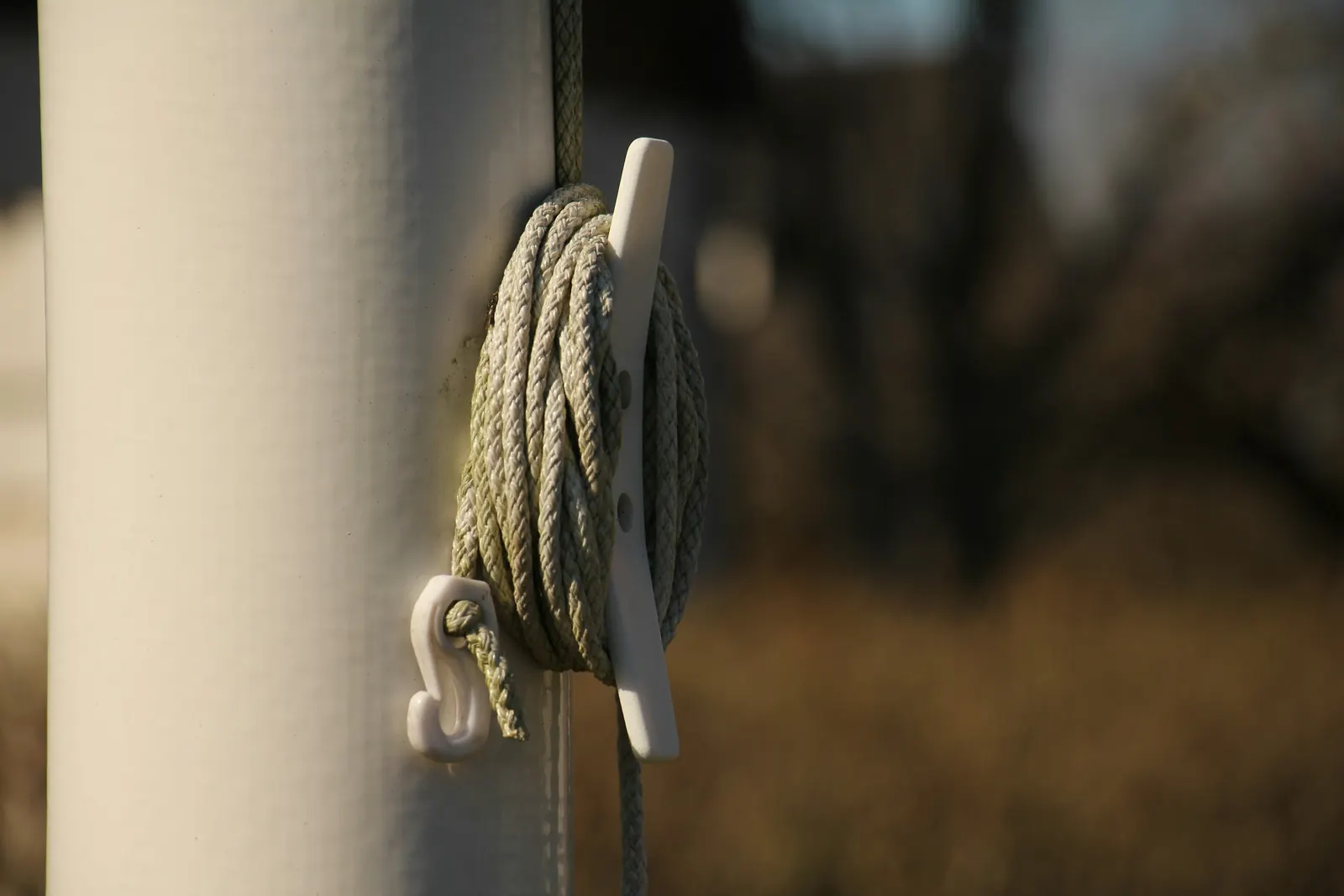
On a pole with an external halyard, the loop runs on the outside of the pole and is tied off on a cleat near the base. It is simple, cheap to replace and easy to check, but the rope is exposed to the weather and within reach of anyone passing by, and it can slap against the pole in the wind.
Internal halyard
On a pole with an internal halyard, the rope runs inside the pole and comes out through a door near the base, often with a counterweight or winch that keeps it tight. This protects against theft and vandalism and reduces rope noise. According to the Victorian Department of Education, the halyard at government schools is internal, with a lockable hatch to reduce vandalism and for safety.
Raising and lowering the flag
The PM&C protocol describes how the flag is handled:
- The flag is raised briskly and lowered with dignity.
- It flies aloft and free, as close as possible to the top of the pole, with the rope tightly secured.
- It is raised no earlier than first light and lowered no later than dusk, unless it is lit at night.
- When several flags are flown, the Australian National Flag is raised first and lowered last, unless all flags are raised together.
For half-mast, the flag is first raised to the peak and then lowered slowly to about a third of the way down the pole. More in the guide to half-mast.
The truck and the finial
The truck carries the pulley. A fixed truck holds the halyard in one position; a revolving truck turns with the wind, so that the flag and halyard follow the wind rather than winding around the pole. The finial, often a ball, sits on top of the truck and keeps water out of the top of the pole.
Yardarm and gaff
On a flag mast, a yardarm and a gaff each have their own halyards, so several flags can fly from one mast. The peak of the gaff is the position of honour, according to PM&C, even though it is lower than the masthead. More in the guide to types of flagpoles.
The base
The base holds the pole upright. It can be a sleeve set in concrete, a base plate bolted to a footing, or a hinged base that allows the pole to be lowered. The Victorian Department of Education lists all three for school flagpoles. A hinged pole makes it possible to replace the halyard or service the truck on the ground rather than at height, which is covered in the guide to flagpole safety.
When something stops working
A stuck halyard, a seized pulley or a flag that winds around the pole are the most common problems. Their causes are described in the guide to flagpole repair, and the individual parts in the guide to flagpole accessories.
Frequently asked questions
How is a flag raised on a flagpole?
The flag is clipped to a halyard, a rope that runs from the base over a pulley at the top of the pole and back down. Pulling one side of the halyard raises the flag; the other side lowers it. The halyard is then tied off on a cleat or, with an internal halyard, secured inside the pole.
How is the flag raised according to protocol?
According to the Australian Flags booklet, the flag is raised briskly and lowered with dignity, and it flies as close as possible to the top of the pole with the rope tightly secured. When several flags are flown, the Australian flag is raised first and lowered last.
Why does a flag wrap around the pole?
A flag can wind itself around the pole when the wind changes direction often. A revolving truck at the top or clips that turn freely reduce this, and a halyard that is kept tight keeps the flag at the top of the pole.
What is a hinged flagpole for?
A hinged base allows the pole to be lowered to the ground for maintenance, such as replacing the halyard or the pulley. The Victorian Department of Education lists hinged bases among the ways flagpoles are installed at schools.
Sources
This guide is based on the following sources:
- Australian Flags booklet – Flying and handling – Department of the Prime Minister and Cabinet
- Australian Flags booklet – Glossary – Department of the Prime Minister and Cabinet
- Australian Flags booklet – Flying the Australian National Flag at half-mast – Department of the Prime Minister and Cabinet
- Flags and patriotic ceremonies – Flagpoles – Department of Education, Victoria
Related guides
- Flagpole accessoriesThe parts of a flagpole explained: truck and pulley, finial, halyard, clips, cleat, internal halyard hatch, yardarm, base and lighting, as used in Australia.
- Types of flagpolesAn overview of flagpole types in Australia: fixed and hinged in-ground poles, telescopic poles, wall-mounted poles, flag masts with yardarm and gaff.
- Flagpole repairCommon flagpole faults in Australia and their causes: broken or stuck halyards, seized pulleys, wrapped flags, corrosion, loose bases and storm damage.
- Flagpole safetyFlagpole safety in Australia: wind regions and cyclones, overhead power lines, underground services, work at height, WHS duties and vandal-resistant halyards.