
Types of flagpoles in Australia – an overview
Published Written by Flagpole Guides
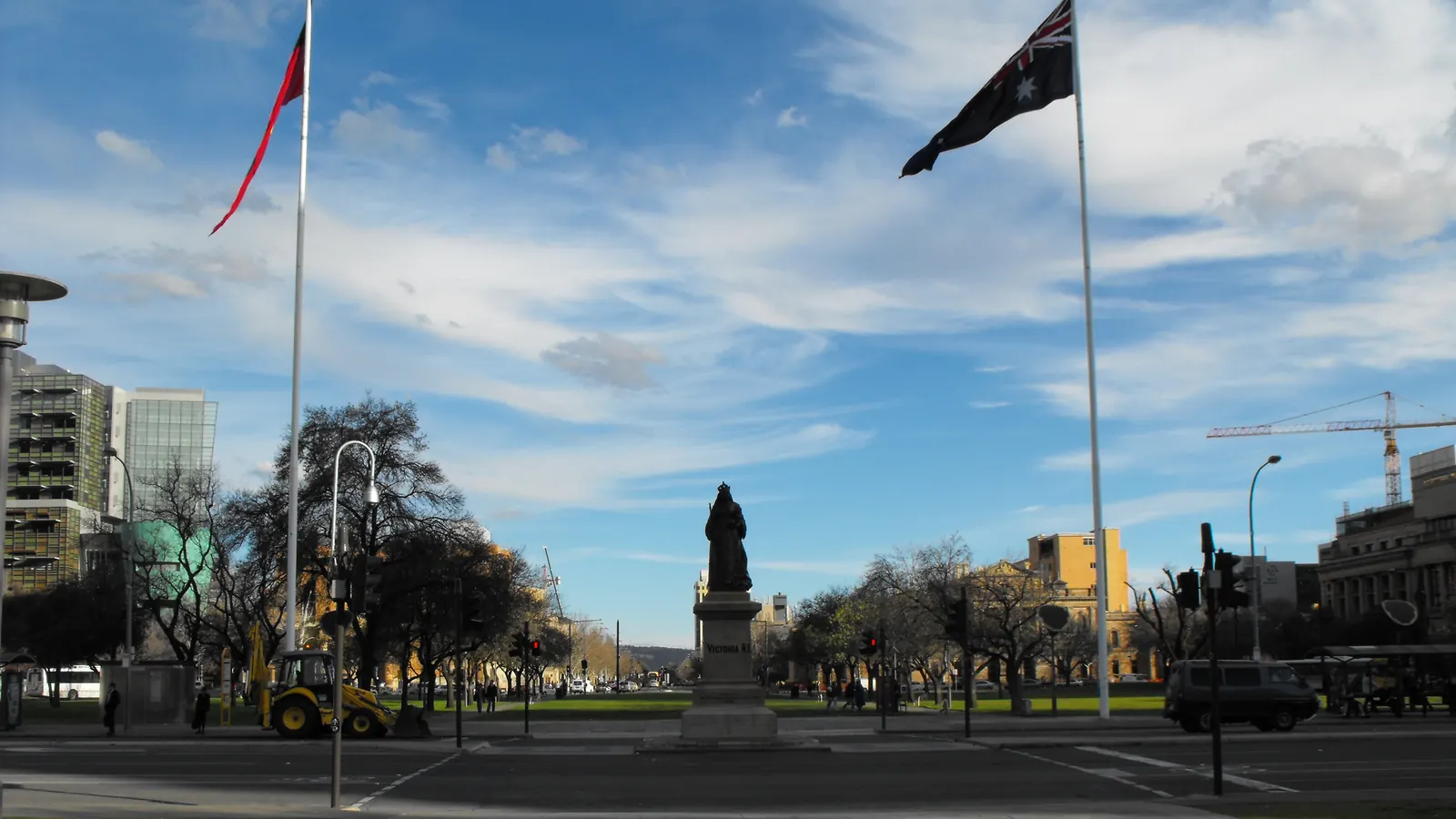
A flagpole can be a simple pole in a front yard or a flag mast with rigging for several flags. In Australia, most flagpoles are made of aluminium and stand in the ground, but there are several ways of fixing them and of raising the flag. The Victorian Department of Education, which publishes guidance on flagpoles for government schools, describes three ways of installing a pole: free-standing with a fixed base, free-standing with a hinged base, and attached to a building.
Free-standing with a fixed base
The most common type is the free-standing pole with a fixed base. According to the Victorian guidance, either a concrete base is poured around the pole, or around a tubular sleeve into which the pole is then inserted, or a base plate is bolted down onto a concrete footing. A pole in a sleeve can be taken out for maintenance or replacement. Foundations are covered in the guide to installing a flagpole.
Hinged base
With a hinged base, the concrete footing carries a metal hinge that allows the pole to be lowered, for example for maintenance. The Victorian guidance adds that hinged options are best considered together with experienced manufacturers and installers. Lowering a pole to the ground avoids much of the work at height described in the guide to flagpole safety.
Telescopic poles
Telescopic or sectional poles come in shorter sections that fit into each other or join together. They are easier to transport and are sold as kits for homes and farms. More about carrying long poles is in the guide to transporting a flagpole.
Building-attached and wall-mounted poles
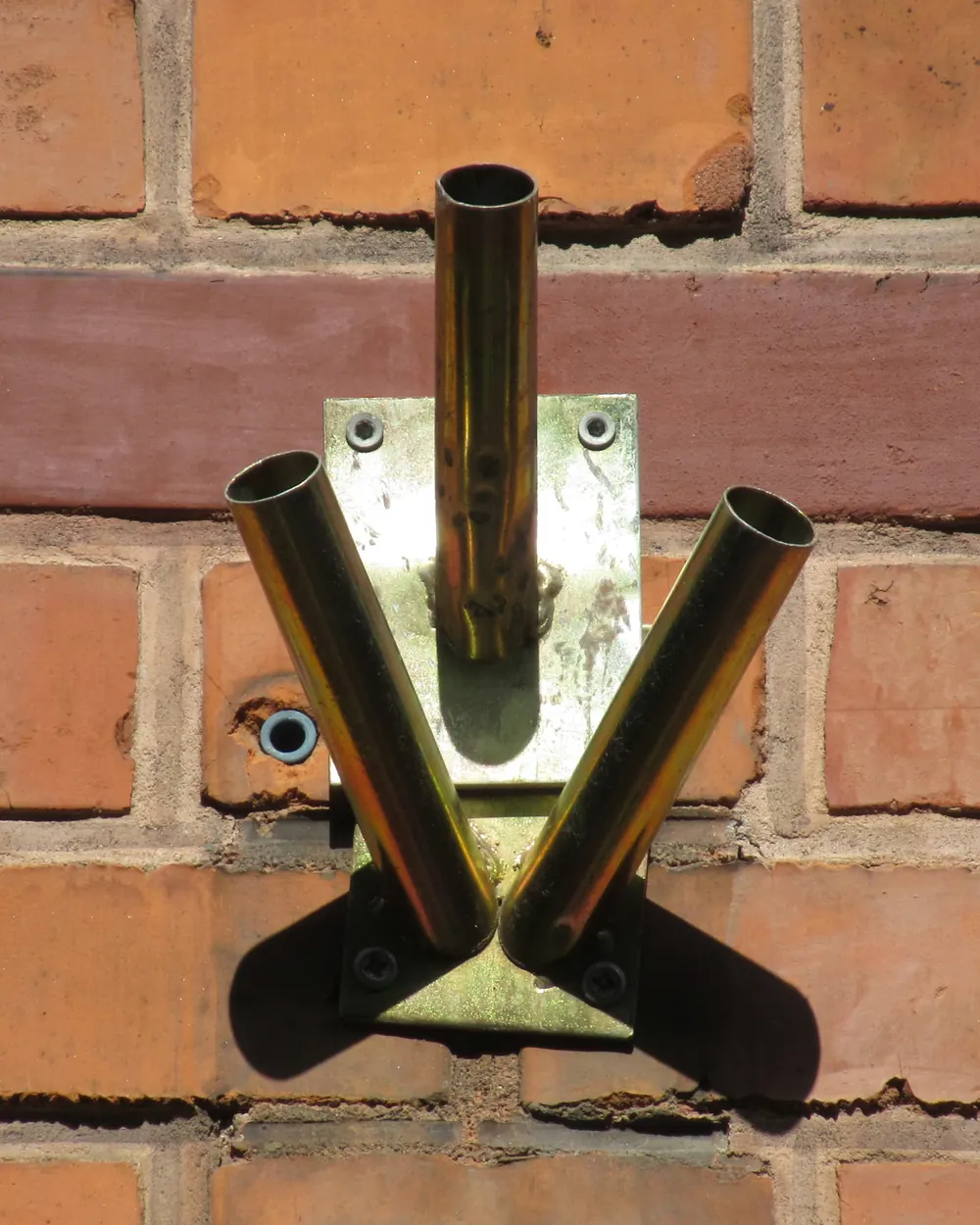
Some sites have no room for an in-ground pole. According to the Victorian guidance, schools on tight inner-urban sites may find it more practicable to attach flagpoles to the outside of their buildings. Wall-mounted flag staffs, often at an angle, are common on shops and houses. The permit rules treat them separately: in Victoria, for example, a pole attached to a building is exempt from a building permit up to 3 metres above the highest point of attachment. According to the flag maker Flags Fantastic, a flag on a wall-mounted pole of up to 6 metres is commonly 1800 × 900 mm.
Flag masts with yardarm and gaff
A flag mast in the nautical style has a yardarm, a cross arm, and sometimes a gaff, a spar set diagonally on the after side of the mast, as the glossary of the booklet Australian Flags explains. It can carry several flags from one pole: the Australian flag at the peak of the gaff or at the masthead, and other flags on the arms of the yardarm. According to PM&C, the peak of the gaff is the position of honour. Flag masts are seen at yacht clubs, surf clubs, naval sites and waterfront properties. The positions are explained in the guide to flag protocol.
External or internal halyard
- External halyard: the rope runs outside the pole and is tied off on a cleat. It is simple and easy to reach.
- Internal halyard: the rope runs inside the pole behind a lockable door, often with a counterweight. According to the Victorian Department of Education, the halyard at government schools is internal, with a lockable hatch to reduce vandalism and for safety.
How the parts work is explained in the guide to how a flagpole works.
Straight or tapered
Flagpoles are either the same diameter along their whole length or tapered, narrower at the top. According to the Victorian guidance, a straight 6 metre pole is typically 80 mm in diameter, while a tapered pole has a base diameter of about 90 mm for 6 metres and about 100 mm for 7.5 metres, and can be more expensive.
Several flagpoles
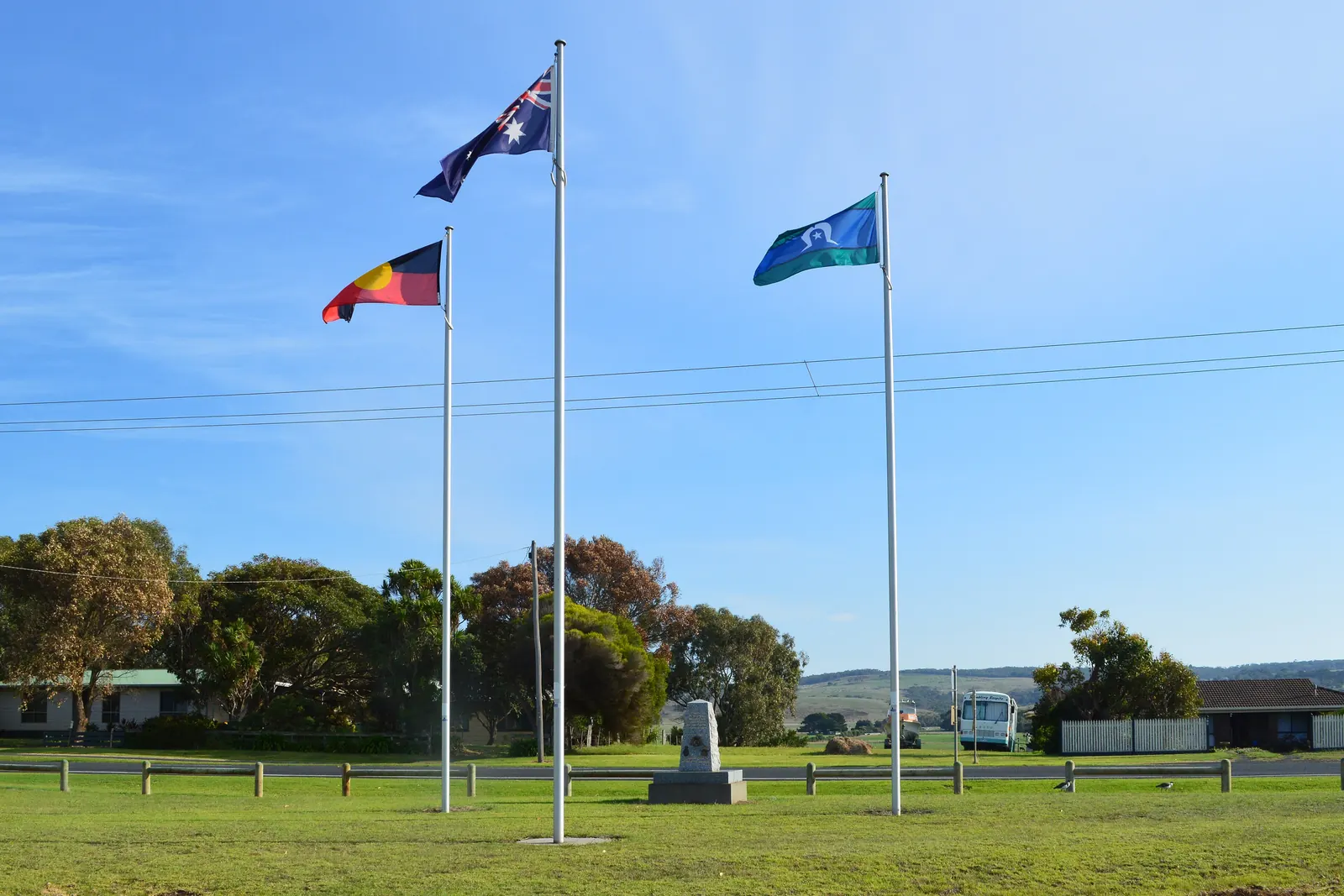
Where more than one flag is flown, each flag has its own pole, as the PM&C protocol states that two flags are not flown from the same flagpole. According to the Victorian Department of Education, new government schools in Victoria are built with three flagpoles, so that the Australian, Victorian and Aboriginal or Torres Strait Islander flags can be flown together. Materials are compared in the guide to flagpole materials, and heights in the guide to flagpole heights.
Frequently asked questions
What types of flagpoles are there?
The main types are free-standing in-ground poles, with a fixed or hinged base, telescopic poles, flagpoles attached to a building, and flag masts with a yardarm and gaff. They differ in how they are fixed, how the flag is raised and how many flags they can carry.
What is the difference between an internal and an external halyard?
With an external halyard, the rope runs on the outside of the pole. With an internal halyard, it runs inside the pole and is reached through a lockable door. For Victorian government schools, the state’s Department of Education asks for internal halyards with a lockable hatch, to reduce vandalism and for safety.
What is a flag mast?
According to the glossary of the Australian Flags booklet, a flag mast is a free-standing pole used for flying flags, and the term is often used for a flagpole with a yardarm and gaff. The yardarm is a cross arm; the gaff is a spar set diagonally on the after side of the mast.
Can a flagpole be attached to a house?
Yes. Wall-mounted and building-attached flagpoles are common where there is no room for an in-ground pole. The states set separate height limits for poles attached to a building, for example 3 metres above the highest point of attachment under the Victorian Building Regulations.
Sources
This guide is based on the following sources:
- Flags and patriotic ceremonies – Flagpoles – Department of Education, Victoria
- Australian Flags booklet – Glossary – Department of the Prime Minister and Cabinet
- Australian Flags booklet – Flying the Australian National Flag on a flagpole with a gaff – Department of the Prime Minister and Cabinet
- Building Regulations 2018, Schedule 3, item 13 – Victorian Legislation
- Choosing the right flag – Flags Fantastic
Related guides
- Flagpole materialsFlagpole materials compared for Australian conditions: aluminium, fibreglass, steel and timber, finishes, coastal corrosion, cyclones and upkeep.
- Flagpole heightsHow tall a flagpole can be in Australia without a permit, state by state, the common heights of 4.5 to 9 metres and how pole height and flag size go together.
- How a flagpole worksHow a flagpole works: the halyard and pulley, internal and external halyards, raising briskly and lowering with dignity, gaffs and the hinged base.
- Flagpole accessoriesThe parts of a flagpole explained: truck and pulley, finial, halyard, clips, cleat, internal halyard hatch, yardarm, base and lighting, as used in Australia.