
Flagpole heights in Australia: common heights and permit limits
Published Written by Flagpole Guides
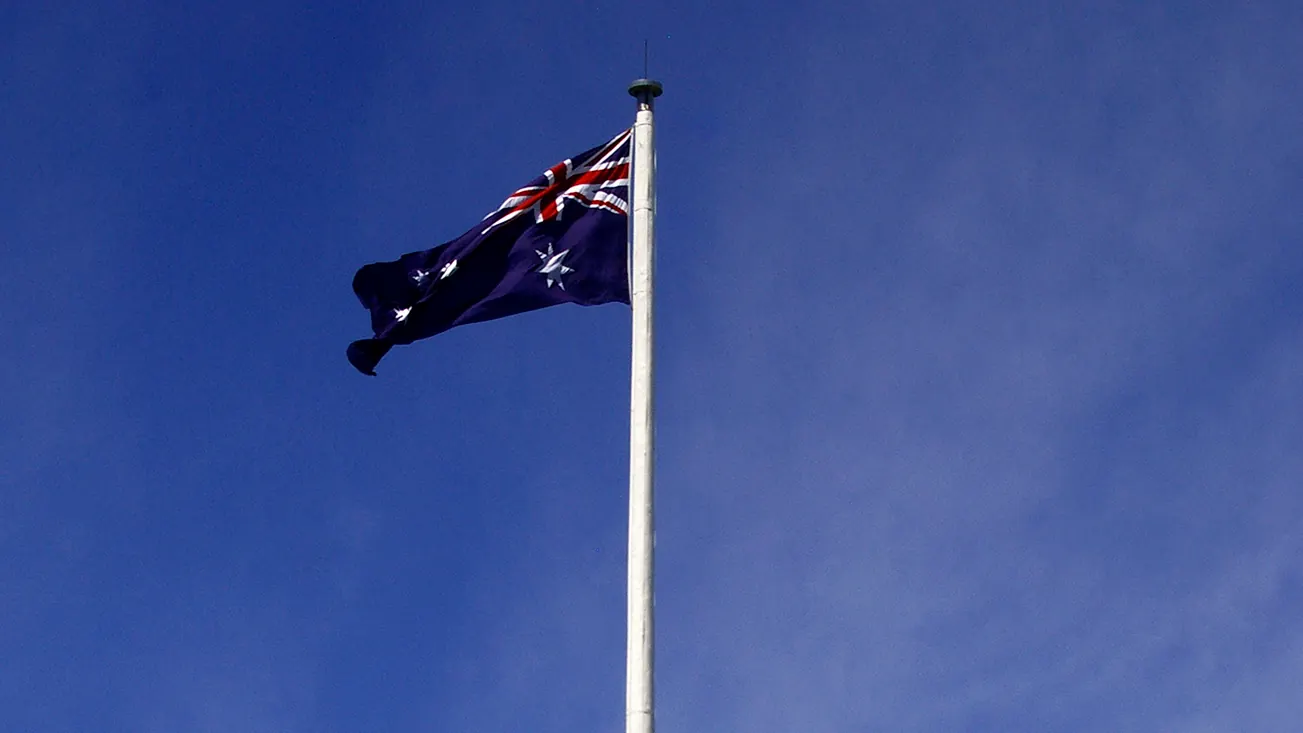
How tall a flagpole can be depends on what it is for and where it stands. In Australia, the height also decides whether the pole needs a permit, and every state and territory draws the line in a different place. Common heights run from about 4.5 metres at a house to 9 metres or more at councils and businesses, with 6 metres as the most usual size for schools and homes.
Height limits without a permit
The table shows the height up to which a flagpole is exempt from a building permit or development approval in each state and territory. Each exemption comes with further conditions, such as distance from boundaries, heritage listings or wind regions.
| State or territory | Free-standing pole | Pole attached to a building | Rule |
|---|---|---|---|
| New South Wales | 6 m, diameter up to 90 mm, 3 m from side and rear boundaries | – | Exempt and Complying Development Codes, cl. 2.40 |
| Victoria | 8 m above ground | 3 m above the highest point of attachment | Building Regulations 2018, Sch. 3 item 13 |
| Queensland | 10 m above the natural ground | 3.5 m above the building | Building Regulation 2021, Sch. 1 s. 2 |
| Western Australia | 3 m, outside wind regions C and D | 2 m above the highest point of attachment | Building Regulations 2012, Sch. 4 |
| South Australia | 10 m | 4 m above the topmost point of attachment | PDI (General) Regulations 2017, Sch. 4 cl. 4 |
| Tasmania | 6 m above ground | 6 m above the topmost point of attachment | Director’s Determination, item 1.3.16 (low risk work) |
| Australian Capital Territory | 10 m above finished ground level (development approval) | – | Planning (Exempt Development) Regulation 2023, s. 1.54 |
| Northern Territory | 6 m above ground | 2 m above the highest point of attachment | Building Note 114 |
A few conditions stand out:
- In New South Wales, only one flagpole per lot is exempt, the flag is no larger than 2.5 square metres and is not used for advertising, and the exemption does not apply on land with an item on the State Heritage Register.
- In Queensland, the exemption applies to a flagpole outside an area covered by the Civil Aviation Safety Authority’s Manual of Standards, Part 139, which concerns aerodromes.
- In South Australia, the exemption does not apply to a local heritage place, and in a designated airport building heights area the lower limit applies.
- In Western Australia, the exemption does not apply in wind regions C and D of the wind standard AS/NZS 1170.2, which cover cyclone-prone coasts.
A taller pole, or one on a heritage site, usually needs an application to the local council or a building surveyor. More in the guide to installing a flagpole.
Common heights
The Australian flag maker Evan Evans links pole heights to typical sites in its size guide:
| Height | Typical use |
|---|---|
| Up to 3 m | Small residential or compact outdoor displays |
| 4.5 m | Homes, clubs and smaller commercial sites |
| 6 m | Schools, businesses and community sites |
| 7.5 m | Council buildings, civic sites and larger properties |
| 9 m | Public spaces, larger commercial sites and high-visibility areas |
| 12 m | Landmark sites and major public displays |
According to the Victorian Department of Education, 6 metres, the equivalent of a two-storey building, is the recommended height for most school situations, and 7.5 metre poles may occasionally be warranted. Flagpoles under 8 metres at Victorian schools need no council approval or building permit.
Height and flag size
A taller pole carries a larger flag. Australian flag makers use a rule of thumb of a flag length of one quarter to one third of the pole’s height, which gives a 1800 × 900 mm flag on a 6 metre pole and a 2750 × 1380 mm flag on a 9 metre pole. The flag size calculator works it out, and all standard sizes are in the guide to flag sizes.
Height, wind and the footing
Height also drives the loads. A taller pole catches more wind and needs a larger diameter and a bigger footing, and in cyclonic regions the design allows for much stronger winds. Poles near airports can be limited in height, as the Queensland and South Australian rules show. More in the guides to flagpole safety and types of flagpoles.
Frequently asked questions
How tall can a flagpole be without a permit in Australia?
It depends on the state or territory. A free-standing flagpole needs no building permit or development approval up to 3 metres in Western Australia, 6 metres in New South Wales, Tasmania and the Northern Territory, 8 metres in Victoria and 10 metres in Queensland and South Australia, each with further conditions. In the ACT, a flag pole up to 10 metres is exempt from development approval.
What is the most common flagpole height?
Six metres is common for homes, schools and businesses. The Victorian Department of Education gives 6 metres, the height of a two-storey building, as the recommended height for most school situations, with 7.5 metre poles occasionally warranted.
What size flag goes with the height of the pole?
Australian flag makers use a rule of thumb of a flag length of one quarter to one third of the height of an in-ground pole. In their size guides, a 6 metre pole carries a 1800 × 900 mm flag and a 9 metre pole a 2750 × 1380 mm flag.
Is the height measured from the ground?
Yes, for a free-standing pole the rules measure the height above ground level. For a pole attached to a building, several states measure it above the highest point of attachment, for example 3 metres in Victoria, 3.5 metres in Queensland and 4 metres in South Australia.
Sources
This guide is based on the following sources:
- State Environmental Planning Policy (Exempt and Complying Development Codes) 2008, clauses 2.39–2.40 – NSW Legislation
- Building Regulations 2018, Schedule 3, item 13 – Victorian Legislation
- Building Regulation 2021, Schedule 1, section 2 – Queensland Legislation
- Building Regulations 2012, Schedule 4 – Western Australian Legislation
- Planning, Development and Infrastructure (General) Regulations 2017, Schedule 4, clause 4 – South Australian Legislation
- Director’s Determination – Categories of Building and Demolition Work – Consumer, Building and Occupational Services, Tasmania
- Planning (Exempt Development) Regulation 2023, section 1.54 – ACT Legislation Register
- Building Note 114 – Non-habitable buildings and structures not requiring building permit and occupancy certification – Northern Territory Government
- Flags and patriotic ceremonies – Flagpoles – Department of Education, Victoria
- Australian flag size guide – Evan Evans
Related guides
- Flag sizesStandard Australian flag sizes from 900 × 450 mm to 3600 × 1800 mm, the 1:2 proportions of the national flag and which size suits which flagpole height.
- Installing a flagpoleInstalling a flagpole in Australia: when a permit is needed in each state, boundary setbacks, heritage, footings, underground services and power lines.
- Types of flagpolesAn overview of flagpole types in Australia: fixed and hinged in-ground poles, telescopic poles, wall-mounted poles, flag masts with yardarm and gaff.
- Flag size calculatorThe flag size calculator shows the flag length for a flagpole by the flag makers’ rule of thumb, the size at 1:2 and the nearest standard Australian size.