Buying a flag in Australia: price, size and quality
Published Written by Flagpole Guides
A flag can look the same in two online shops and still differ a lot in price. The differences usually come from size, fabric, manufacture and finish. This guide does not list prices, as they vary between makers and retailers and change over time. Instead it explains what affects the price of a flag in Australia, what to look for in the details and which consumer rights apply.
What affects the price of a flag?
| Factor | How it affects the price |
|---|---|
| Size | More fabric, more printing or sewing, stronger finish |
| Fabric | Knitted polyester, woven polyester and nylon differ in weight and durability |
| Printed or sewn | Sewn or appliquéd flags take more work than printed ones |
| Finish | Reinforced hoist, rope and clips or loops, double stitching at the fly |
| Design | Standard flags cost less than custom designs made to order |
| Licensing | The Aboriginal flag is made under licence by one manufacturer |
Flag price and size
Size is usually the biggest single factor. The standard Australian sizes run from 900 × 450 mm to 3600 × 1800 mm, and in the size guide of the Australian flag maker Evan Evans, 1800 × 900 mm is the most common outdoor size, suited to a 6 metre pole. A larger flag takes more material and a stronger finish, and it wears the halyard and pole harder in the wind. Which size suits a pole is explained in the guide to flag sizes and worked out by the flag size calculator.
Fabric and manufacture
- Knitted polyester: light and flies well in low wind; common for everyday flags.
- Woven polyester: heavier and more durable; Evan Evans offers it for higher-wear outdoor use.
- Printed flags: the design is printed or dyed into the fabric; on single-sided flags it shows through in mirror image on the back.
- Sewn or appliquéd flags: the parts are cut and sewn together, which takes more work and is used for ceremonial and long-term display.
Sun, wind and salt air shorten the life of any flag. More in the guide to flagpole lifespan.
Finish and fittings
Outdoor flags usually have a reinforced header with loops or rope and clips for the halyard; indoor presentation flags have a sleeve for a pole. Double or quadruple stitching at the fly end makes a flag more resistant to fraying. The halyard system of the flagpole decides which fitting is needed, as explained in the guide to how a flagpole works.
The official design
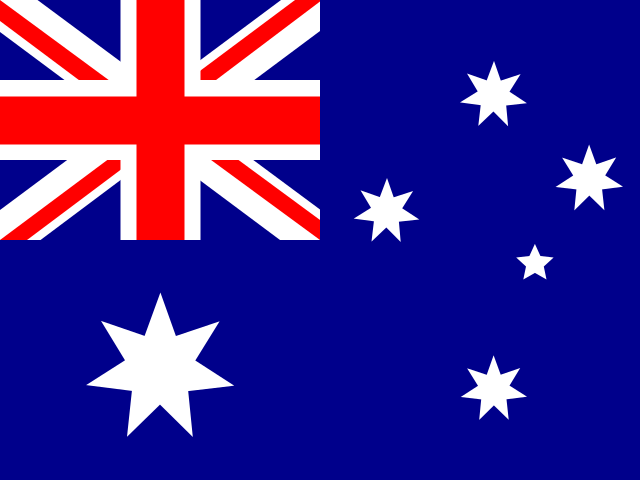
The Australian National Flag’s design is set out in the Flags Act 1953, and PM&C gives its colours as PANTONE 280 blue and PANTONE 185 red. PM&C’s guidelines for the use of the flag ask that it be reproduced completely and accurately. Goods bearing the flag are restricted imports, and importers get PM&C’s approval of the design before importing them. More in the guide to the Australian flag.
The Aboriginal and Torres Strait Islander flags
Since 2022, the Commonwealth has owned the copyright in the Australian Aboriginal Flag. According to PM&C, Carroll & Richardson-Flagworld is the exclusive licensed manufacturer of the flag on flags, pennants, banners and bunting, while the design may be reproduced freely on other media. The Torres Strait Island Regional Council holds the copyright in the Torres Strait Islander Flag, and permission to reproduce it is requested from the council. More in the guide to flag types.
Flags through members of parliament
According to PM&C, Senators and Members of the Australian Parliament may distribute the Australian National Flag, the Aboriginal flag and the Torres Strait Islander flag to eligible people and groups under the Nationhood Material Program. Requests go to the electorate office of the local Member or a Senator, and the number of flags depends on each office’s budget, demand and policies.
Consumer rights when buying
- Consumer guarantees: under the Australian Consumer Law, products are of acceptable quality, fit for any purpose the seller was told about and match their description, according to the ACCC. These rights apply automatically and cannot be taken away by a “no refunds” sign.
- Major or minor problem: the remedy depends on the seriousness of the problem; for a minor problem, the business can choose to repair it.
- Change of mind: the consumer guarantees do not cover a change of mind; a business’s own change-of-mind policy applies if it has one.
- Total price: according to the ACCC, the displayed price is the total price as a single figure, including GST and unavoidable fees.
- Overseas sellers: a business overseas that sells directly to consumers in Australia follows the Australian Consumer Law, though getting a remedy can be harder in practice.
Comparing offers
Offers are easier to compare when the details are clear: the exact size in millimetres, the fabric, printed or sewn, the type of finish and fittings, and for the Aboriginal flag, whether it comes from the licensed maker. The halyard and flagpole are covered in the guide to buying a flagpole.
Frequently asked questions
What affects the price of a flag?
The price of a flag depends mainly on its size, the fabric, whether it is printed or sewn, how the edges and the hoist are finished, and whether it is a standard design or made to order. For the Aboriginal flag, licensing also plays a part, as flags are made by one licensed manufacturer.
Why are no prices listed here?
Prices differ between makers and retailers and change over time. This guide explains what affects the price of a flag, which makes it easier to compare offers on the same basis.
Can I get an Australian flag for free?
Sometimes. According to PM&C, Senators and Members of the Australian Parliament may distribute the Australian National Flag, the Aboriginal flag and the Torres Strait Islander flag to eligible people and groups under the Nationhood Material Program, through their electorate offices. Availability depends on each office’s budget and policies.
What are my rights if a flag is faulty?
Under the Australian Consumer Law, products come with consumer guarantees, among them that they are of acceptable quality, fit for purpose and match their description. According to the ACCC, these rights cannot be taken away by a ‘no refunds’ sign, and the remedy depends on whether the problem is major or minor.
Can I return a flag if I change my mind?
The consumer guarantees do not cover a change of mind, according to the ACCC. A business may offer a change-of-mind policy of its own, and if it does, it has to follow it.
Sources
This guide is based on the following sources:
- Requesting Australian flags – Department of the Prime Minister and Cabinet
- Use of the Australian National Flag and other official flags – Department of the Prime Minister and Cabinet
- Consumer rights and guarantees – Australian Competition and Consumer Commission
- Repair, replace, refund, cancel – Australian Competition and Consumer Commission
- Price displays – Australian Competition and Consumer Commission
- Australian flag size guide – Evan Evans
- Choosing the right flag – Flags Fantastic
Related guides
- Flag sizesStandard Australian flag sizes from 900 × 450 mm to 3600 × 1800 mm, the 1:2 proportions of the national flag and which size suits which flagpole height.
- Flag size calculatorThe flag size calculator shows the flag length for a flagpole by the flag makers’ rule of thumb, the size at 1:2 and the nearest standard Australian size.
- Flag typesThe official flags of Australia: the national flag, the red ensign, the Aboriginal and Torres Strait Islander flags, Defence ensigns and state flags.
- The Australian flagWhat the Australian flag means: the Union Jack, the Commonwealth Star and the Southern Cross, the colours, the design in the Flags Act and its protection.
- Buying a flagpoleBuying a flagpole in Australia: what affects the price – height, material, halyard, base, delivery and installation – plus permit limits and consumer rights.
- Flag flying rulesThe rules for flying the Australian flag: who may fly it, hoisting times, flying at night, the dignity of the flag, disposal of old flags and commercial use.